
A premium jewelry box can look convincing in one sample and still develop inconsistencies during mass production. For B2B buyers, quality control therefore needs to cover more than a final visual check. It should connect the approved sample, confirmed specifications, production checks, defect classification and protective packaging into one practical process.
This jewelry box quality control checklist is designed for brands, retailers, wholesalers, gift companies and sourcing teams reviewing custom or bulk orders. It explains what to confirm before production, what to inspect before shipment and how to communicate acceptance criteria clearly with a manufacturer.
Why Quality Control Matters for Bulk Jewelry Box Orders
Jewelry cases contribute directly to product presentation. Uneven finishes, loose lining, misaligned hardware or poorly fitted trays can reduce perceived value even when the box remains technically usable. In a bulk order, repeated minor problems can become a commercial issue because they affect consistency across retail displays, gift programs or branded collections.
A useful inspection process should help buyers answer four questions:
- Does the production match the approved sample and agreed specifications?
- Are the product's appearance and functions consistent enough for the intended market?
- Have defects been classified according to their actual effect on safety, function and presentation?
- Is the packaging suitable for protecting the confirmed product structure during shipment?
The objective is not to promise a completely defect-free order. It is to establish measurable references, identify unacceptable deviations and resolve problems before shipment whenever possible.
What Should Be Confirmed Before Production?
Quality control begins before materials are cut or assembled. If the buyer and manufacturer use different references, the final inspection may identify disagreements rather than genuine production defects. Buyers preparing a new branded program can use our private label jewelry storage box guide to define structure, materials, interior layout, logo method, packaging and approval requirements before production starts.
At Ezicase, the approved physical sample is normally retained at the factory as the main production and inspection reference. It should be used together with confirmed dimensions, a specification sheet, approved logo artwork, material or color samples and other agreed production information. This is especially useful for details that are difficult to define only in writing, such as gloss level, lining texture, padding firmness or the overall feel of a closure.
Before bulk production, confirm the following:
Product structure and capacity
- Overall length, width and height
- Number of levels, drawers and removable trays
- Compartment layout and intended jewelry types
- Ring-roll, necklace-hook, pocket or mirror configuration
- Lid, drawer and tray opening methods
For more detailed layout planning, see our jewelry box compartment sizing guide.
Exterior and interior materials
The specification should distinguish the structural material from the decorative surface. For example, a box may use an MDF structure with a lacquered, wood-grain-effect or PU-leather-wrapped exterior. Genuine leather can also be sourced for suitable projects, but it should be confirmed specifically rather than treated as a standard stock material.
Interior materials, colors and padding should also be recorded. Buyers comparing velvet, microfiber and other lining options can refer to our guide to jewelry box lining materials for custom projects.
Color and finish reference
Use the most suitable approved reference for the material and process. This may be a Pantone reference, physical material swatch, coating sample or signed product sample. Because materials reflect light differently, a printed color code alone may not reproduce the appearance of PU leather, fabric, wood-grain effect or lacquer.
Logo and hardware
Confirm the logo artwork, size, position, color and application method. Depending on the material and project, available methods may include silk-screen printing, hot stamping, laser engraving, a metal logo plate or a UV-printed metal label.
Hinges, locks, latches, handles, feet and decorative fittings should be identified by their approved design and finish. If a project uses plated hardware, the agreed color sample is usually more useful than a general description such as “gold” or “silver.”
Packaging specification
The approved packing method should identify every protective layer, the product orientation, the individual carton and the master carton. Packaging should be treated as part of the specification rather than decided only after production is complete.
If the product is still at the sample stage, our custom jewelry box sample approval guide explains how to record these references before authorizing mass production.
How Should Exterior Finish and Workmanship Be Inspected?
Exterior inspection should cover the complete product under consistent inspection lighting and from multiple angles. The inspector should compare the production unit with the retained sample and agreed finish reference rather than relying on memory.
For lacquered or wood-grain-effect cases, check:
- Color and gloss consistency across the lid, sides, base and drawer fronts
- Dust, particles, pinholes, scratches, dents or uneven coating
- Clean edges and corners without chips or visible repair marks
- Consistent panel gaps and alignment
- Flatness and stability when placed on a level surface
For PU-leather-wrapped or genuine-leather projects, check:
- Wrinkles, bubbles, loose wrapping or lifting edges
- Clean folding at corners and seams
- Consistent grain direction where this has been specified
- Stitching alignment, stitch length and loose threads where stitching is used
- Glue marks or discoloration around wrapped edges
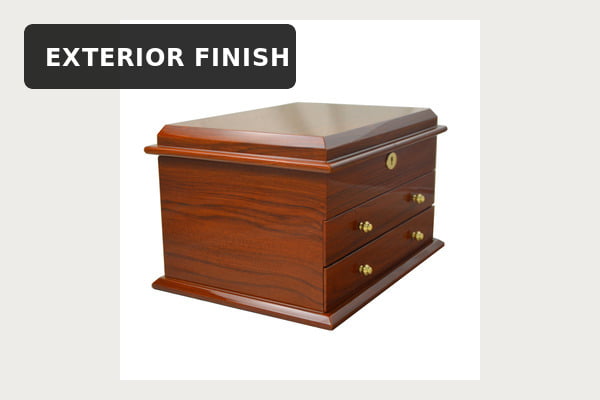
Not every small visual variation has the same commercial effect. The acceptable limit should reflect the product positioning, viewing distance, finish type and approved sample. A premium retail case will normally require tighter visual consistency than a basic protective storage box.
What Should Be Checked Inside the Jewelry Box?
Interior quality affects both presentation and the way jewelry contacts the product. Inspection should begin with cleanliness and then move to material application, compartment accuracy and protective details.
Lining application
Check the lining for dust, stains, visible adhesive, wrinkles, sagging, uneven tension and frayed edges. Seams should appear clean where two lined panels meet. Pile direction or shading should be compared with the approved sample when it materially affects appearance.
Compartments and inserts
Measure the critical compartments defined in the specification. Ring rolls should provide consistent spacing and support. Necklace hooks, pockets and earring sections should be secure and positioned as approved. Padding should feel reasonably consistent across comparable areas.
For removable trays, verify that the tray:
- Sits level in its intended position
- Can be lifted without excessive resistance
- Does not scrape the surrounding lining
- Does not move excessively when the case is handled normally
- Leaves the correct usable storage area beneath it
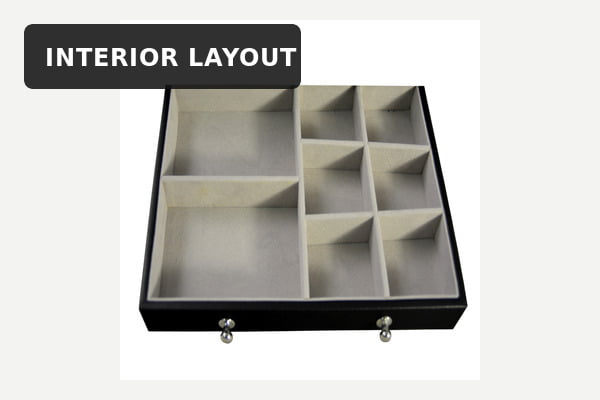
Inspectors should also check for exposed staples, screws, rough edges or hard contact points that could mark the jewelry or damage the lining. These findings should be assessed by severity rather than grouped with ordinary cosmetic imperfections.
How Should Hardware, Drawers and Moving Parts Be Tested?
Functional inspection should reproduce normal use without applying unrealistic force. Open and close representative units several times and compare the feel and alignment across the sample.
Lid and hinges
- Confirm that the lid aligns with the base when closed.
- Check that hinges and lid supports are securely installed.
- Look for loose, missing, raised or damaged screws.
- Make sure the lid opens through its intended range without rubbing adjacent surfaces.
- Confirm that the lid remains stable if the approved design includes a holding mechanism.
Locks and closures
Locks, latches, magnetic closures and keys should operate without sticking or excessive force. The closed lid should not have an unintended gap caused by incorrect hardware position.
Drawers and removable components
Drawers should move smoothly, close to the intended position and remain reasonably aligned with surrounding panels. Removable trays, mirrors and handles should be secure and should not create unexpected contact with adjacent surfaces.
The pink PU leather jewelry organizer box with secret cabinet, model GC02-JB-02PG, provides a practical example of why hardware, lid alignment, mirror installation, removable components and closure operation should be checked together rather than as isolated details.
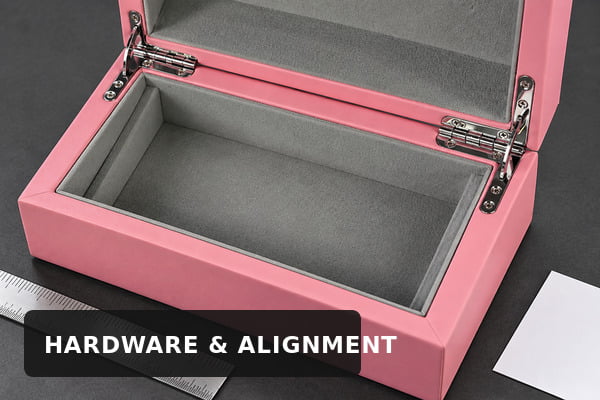
The presence of hardware is not enough. Its installation, alignment and interaction with the surrounding structure determine whether the case performs consistently in everyday use.
How Should Logo, Dimensions and Specifications Be Verified?
Branding errors can make otherwise usable products unsuitable for sale. Inspect the logo against the approved artwork and sample, checking:
- Application method
- Position and alignment
- Width and height
- Color or plating finish
- Clarity of fine lines and lettering
- Adhesion and surface cleanliness
- Consistency across the inspected units
Do not approve a logo only because it is present. An incorrect position, distorted artwork or inconsistent finish can affect the complete presentation of a private-label product.
Dimensions should be checked against the agreed specification and tolerances. Focus on measurements that influence function or presentation, such as external size, drawer clearance, tray fit, ring-roll spacing and key compartment dimensions. There is no single tolerance suitable for every jewelry case; it should be agreed according to the material, structure and intended use.
The stated capacity should also be physically realistic. If a case is intended for particular jewelry types or sizes, test representative items or agreed samples rather than assuming that a compartment count alone proves suitability.
How Should Defects and Inspection Results Be Classified?
Classifying defects helps buyers and manufacturers make consistent decisions. A practical system separates critical, major and minor defects according to their effect.
Critical defects
Critical defects create an unacceptable safety risk or make the product unsafe to handle. Examples may include exposed sharp points, seriously insecure components or other conditions that could cause injury during normal use.
Major defects
Major defects affect function, structure, branding or normal saleability. Examples may include a non-working lock, badly misaligned lid, unusable drawer, incorrect logo, severe finish damage, detached lining or a substantially incorrect compartment layout.
Minor defects
Minor defects are smaller workmanship or cosmetic variations that do not prevent normal use. Their acceptability depends on the approved standard and product positioning. Several repeated minor defects may also indicate a broader process-consistency problem.
When an AQL sampling inspection is required, the sampling level, sample size and acceptance/rejection numbers should be agreed for the project. One possible agreed arrangement is Critical 0, Major 2.5 and Minor 4.0, but it should not be assumed for every order. AQL is a lot-assessment tool; it does not mean that every unit in an accepted shipment has been inspected or that the shipment contains no defects.
Ezicase can conduct final full inspection and can accommodate a third-party pre-shipment inspection when arranged for the project. A formal inspection report can be provided when requested. The report format and included records should be agreed in advance because not every order requires the same photographs, measurements, signatures, batch references or corrective-action documentation.
Useful inspection records may include:
- Order and product reference
- Inspection date and inspected quantity
- Approved sample or specification reference
- Photos of representative units and defects
- Measurements of critical dimensions
- Defect descriptions and classifications
- Rework, sorting or re-inspection results where applicable
- Overall inspection conclusion and any required buyer decision
What Packaging Checks Are Needed Before Shipment?
A correctly manufactured jewelry case can still be damaged if it moves, rubs or receives insufficient corner protection during transport. Packaging inspection should therefore confirm both the presence and the correct placement of every agreed layer.
For Ezicase premium products, a common export packing method includes:
- A nonwoven spunlace fabric bag to protect the surface from abrasion
- EPE protective end caps at both ends to provide cushioning
- An individual kraft carton
- An outer master shipping carton
Gift-box projects may use the gift box as an additional presentation layer, together with protective EPE, an individual outer carton and a master carton according to the approved packing specification.
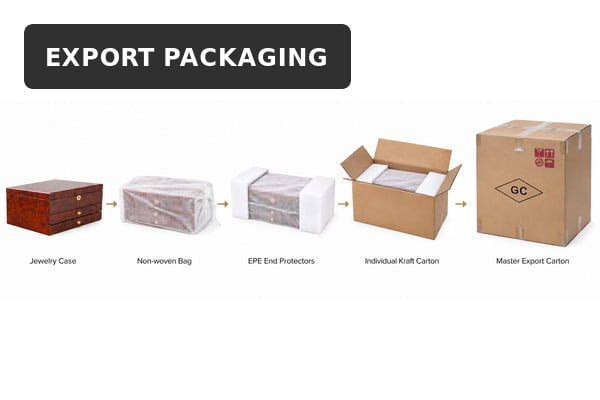
During final packing inspection, check:
- The fabric bag is clean and fully covers the intended surfaces.
- EPE protectors are correctly positioned and fit the product.
- The product does not move excessively inside the individual carton.
- The individual carton is undamaged and correctly closed.
- Carton quantity, shipping marks and product references are correct.
- The master carton is suitably sealed and within the confirmed packing specification.
More information is available in our guide to packaging jewelry boxes for international shipping.
Final Jewelry Box Quality-Control Checklist
Before releasing a bulk order, the buyer or inspector should confirm that:
- The retained approved sample and current specification were available for comparison.
- Exterior materials, color and finish match the approved reference within the agreed standard.
- Lining, compartments, ring rolls, trays and internal accessories are clean and correctly installed.
- Lids, hinges, locks, drawers and removable components operate as intended.
- Logos match the approved artwork, position, size and application method.
- Critical dimensions and functional clearances have been checked.
- Defects have been recorded and classified consistently.
- Required rework, sorting or re-inspection has been completed.
- The agreed protective packaging has been applied correctly.
- Any required inspection report or third-party result has been reviewed before shipment approval.
For a new OEM or private-label project, buyers can explore our custom jewelry case collection and review available customization options. The checklist should then be adapted to the exact material, structure, finish, logo and packaging of the selected design.
Frequently Asked Questions
Does an approved sample replace a written specification?
No. A physical sample is valuable for appearance, texture and functional feel, while written records clarify dimensions, materials, logo details and packaging. They should be used together. Ezicase normally retains the approved sample at the factory as a reference for mass production and inspection.
Does AQL mean an accepted order has no defects?
No. AQL uses a defined sampling plan and acceptance/rejection numbers to assess a production lot. It does not prove that every unit was inspected or that no defects exist. Full inspection and AQL sampling serve different purposes and should be selected according to the project.
Should every dimension be measured during final inspection?
Not necessarily. Prioritize dimensions that influence assembly, fit, storage capacity, drawer movement, tray placement or the intended jewelry. Decorative or non-critical measurements can be checked according to the agreed inspection plan.
Can the checklist be customized for a specific jewelry case?
Yes. The inspection points should reflect the confirmed structure, materials, finish, compartments, logo method, hardware and packaging. Ezicase can coordinate project-specific inspection requirements with B2B buyers before production and provide a formal inspection report when it is requested and agreed.
Conclusion
Effective jewelry box quality control connects sample approval, production references, workmanship inspection, functional testing, defect classification and packaging verification. The checklist should be specific enough to guide acceptance decisions without pretending that every material, finish or structure can use the same tolerance.
By agreeing on inspection points before production and keeping the approved sample at the factory, buyers and manufacturers gain a clearer basis for handling variations before shipment. Contact Ezicase to discuss the structure, materials and inspection requirements for your next custom jewelry case project.
