Sourcing a jewelry box for a brand, retailer or wholesale program involves more than comparing photographs and unit prices. The box must suit the intended jewelry, support the required presentation, survive normal handling and remain practical to manufacture consistently in bulk.
Understanding how to choose a jewelry box manufacturer requires a structured review of product fit, materials, sampling, quality control, packaging and communication. The most suitable supplier is not automatically the largest factory or the one offering the lowest initial quotation. It is the manufacturer whose experience and production approach match the actual project.
Start With Your Product and Business Requirements
Before contacting suppliers, prepare a clear project brief. This does not need to be an engineering drawing, but it should give the manufacturer enough information to recommend a realistic starting structure.
Confirm the following points internally:
- the types and approximate sizes of jewelry to be stored;
- the preferred external dimensions and opening method;
- required compartments, ring rolls, hooks, trays or drawers;
- preferred exterior and lining materials;
- logo method and approximate placement;
- estimated order quantity;
- target market and positioning;
- required packaging scope;
- expected sample and delivery schedule.
Reference photographs, sketches or an existing physical product can help explain the direction. However, they should be accompanied by written requirements so that appearance, dimensions and functions are not interpreted differently by each supplier.
Buyers still comparing basic formats can first review the jewelry box buying guide. They can also review Ezicase capabilities and product structures as a custom jewelry box manufacturer.
Does the Manufacturer Have Relevant Jewelry Box Experience?
Factory size alone does not establish suitability. A supplier may have substantial packaging capacity without regularly producing hinged jewelry boxes, multi-level organizers, fitted interiors or lacquered cases.
Ask whether the manufacturer already works with products that share important characteristics with your project:
- similar external construction and proportions;
- comparable lacquer, wood, PU or leather finishes;
- hinged lids, removable trays or drawers;
- related jewelry compartment layouts;
- comparable hardware and logo applications;
- similar order quantities and packaging requirements.
Relevant existing experience can reduce development uncertainty because the supplier already understands the assembly sequence and common production risks. It does not eliminate the need for sampling, but it provides a more reliable starting point than selecting a supplier only from a low quotation.
Should You Use an Existing Design or Develop a New Structure?
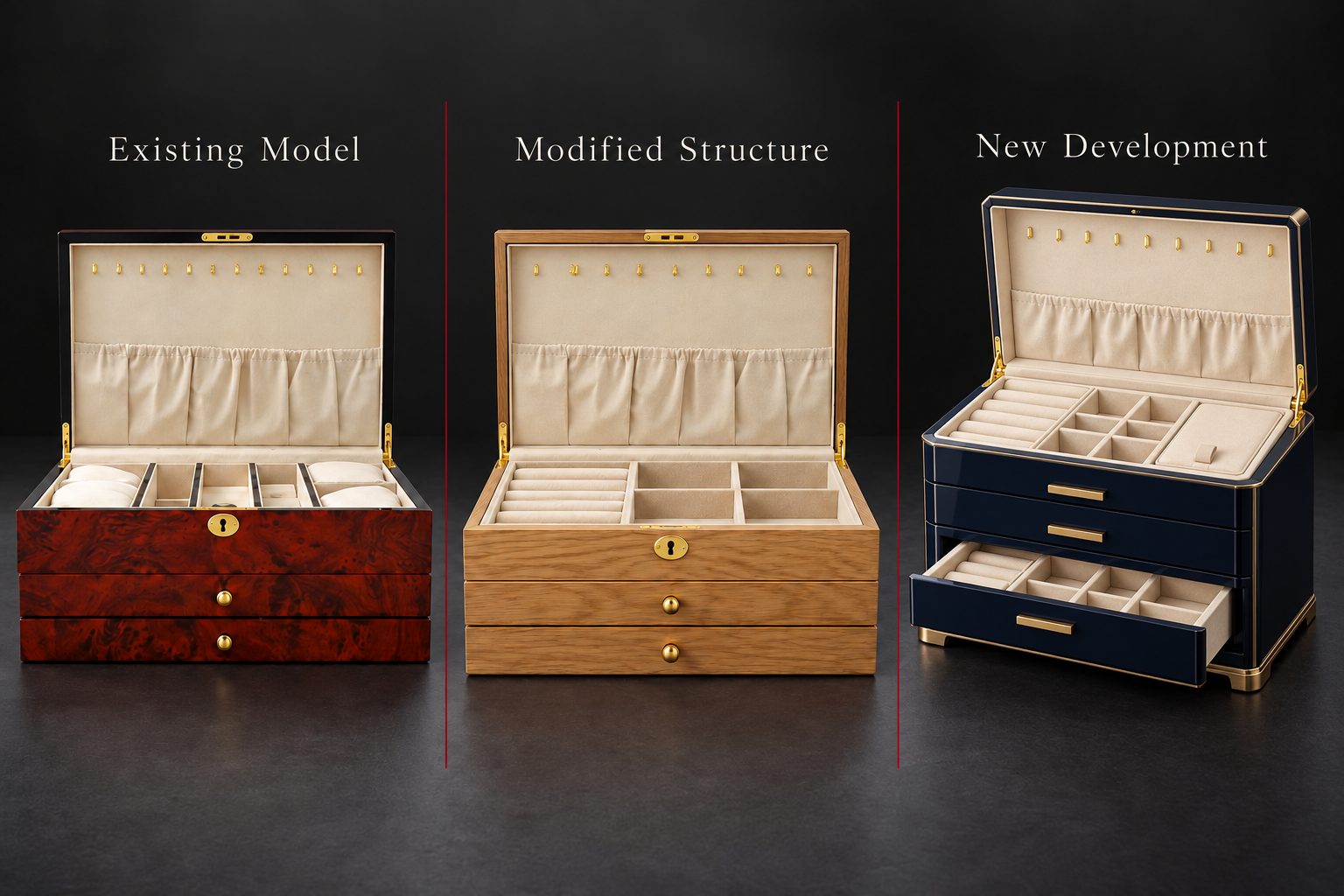
Most B2B jewelry box projects follow one of three routes.
Existing structure
The buyer selects an established box structure and confirms suitable colors, materials, lining, hardware and branding. This route can simplify development because the basic construction is already known. Whether it also reduces MOQ, cost or sample time depends on the requested material and branding changes.
Modified existing structure
An existing structure is adjusted to suit a different compartment layout, surface material, hardware finish or packaging requirement. This can create useful differentiation without rebuilding every part of the product, although changes to dimensions, drawers or hardware may still affect tooling and quantity requirements.
New structural development
A substantially new form, drawer arrangement or opening method requires more development work. Ezicase can coordinate the complete development process and use specialist external processing where the design requires it. Feasibility, tooling, sample revisions, quantity and lead time are evaluated according to the specific design.
Brands working from an earlier planning stage can use the private label jewelry storage box guide to define the requirements that should be confirmed before production.
Can the Supplier Explain Materials and Construction Accurately?
Broad descriptions such as “wooden,” “leather” or “velvet” are not sufficient for comparing quotations. Buyers should ask what each visible and structural component actually is.
Ezicase primarily manufactures wooden jewelry boxes, including solid-wood structures and other wood-based constructions. MDF, rigid paperboard and plastic-based structures can also be evaluated when they are suitable for the intended product and order.
Exterior options may include lacquer, wood veneer or woodgrain finishes, PU covering and genuine leather. Genuine leather and specialty paper can be sourced according to the design and project requirements.
Interior materials may include velvet, microfiber and other suede-look fabrics. They should not be described interchangeably because their construction, appearance, touch and processing requirements differ. The jewelry box lining materials guide provides a closer comparison of common options.
Before approving a sample, confirm the agreed material names, colors and visible finishes in writing. Ezicase provides the basic product and project specifications needed for confirmation, while any additional documentation is defined according to the project scope.
Can the Manufacturer Develop a Functional Interior Layout?
The interior should be designed around the intended jewelry assortment, not simply around an attractive empty layout.
Review how the proposed design handles:
- ring sizes and settings;
- necklace length and separation;
- bracelet, bangle or watch width;
- earring placement;
- removable tray access;
- usable drawer depth;
- lid and drawer clearance;
- movement during handling and transport.
There is no universal compartment size that works for every jewelry collection. Buyers should provide representative jewelry dimensions and, where possible, test the physical sample with actual pieces. This reveals crowding, tangling, difficult access and clearance problems that may not be visible in a drawing or empty box.
For the planning method, see the jewelry box compartment sizing guide.
Which Logo and Branding Methods Can Be Applied?
The appropriate logo method depends on the surface material, texture, logo detail, color and order quantity. Ezicase can support methods including:
- silk screen printing;
- hot stamping;
- laser engraving;
- customized metal logo nameplates.
Metal nameplates and some customized components normally have quantity or setup requirements. A method that works on a flat lacquered panel may not produce the same result on textured PU, fabric or curved hardware.
Approve the logo on the actual sample surface whenever possible. Confirm its size, placement, orientation, color and contrast rather than relying only on a digital preview. More options can be reviewed on the Ezicase customization page.
How Should the Sample and Golden Sample Be Managed?
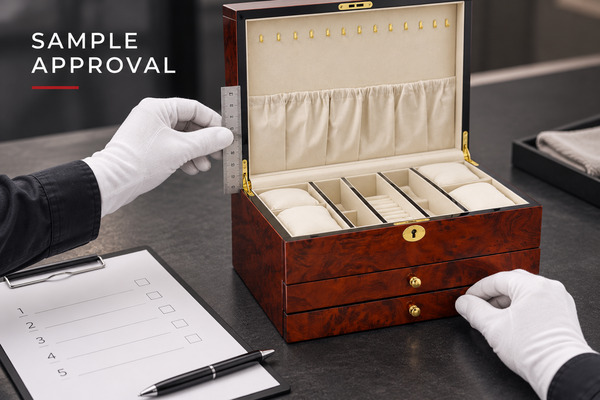
A physical sample helps the buyer verify whether the agreed design works as a complete product. Review the structure, dimensions, materials, color direction, finish, hardware, interior layout, logo and packaging included in the sample scope.
Record requested revisions in writing and use numbered photographs where necessary. A clear comment such as “realign the upper drawer front” is more useful than a general instruction to “improve the quality.”
After approval, Ezicase normally retains an approved physical sample at the factory as a production reference. The exact retention arrangement depends on the project. The sample should be identified clearly so that production and inspection teams understand which version was approved.
The custom jewelry box sample review guide explains the approval process in more detail.
What Should You Check About Quality Control and Inspection?
Quality checks are carried out at relevant points from material preparation through assembly and final inspection. The exact inspection scope depends on the product construction, approved sample and order requirements.
Depending on the construction, practical checks may cover:
- material and color consistency against the agreed reference;
- surface cleanliness and visible marks;
- edge, corner and wrapping quality;
- lid, drawer and hardware alignment;
- hinge, lock and closure operation;
- interior lining, dividers and removable parts;
- logo position and appearance;
- product fit inside the approved packaging.
Adhesion and assembly quality are checked in practice. If a project requires specific material or laboratory testing, the required method, scope and documentation should be agreed before production.
Final inspection can be conducted, and pre-shipment inspection sampling can be arranged where required. When an AQL plan is agreed, Ezicase can work with Critical 0, Major 2.5 and Minor 4.0. A formal outgoing inspection report can be provided when requested, but its contents and format should be agreed for the project.
Buyers can use the jewelry box quality control checklist to define the inspection scope.
Can the Packaging Protect the Jewelry Box During Shipping?
Packaging should be reviewed with the actual product because weight, dimensions, finish and structure affect the required protection.
For applicable high-end products, Ezicase commonly uses four protective layers:
- a water-spun nonwoven protective bag to reduce rubbing and surface contact;
- pearl-cotton protection fitted at both ends;
- an individual kraft carton;
- a master shipping carton for grouped transport.
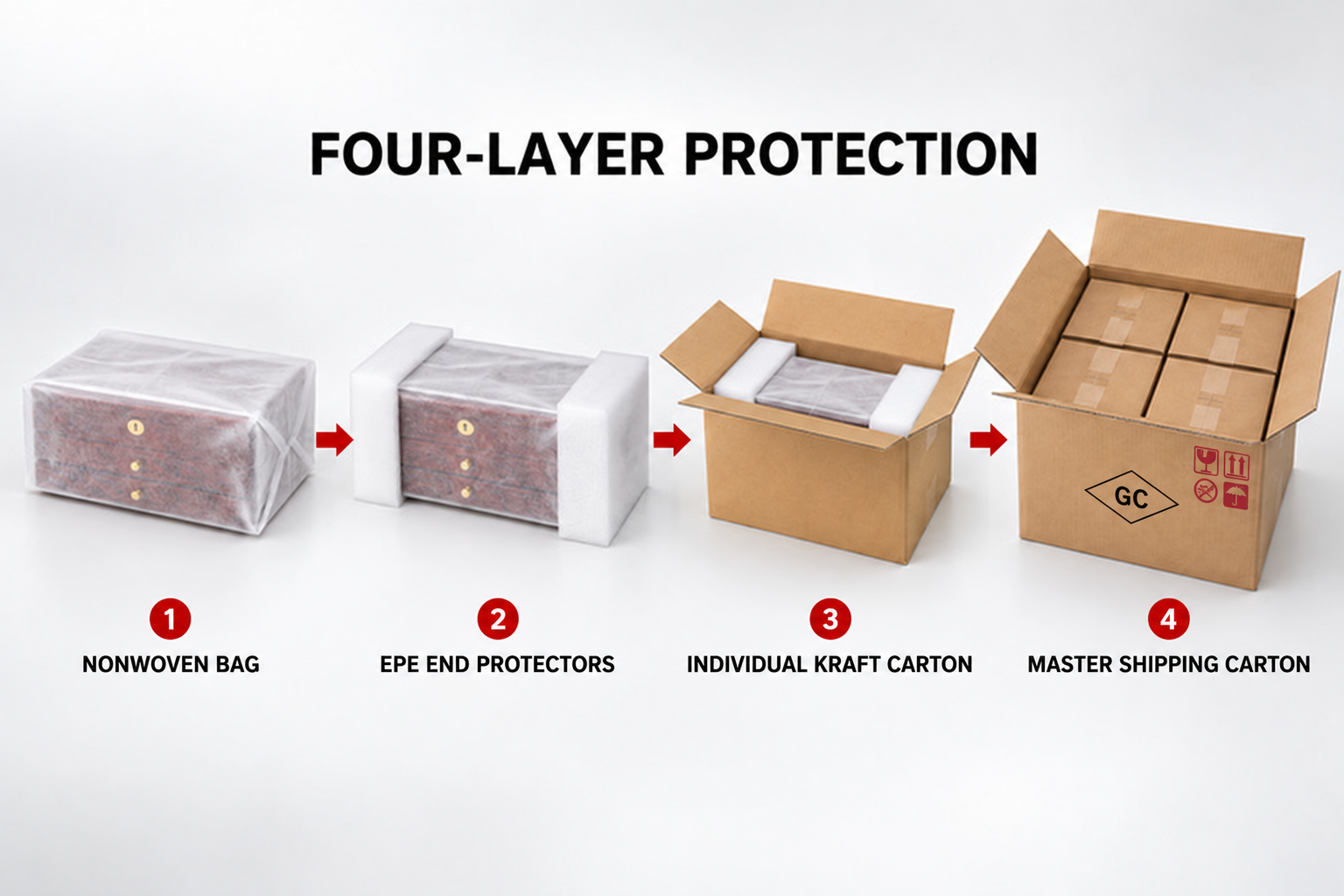
The master-carton specification and closing method are selected according to product dimensions, packed weight, quantity and shipping requirements. Gift-box packaging and project-specific transport tests can also be arranged when included in the confirmed project scope.
See the jewelry box shipping packaging guide for a closer explanation of the packaging layers.
How Should You Compare MOQ, Price and Lead Time?
Supplier quotations are only comparable when they are based on the same scope. A lower price may reflect a different core structure, exterior material, lining, hardware, logo method or packaging arrangement.
Before comparing totals, confirm:
- structural dimensions and materials;
- exterior and lining specifications;
- hardware and logo method;
- tooling or setup charges;
- sample cost and revision scope;
- individual and export packaging;
- inspection or testing requirements;
- trade terms and transport scope;
- what is included in the stated lead time.
MOQ, pricing and timing vary according to whether the project uses an existing structure, modified design or new development. Special materials, custom hardware and metal nameplates may also require different quantities. These points should be confirmed after the specification is sufficiently clear.
What Documents and Compliance Information Should You Request?
Documentation should match the product, destination market and claims the buyer needs to make.
Useful project records may include:
- the approved basic product specification;
- material and color references;
- sample revision records;
- confirmed packaging method;
- commercial terms and delivery basis;
- inspection requirements;
- available supplier material or component reports;
- a non-disclosure agreement for confidential projects.
Ezicase can sign an NDA for appropriate projects. Available compliance documents are matched to the relevant lining, leather, board, hardware or other component so that the buyer can understand the exact scope of each report.
What Are the Warning Signs When Evaluating a Supplier?
Potential warning signs include:
- describing materials only as “high-quality wood” or “premium leather” without identifying the actual construction;
- issuing a precise quotation before the structure, material, interior and packaging scope are understood;
- changing material descriptions between the quotation and sample;
- refusing to record sample revisions in writing;
- treating digital images as final color approval;
- promising extensive structural or hardware customization at very low quantities without explaining the conditions;
- making broad certification claims without identifying the tested material or scope;
- presenting a carefully hand-finished sample without explaining how the same result will be controlled in bulk production.
These signs do not automatically disqualify a supplier, but they indicate where the buyer should request clearer evidence before proceeding.
A Practical Jewelry Box Manufacturer Evaluation Checklist
Use the following checklist when comparing suppliers.
Product and production fit
- Does the supplier regularly produce related structures?
- Can it explain which parts are existing and which require development?
- Does its normal order scale match the project?
Materials and construction
- Are the core, exterior and lining materials identified accurately?
- Are hardware and opening methods clearly described?
- Are available reports linked to the correct material or component?
Sampling and approval
- Is the sample scope defined before work begins?
- Are revisions recorded clearly?
- Will the approved physical sample be retained and identified?
Quality and packaging
- Are the inspection criteria agreed before production?
- Can an inspection report be supplied if requested?
- Is the packaging designed around the actual product and shipping route?
Commercial communication
- Are tooling, setup, packaging and testing costs separated clearly?
- Are MOQ and lead time linked to the confirmed specification?
- Does the supplier distinguish confirmed details from items still under review?
Frequently Asked Questions
What information should I send to a jewelry box manufacturer?
Send the approximate dimensions, intended jewelry assortment, preferred structure, exterior and lining direction, required compartments, logo method, estimated quantity, packaging scope and target schedule. Reference photographs or sketches are helpful when their required features are also explained in writing.
Can an existing jewelry box design be customized?
Yes, but the practical scope depends on the existing structure, materials, hardware and order quantity. Changes to color, lining and logo are usually different in complexity from changes to dimensions, drawers or opening mechanisms. The manufacturer should evaluate the requested modifications before confirming cost, MOQ and timing.
Is a physical sample necessary before bulk production?
For a custom project, a physical sample is the most reliable way to confirm material appearance, function, jewelry fit and overall construction. Whether another sample is needed after revisions depends on the importance of the changes and the approval method agreed by both parties.
Can jewelry boxes use genuine leather?
Yes. Ezicase can source genuine leather to match the design and project requirements. Because natural leather varies in grain, thickness and appearance, the selected material and acceptable variation are confirmed during material selection and sample approval.
What quality-control report should a buyer request?
The report should reflect the agreed inspection scope. It may cover dimensions, appearance, function, logo, packaging and sampled defect results. Ezicase can provide a formal outgoing inspection report when requested, but the format and level of detail should be confirmed before inspection.
How should buyers compare quotations from different manufacturers?
Compare quotations against the same structure, materials, lining, hardware, logo, packaging, inspection scope and trade terms. If these details differ, the unit prices do not represent the same product.
Choose a Manufacturer That Fits the Project
Knowing how to choose a jewelry box manufacturer means identifying the supplier whose product experience, materials, sampling process, quality controls, packaging and communication fit the actual program.
Define the product before comparing prices, verify important decisions through a physical sample and record the agreed requirements clearly. This gives both buyer and manufacturer a practical basis for controlling bulk production.
Brands and purchasing teams can contact Ezicase to discuss their jewelry box requirements with our sales team.
