
The lining inside a jewelry box influences more than its appearance. It affects how rings, earrings, necklaces, bracelets, and mixed collections are organized, how the compartments are constructed, and how the finished product supports a brand’s presentation.
For B2B buyers, selecting jewelry box lining materials should therefore be part of the complete product-development process. The material needs to work with the jewelry assortment, internal layout, exterior finish, production method, target price level, and intended retail market.
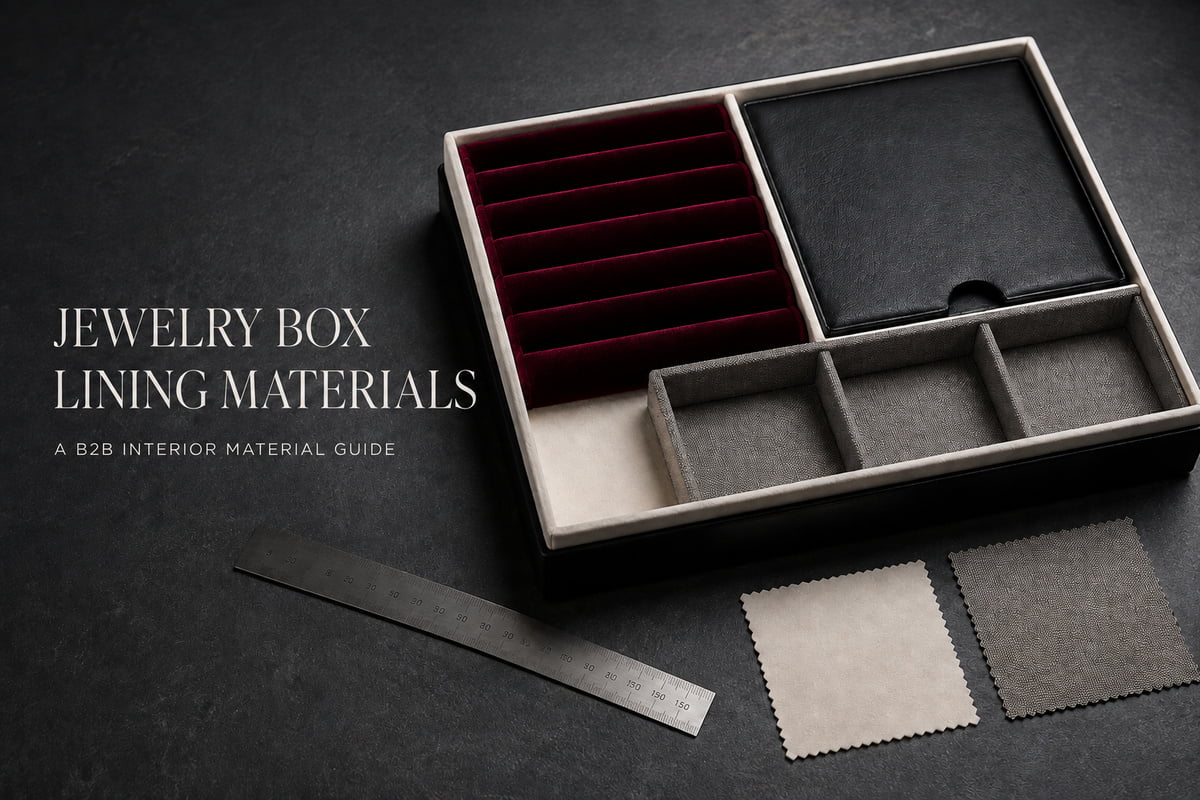
There is no single lining that is automatically suitable for every jewelry box. A practical specification begins by defining what the box must hold and how the user should access each item. From there, buyers can compare material texture, thickness, color, wrapping method, and compatibility with the proposed structure.
Why Lining Should Be Planned as Part of the Whole Jewelry Box
Interior lining is sometimes selected near the end of a project, after the exterior and dimensions have already been decided. This can create avoidable limitations because the lining occupies space and must be applied around dividers, ring rolls, tray edges, pockets, hooks, cushions, and other components.
A thick material may reduce the finished usable dimensions of a small compartment. A fabric that looks attractive as a flat swatch may be difficult to wrap neatly around narrow dividers or sharp corners. Materials with a visible pile or directional texture may also look different depending on how they are cut and installed.
The lining should therefore be reviewed together with:
- The jewelry assortment and approximate item sizes
- Ring rolls, hooks, pockets, trays, drawers, and open areas
- The structural core and external dimensions
- The exterior material, finish, hardware, and color
- Logo placement and other brand details
- Sampling and production feasibility
Buyers who are still defining the overall product can begin with our complete jewelry box buying guide. When the product assortment is already known, the jewelry box compartment sizing guide provides a more detailed method for planning usable interior space.
Start With the Jewelry Assortment
The intended contents should guide the interior structure before a lining material is approved. A mixed jewelry collection usually needs several storage formats rather than one repeated compartment.
Rings and Small Earrings
Ring rolls provide compact organization, but their spacing, firmness, surface material, and finished width need to be reviewed together. Small earrings may share ring-roll areas or require separate compartments, depending on the product concept.
Necklaces and Pendants
Necklaces often need hooks, pockets, longer open sections, or removable panels to reduce tangling and keep pendants visible. The lining material must work around these fittings without interfering with access.
Bracelets, Brooches, and Larger Pieces
Wider compartments, cushions, or open storage zones may be more appropriate for larger items. Buyers should confirm the usable dimensions after the lining and divider construction are included—not only the unlined dimensions shown in an early drawing.
Mixed Collections
A mixed collection may combine ring rolls, open compartments, removable trays, drawers, and lower storage. In this situation, more than one interior construction method may be used even when the visible color remains consistent throughout the box.
Common Jewelry Box Interior Material Directions
Material names alone do not define the finished result. Fiber composition, backing, surface texture, thickness, color, and application method can vary between suppliers. Buyers should review actual swatches and an assembled sample rather than approving only a general name such as “velvet” or “microfiber.”
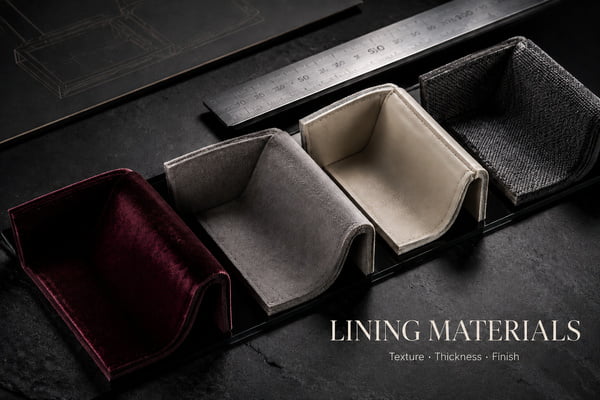
Velvet and Velvet-Like Fabrics
Velvet and velvet-like fabrics create a soft, light-absorbing appearance that is commonly associated with jewelry presentation. They are available in different pile lengths, densities, backings, and fiber compositions.
For a custom project, buyers should compare how the selected fabric looks when applied to flat bases, ring rolls, narrow dividers, and vertical walls. Pile direction and pressure during assembly can change the visible shade, particularly on darker colors.
The material should not be assumed to provide anti-tarnish, moisture-control, or other special performance unless that property is separately documented and confirmed for the actual material.
Microfiber and Suede-Like Finishes
Microfiber and suede-like materials can provide a fine, even surface with a contemporary appearance. They may be considered for trays, dividers, cushions, or larger lined panels where applicable.
The term “microfiber” covers many specifications. Buyers should confirm the exact sample, backing, thickness, color, and intended application instead of treating every microfiber material as interchangeable.
PU Leather Interior Surfaces
PU leather can create a cleaner, more structured visual effect than a soft-pile fabric. It may be used on selected trays, dividers, covers, or accent areas when the material and structure are compatible.
Because PU leather has a distinct surface grain, thickness, backing, and folding behavior, edge treatment and corner execution should be reviewed in the physical sample. It must also be identified accurately and should not be described as genuine leather.
Fabric-Covered Cushions and Inserts
Some interiors use fabric over a shaped insert rather than applying lining directly to the structural body. This approach can support ring rolls, cushions, display pads, and product-specific holders.
The insert material, covering material, finished dimensions, fit, and removal method all need to be specified. Foam or EVA may be used in certain structures, but the actual construction should be confirmed for each model rather than assumed from appearance.
Mixed-Material Interiors
A single jewelry box can combine several methods—for example, a soft fabric on the compartment base, a wrapped removable tray, covered ring rolls, and a different surface on a central lid or accessory panel.
Mixed-material interiors can create useful visual and structural contrast, but the colors, surface textures, seams, and transitions should be approved as one complete system.
Match the Material to the Interior Structure
The most suitable lining is not determined only by softness. It must be capable of producing clean, repeatable details on the proposed interior.
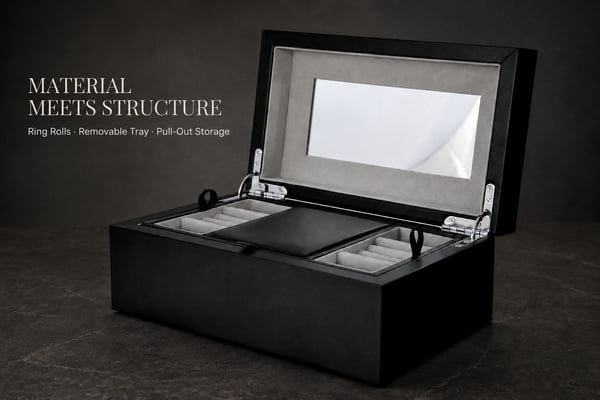
Review the following areas during development:
- Ring rolls: finished spacing, firmness, alignment, and ease of access
- Dividers: lining thickness, straight edges, wrapped corners, and usable compartment width
- Removable trays: fit, lifting method, stability, and clearance above the lower section
- Drawers: movement, interior height, corner finish, and consistency between levels
- Hooks and pockets: attachment position, access, and suitability for the intended necklace length
- Open compartments: finished base, wall alignment, and actual usable dimensions
- Mirrors and lid interiors: transition between the mirror, lining, frame, and hardware
The GC02-JB-02BG black PU leather two-layer jewelry box demonstrates how a gray lined interior can be divided into side storage zones and a removable central section, with additional storage underneath. The product should be evaluated as a complete structure rather than treating its lining as an isolated fabric choice.
For larger cabinet formats, the GC02-JB-01WBR high-gloss white jewelry collection box provides another development direction. Its rigid lacquered cabinet, upper organizer, mirror, and multiple drawers require the interior finish to remain visually coordinated across different levels and access points.
How Interior Color Affects Presentation
Color changes the relationship between the jewelry, interior, exterior, and hardware. It does not determine quality by itself, and no color is universally more premium.
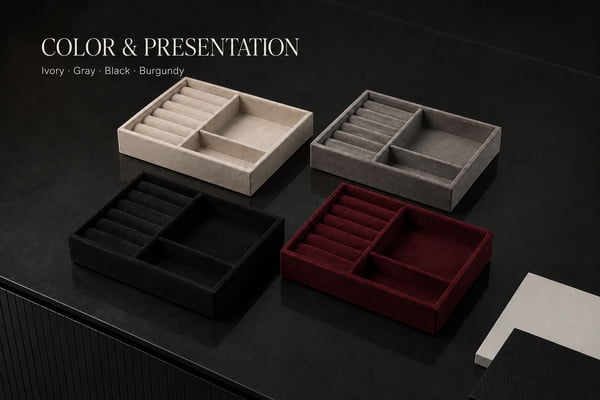
When comparing colors, consider:
- Contrast with the intended jewelry assortment
- Coordination with the exterior material and finish
- Compatibility with the brand’s established palette
- How light and shadow affect the visible texture
- The appearance of edges, seams, dust, and handling marks
- Color consistency between flat panels, ring rolls, trays, and drawers
Light neutral colors can produce a clean presentation and make dark items easy to distinguish. Darker colors can create stronger contrast with light metals and gemstones. Gray, taupe, ivory, black, burgundy, and other restrained shades can all support different market positions when they are coordinated with the complete product.
Color approval should be based on a physical material sample under representative lighting. Screens, photographs, and digital color values are useful references but may not reproduce the actual material exactly.
The choice of exterior structure also affects the overall presentation. Buyers comparing rigid lacquered cabinets with leather-covered formats can review our guide to wooden and leather jewelry box structures.
What B2B Buyers Should Specify to a Manufacturer
A request such as “gray velvet interior” is rarely enough for accurate product development. A clearer sourcing brief should include:
- Jewelry categories and approximate dimensions
- Required ring rolls, hooks, pockets, dividers, trays, drawers, or cushions
- Preferred material direction and reference swatch
- Interior color and acceptable variation
- Exterior material, finish, color, and hardware
- Logo method and placement
- Target product dimensions
- Expected order quantity and target market
- Packaging and presentation requirements
- Areas that must be checked during sampling
If the interior must be developed around a specific product assortment, share representative jewelry dimensions or physical samples where practical. This helps the manufacturer evaluate usable space, access, divider positions, and insert construction.
Ezicase supports project-based development of materials, colors, compartments, trays, inserts, branding, and packaging. Available options depend on the selected structure, material, quantity, and manufacturing feasibility. Buyers can review the current custom jewelry case collection, explore leather jewelry case structures and wooden jewelry box structures, or discuss custom interior materials and compartment development with the Ezicase team.
What to Review During Sampling
A flat material swatch is useful for selecting color and texture, but it cannot show the complete result around corners, dividers, rolls, trays, or moving components. The assembled sample remains the most important approval reference before production.
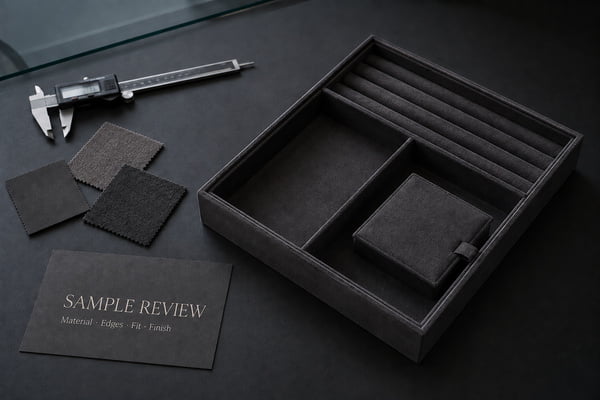
Before approving the sample, confirm:
- The actual lining material and approved color
- Texture and visible pile direction where applicable
- Finished usable dimensions after lining
- Ring-roll spacing and firmness
- Divider alignment and wrapped edges
- Corners, seams, joints, and transitions
- Tray fit, removal, and replacement
- Drawer movement and interior clearance
- Hooks, pockets, cushions, and other supports
- Coordination with exterior finish, mirror, hardware, and logo
- Any agreed tolerances or visual inspection points
If the material or construction changes after sample approval, the affected details should be reviewed again. Even a small change in thickness, backing, or insert structure can alter the fit or appearance of the completed interior.
Final Sourcing Checklist
Before requesting a quotation for a custom jewelry box, prepare the following:
- Jewelry assortment and intended use
- Internal layout or reference drawing
- Approximate item and compartment dimensions
- Preferred lining material direction
- Interior color reference
- Exterior material and finish
- Logo and packaging requirements
- Target quantity and market position
- Sample review criteria
A well-defined brief allows the buyer and manufacturer to discuss feasibility earlier, compare appropriate options, and reduce ambiguity during sampling.
Conclusion
Choosing jewelry box lining materials is not a matter of selecting the softest fabric or the darkest color. The material must work with the jewelry assortment, usable dimensions, interior components, exterior presentation, and production method.
For brands, retailers, distributors, and private-label buyers, the strongest approach is to approve the interior as a complete system: material, color, structure, craftsmanship details, and sample performance in normal use. Ezicase can support custom jewelry box projects with coordinated exterior finishes, interior layouts, lining options, branding, and packaging based on the requirements and feasibility of each project.
