
Wholesale watch winder buying is less about finding one “best” model than building a controlled first assortment. A practical starting range should cover clearly different customer needs without repeating too many similar capacities, finishes or functions. Buyers can then use small ready-stock orders to test demand, collect feedback and replenish the models that fit their market.
For retailers, distributors and importers, the difficult part is deciding how many variations to introduce at once. Adding every attractive option can make a first order unnecessarily complex.
The better approach is to treat the initial order as a structured market test. This guide explains how to select wholesale watch winders by customer segment, capacity, finish and feature level—and how to expand the range after real demand becomes clearer.
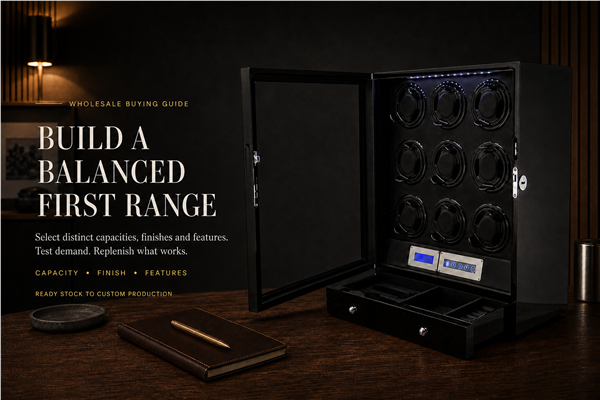
Why Is Wholesale Watch Winder Buying an Inventory Decision?
Wholesale watch winder sourcing is an inventory decision because every model occupies a different position in the buyer’s range. Capacity, dimensions, appearance, functions, packaging and expected retail level all influence who may buy it and how easily it can be stored, explained and replenished.
A product can be well made and still be unsuitable for a particular market. A large 12-position cabinet may appeal to established collectors but require more display space and customer commitment. A compact model is easier to introduce but may not satisfy customers seeking centralized storage.
Before requesting prices, buyers should define several commercial boundaries:
- Who is the intended end customer?
- Is the product an entry accessory, a premium gift or a major display piece?
- Which retail price bands need to be represented?
- How much warehouse and showroom space is available?
- Will customers need detailed guidance on settings and operation?
- How quickly can successful models be replenished?
These questions help prevent several models from competing for exactly the same customer.
Which Customer Segment Should Your First Range Serve?
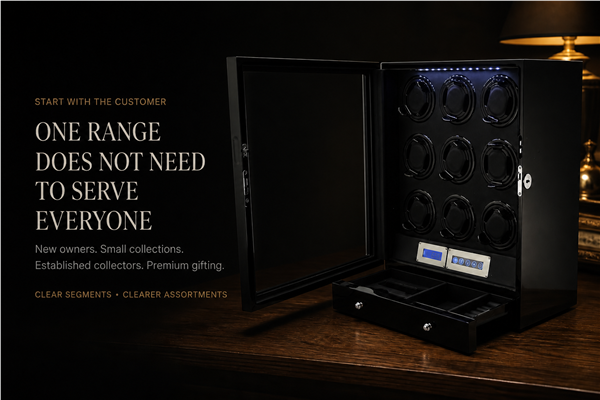
The first range should be built around identifiable customer groups rather than the largest possible selection.
Common segments may include:
Customers New to Watch Winders
These customers often need a clear explanation of compatibility and settings. Compact products with straightforward controls may be easier to introduce, although suitability still depends on the model and watch movement.
Owners of Small Automatic-Watch Collections
Customers with several automatic watches may compare two-, three- or four-position configurations. Available space and the need for static storage can be as important as active winding capacity.
Established Collectors
Larger cabinets can provide centralized presentation for multiple watches. Buyers should look beyond the number of visible holders and confirm the real winding capacity, control arrangement, external dimensions and access requirements.
Gift and Presentation Buyers
For premium gifting, appearance, packaging and ease of use may carry more weight than maximum capacity. Branding remains dependent on the surface, structure and available processing method.
One range does not need to serve every segment immediately. A focused selection is easier to present and evaluate.
How Should Buyers Build a Balanced Initial Range?
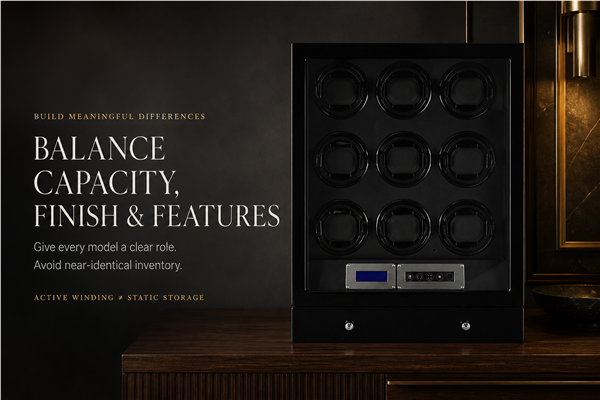
A balanced initial range should contain meaningful differences. Each selected model should have a clear role based on capacity, exterior effect, feature level or price position. If two models differ only slightly and target the same customer, ordering both may add inventory without adding much choice.
Balance Active Capacity and Storage
Capacity must distinguish active winding positions from static storage slots. For example, a configuration described as “4 winders + 6 storage” has four active winding positions and space to store six additional watches. It should not be presented as a 10-position watch winder.
Compact two- to four-position designs can cover customers with smaller collections, while larger eight-, nine- or 12-position products may support broader collection display. This is not a rule about what will sell best. The appropriate mix depends on the retailer’s audience, available space and price structure.
Buyers comparing different configurations can also review our guide to single and multi watch winders for the practical differences between compact and larger formats.
Limit Overlapping Exterior Effects
Exterior appearance helps establish the visual identity of a range. Ezicase watch winders may use finishes such as high-gloss lacquer, woodgrain effects, veneer, wrapped materials or carbon-fiber-look surfaces, depending on the model.
For an initial order, buyers can select finishes that create visible contrast instead of stocking numerous near-identical variations. A dark woodgrain effect and a carbon-fiber-look option may address different presentation preferences more clearly than several similar black finishes.
Material names should also be accurate. A woodgrain appearance does not automatically mean solid wood, and a wrapped surface should not be described as genuine leather unless the selected model uses verified genuine leather.
Separate Feature Levels Clearly
Functions can help distinguish entry, mid-level and presentation-focused models, but not every feature belongs in every first assortment. Depending on the configuration, buyers may compare selectable TPD programs, rotation directions, touchscreen control, LED lighting, open-door stop, remote control, locks, drawers or 12 o’clock alignment.
These functions are model-specific. Buyers should not assume that products from the same exterior series use the same controls or that every winding position can be programmed independently. For a deeper explanation of specifications, see our watch winder buying guide.
Feature differences should be easy for sales staff and customers to understand.
Use Price Position as a Result, Not the Only Starting Point
Price matters, but selecting only by unit price can create an inconsistent range. Two products at different prices may also differ in capacity, construction, dimensions, control system, finish and packaging.
A better comparison considers the complete approved specification. The objective is not to cover every price point; it is to make the differences between products understandable and commercially relevant.
What Must Be Confirmed Before Placing a Wholesale Order?
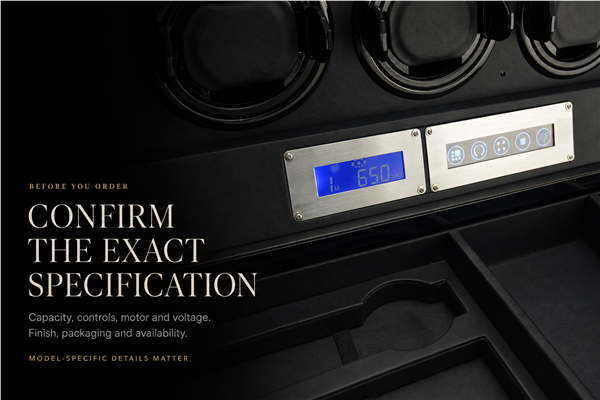
Before ordering, buyers should confirm the exact specification and purchasing conditions for every shortlisted model. Product-family descriptions are useful for browsing, but the quotation and approved model record should control the final decision.
Important confirmation points include:
- Exact model number and required quantity
- Active winding capacity and additional static storage
- External dimensions and approximate packaging requirements
- Preset TPD programs and available rotation directions
- Whether controls apply individually or by group
- Motor specification for the selected model
- Plug, adapter and voltage requirements for the destination market
- Exterior material, finish and interior color
- Relevant lighting, door-stop, lock, remote or alignment functions
- Logo method, size and placement where branding is required
- Packaging scope and any requested packaging changes
- Applicable compliance documents and their exact scope
- Current availability, MOQ and preparation time
Different automatic movements may require different TPD and rotation-direction settings. The end user should check the watch or movement manufacturer’s guidance rather than choose a setting based only on the watch brand. Buyers who need more detail can refer to our watch winder TPD guide.
Logo feasibility also needs model-specific confirmation. Silk printing, a metal badge, a laser-engraved plate or another method may be possible, but no single process is suitable for every surface.
How Can Ready Stock Reduce Initial Commitment?
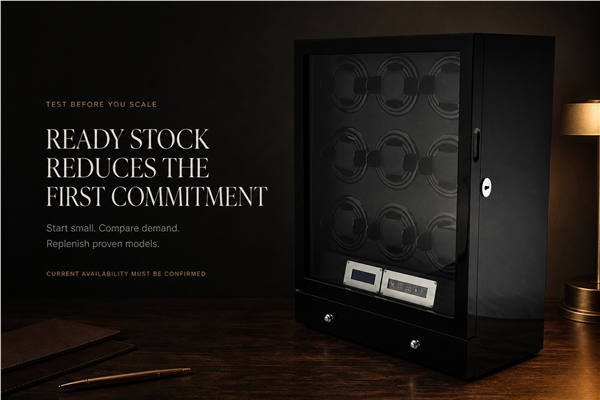
Ready stock can help buyers test a category with a more manageable first order. Instead of waiting for a fully customized production run, a retailer can select existing models, confirm current quantities and compare customer response across a limited assortment.
Selected Ezicase ready-stock watch winders may be available from one piece, subject to the exact model and current inventory. Availability, quantity, preparation time and wholesale price are confirmed when the buyer submits the required models and quantities.
This route can support:
- A first test of the watch winder category
- Comparison of two or more clearly different capacities
- Testing different exterior effects within the same market
- Retail replenishment for an established model
- Time-sensitive sourcing when a suitable finished product is available
Ready stock does not remove the need to check specifications, appearance, packaging and movement-setting guidance. It simply provides a different level of initial commitment.
Branding on stock products is also conditional. Selected models may support logo application, depending on the surface and method, with additional processing time and cost. The feasibility should be reviewed before the order is confirmed.
What Should Buyers Track After the First Order?
The first order becomes more valuable when the buyer records what the market responds to. Sales, customer questions, requested features and after-sales issues can reveal why a model is succeeding or struggling.
Useful feedback includes:
- Which capacities receive the most inquiries?
- Do customers understand the difference between winding and storage positions?
- Which finishes attract attention in the target market?
- Which features influence the final decision?
- Are external dimensions creating placement concerns?
- Do customers need more guidance on TPD or rotation direction?
- Which questions repeatedly delay the purchase?
- Are any issues related to product use, packaging or expectations?
One early order does not prove a permanent trend, and a model with fewer initial sales may still serve an important segment. The objective is to replace assumptions with better evidence over several selling cycles.
In my work with B2B buyers, I often find that the questions customers ask are as useful as the first sales results. Repeated questions about capacity, finish or operation may show where the product range—or the supporting product information—needs improvement.
When Should You Replenish, Expand or Move to Custom Production?
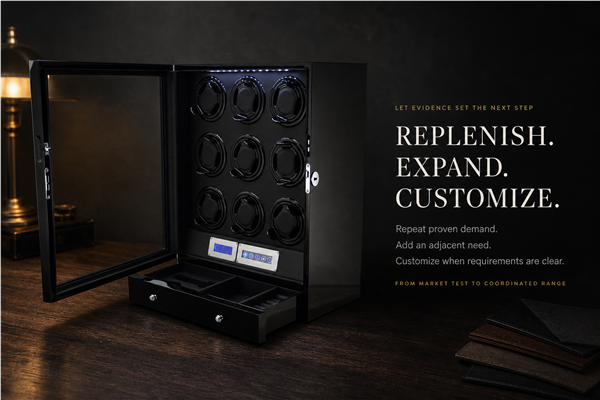
Buyers should replenish when a model demonstrates repeatable demand, expand when feedback reveals an adjacent need, and consider customization when the market requirements are clear enough to justify a coordinated private-label product.
Replenish Proven Models
If a product is selling consistently and still fits the market, replenishing it may be more useful than immediately adding another variation. Stock availability should be reconfirmed for each order.
Expand into an Adjacent Need
Expansion can be based on a clear gap: a larger capacity, a more compact footprint, a contrasting finish or a different functional level. The new model should add a recognizable choice rather than duplicate an existing item.
Move Toward a Coordinated Custom Range
When buyers have evidence about preferred capacities, finishes, interiors, branding and packaging, they can evaluate a custom project. Ezicase custom production may start from 50 units depending on the product structure, material, finish and requested changes.
The practical process is to confirm requirements, use an existing model, client reference image or physical reference as the starting point, make a physical sample, review or revise it, and then proceed to production after approval. Buyers can explore our watch winder customization options when the market is ready for deeper brand integration.
The two routes can also be used in stages. Our guide to ready-stock versus custom watch winders explains when each sourcing approach is more suitable.
Frequently Asked Questions
What Is a Practical MOQ for Wholesale Watch Winders?
MOQ depends on the sourcing route and model. Selected ready-stock products may start from one piece, subject to current inventory. Custom OEM/ODM production may start from 50 units, but the applicable MOQ depends on the construction, materials, finish, functions, branding and packaging requirements.
Should a First Order Include Several Capacities?
Testing more than one capacity can be useful when the models serve different customer groups. Buyers do not need every available size; a compact option, a mid-capacity model and a larger presentation product may provide a useful comparison.
Can a Logo Be Added to Ready-Stock Watch Winders?
Some ready-stock models may support logo application, but feasibility depends on the product surface, structure, artwork, method, size and placement. The additional cost and preparation time should be confirmed before ordering. A method that works on a wrapped surface may not be suitable for lacquer, veneer or another finish.
Build the Range from Evidence, Not Assumptions
A successful first wholesale assortment does not need to be large. It needs to be deliberate. Each model should serve a clear customer group, and the differences in capacity, finish, functions and price position should be easy to explain.
Ready stock provides a practical way to begin with lower trial quantities, but every model still requires specification and availability confirmation. After the first selling period, buyers can use actual feedback to replenish suitable models, add adjacent options or prepare a more coordinated custom range.
To review current options, request the latest Ezicase stock list with your preferred capacities, quantities, target market and delivery schedule. Our team can then confirm available models, purchasing conditions and suitable next steps.
