
Choosing a jewelry box involves more than selecting an attractive exterior. The right design should match the jewelry it will hold, keep different pieces organized, allow comfortable access, and support the intended retail or brand position.
This jewelry box buying guide explains the main structures, materials, interior layouts, and customization decisions buyers should evaluate. It is intended for jewelry brands, retailers, distributors, corporate gift buyers, and anyone planning a coordinated jewelry storage collection.
Start with the jewelry assortment—not the exterior finish. List the types, approximate dimensions, and quantities of the pieces to be stored. Then define the compartments, trays, or drawers required before selecting the exterior material, lining color, hardware, and branding.
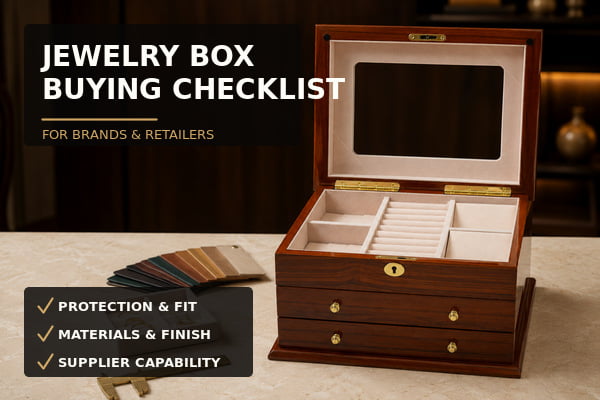
Start With the Jewelry, Not the Box
Before comparing materials or finishes, identify what the box needs to hold. A layout that works well for rings may be unsuitable for necklaces, while a compact travel organizer has different priorities from a multi-level box intended for a full collection.
Prepare a simple product list covering:
- Jewelry categories: rings, earrings, necklaces, bracelets, bangles, brooches, or mixed pieces
- Approximate dimensions and quantities
- Delicate surfaces, gemstones, or protruding settings that need additional clearance
- Whether pieces will be stored individually, as sets, or as a collection
- Whether the box is for home storage, retail, gifting, travel, or repeated presentation
- How frequently each section needs to be accessed
For a custom project, reference samples or accurate product dimensions help the manufacturer evaluate clearances, compartment sizes, and support points. This reduces the risk of creating attractive compartments that do not fit the actual jewelry.
Buyers who want to compare existing structures can begin with the Ezicase jewelry case collection before deciding whether an available format can be adapted or a new layout is required.
Common Types of Jewelry Boxes
The best structure depends on collection size, available space, and intended use.
Single-Level Jewelry Boxes
A single-level box provides an immediate overview of the contents. It works well for focused collections, gift sets, and retail programs where simple access and presentation are important.
The main limitation is capacity. If too many jewelry categories are placed on one level, compartments may become small or poorly matched to the products.
Multi-Level and Drawer Jewelry Boxes
Drawers and stacked trays separate jewelry by category, value, or frequency of use. They can provide more storage without requiring a very wide footprint.
Buyers should check:
- Whether drawers open smoothly and remain aligned
- Whether handles and pulls are comfortable to use
- Whether upper sections block access to lower levels
- Whether drawer depth matches the intended jewelry
- Whether loose trays remain stable during handling
Removable-Tray Designs
Removable trays provide flexible access and can help organize different product groups. They are useful when a brand wants one outer case with several coordinated presentation layers.
The tray should be easy to lift without placing pressure on the jewelry. Its fit also needs to be controlled: too tight and it becomes difficult to remove; too loose and it may shift during transport.
Display-Window and Mirror Designs
A transparent window makes the contents visible without opening the lid and can support retail presentation. A mirror can improve the user experience but also adds weight and requires secure mounting.
These features should be selected according to the use scenario. They are not necessary for every jewelry box and may affect structure, packaging, and shipping requirements.
Choosing the Exterior Structure and Finish
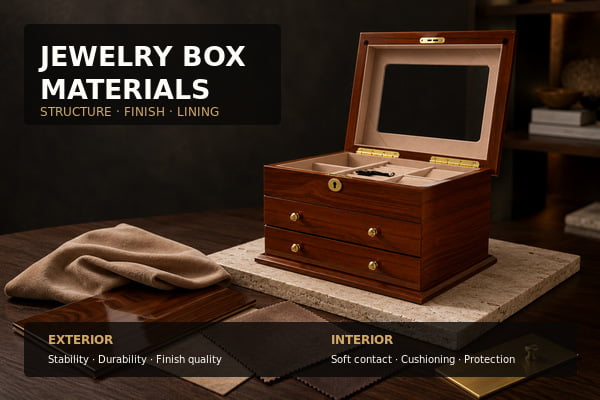
Material descriptions can be confusing because the visible surface and the structural core are not always the same. For example, a product described as a wooden jewelry box may use a stable MDF structure with lacquer, wood veneer, or a decorative wood-grain finish. Buyers deciding between these two presentation directions can review our wooden vs leather jewelry boxes guide for a detailed comparison of supporting structures, exterior finishes, branding options, and B2B sourcing considerations.
MDF-Based Structures
MDF provides a consistent substrate for rigid boxes and can support a range of surface treatments. Depending on the design, it may be finished with high-gloss or matte lacquer, wood veneer, PU leather, or another wrapped material.
Its uniform surface is particularly useful for finishes that require consistent edges and smooth panels. Buyers should ask for a complete construction description instead of assuming that a wood appearance means solid wood.
Solid Wood and Wood Veneer
Solid wood offers natural character, but species, moisture control, construction, and finish all affect the result.
Wood veneer uses a thin layer of real wood over a stable base and can provide a natural-grain appearance with consistent panel construction.
When comparing wooden jewelry cases, clarify whether the product uses solid wood, wood veneer, lacquered MDF, or another wood-effect finish.
Lacquered Finishes
Lacquer can create high-gloss, satin, or matte appearances, depending on the selected process. The visual quality depends not only on the coating but also on substrate preparation, edge finishing, polishing, and color consistency.
For sampling, review the product under normal and angled light to identify uneven surfaces, dust marks, scratches, or color differences.
Leather and PU Leather Coverings
Leather-covered structures create a softer visual and tactile character. Genuine leather, microfiber leather, and PU leather have different costs, consistency, texture, and care considerations.
The quality of a wrapped box also depends on how the material is applied. Inspect corners, seams, folds, edges, and the alignment of any grain or pattern.
Buyers comparing leather jewelry cases should confirm the exact covering material rather than relying on the word “leather” alone.
Comparing Common Exterior Options
| Exterior option | Typical visual direction | Points to evaluate |
|---|---|---|
| Lacquered MDF | Clean, contemporary, high-gloss or matte | Surface preparation, edge quality, polish, and color consistency |
| Wood-veneered MDF | Natural wood character with a stable structure | Veneer pattern, panel matching, edge treatment, and finish |
| PU leather-wrapped MDF | Soft accessory appearance and consistent color | Seam alignment, corner wrapping, abrasion, and material specification |
| Genuine or microfiber leather covering | Premium tactile presentation | Leather grade, texture variation, stitching, and maintenance |
| Solid wood | Natural material character | Species, construction, moisture control, weight, and finish |
Planning the Interior Layout
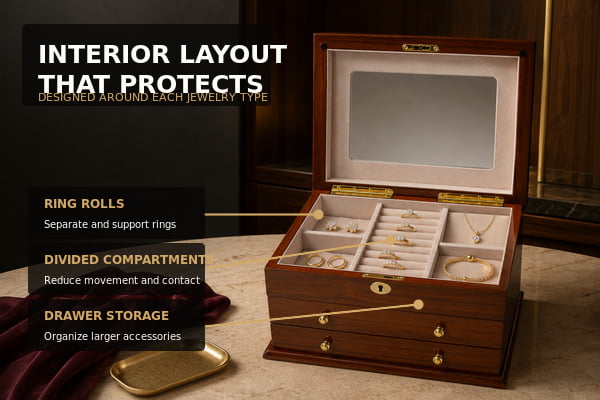
The interior determines whether jewelry remains separated, visible, and easy to retrieve. Every component should have a clear purpose.
Ring Rolls
Padded ring rolls hold rings upright and make them easy to view. The spacing and compression should suit the expected ring sizes without placing unnecessary pressure on settings.
Earring Sections
Small divided compartments work for many earrings, while dedicated panels may suit certain collections. Studs, hoops, and drop earrings require different clearances.
Necklace Hooks and Pockets
Hooks separate chains and reduce tangling. A lower pocket can control pendants and loose chain ends. Check the usable hanging length for longer necklaces.
Bracelet and Bangle Storage
Bracelets may use open compartments, padded rolls, or cushions. Rigid bangles usually require more space than flexible chains.
Open Compartments
Open sections offer flexibility for brooches, larger pendants, and mixed pieces, but oversized compartments may allow items to move during transport.
Drawers and Trays
Drawers expand capacity and allow jewelry categories to be separated. Removable trays improve access but need suitable finger clearance and stable support.
During sample review, test every tray and drawer with the actual products whenever possible. For a practical example, this multi-level jewelry organizer with seven compartments and two drawers combines ring rolls, an earring panel, open storage sections, a built-in mirror, and pull-out drawers within one coordinated structure. It illustrates how different storage functions can be integrated for mixed jewelry collections.
For projects requiring a more precise interior configuration, see our jewelry box compartment sizing guide to learn how to plan usable dimensions, clearance, access, trays, and drawers around different jewelry types.
| Jewelry type | Useful interior feature | Key check |
|---|---|---|
| Rings | Padded ring rolls | Slot spacing and setting clearance |
| Stud earrings | Small divided sections or an earring panel | Easy removal and pair organization |
| Necklaces | Hooks with lower pockets or channels | Hanging length and tangle prevention |
| Bracelets | Open compartments, rolls, or cushions | Width, curvature, and surface contact |
| Bangles | Wider compartments or structured supports | Internal diameter and overall height |
| Brooches and pendants | Padded open compartments | Clearance around pins and settings |
Selecting Linings, Colors and Padding
Interior material influences protection and presentation. Options include velvet, suede-effect fabrics, felt, and PU leather. Buyers should evaluate actual samples rather than relying only on material names.
Consider:
- Surface softness and abrasion risk
- Fiber shedding or visible marks
- Adhesive and edge finish
- Wrinkling around corners and curved components
- Color transfer risk for light-colored products
- Contrast between the lining and the jewelry
- Availability and consistency for repeat orders
Dark linings may hide dark products, while light colors can show dust or handling marks. Balance brand color with visibility and practical use.
If a project requires specialized properties—such as a particular anti-tarnish lining—the exact fabric specification and supporting documentation should be confirmed before approval.
It should not be assumed that every velvet or suede-effect material provides the same protection.
Hardware and Functional Details
Small components can have a significant effect on daily use and perceived quality.
Review the following during selection or sampling:
- Hinges: opening angle, alignment, movement, and load support
- Locks and closures: ease of use and suitability for the intended market
- Handles and pulls: comfort, attachment strength, and finish consistency
- Mirrors and windows: mounting, edge protection, and cleaning access
- Drawer stops: whether drawers pull out safely without accidental release
- Feet and base protection: stability and protection for furniture surfaces
A lock may improve controlled access, but it does not automatically make a jewelry box a security safe.
Product descriptions should distinguish organization and presentation features from certified security performance.
What B2B Buyers Should Check Before Customizing
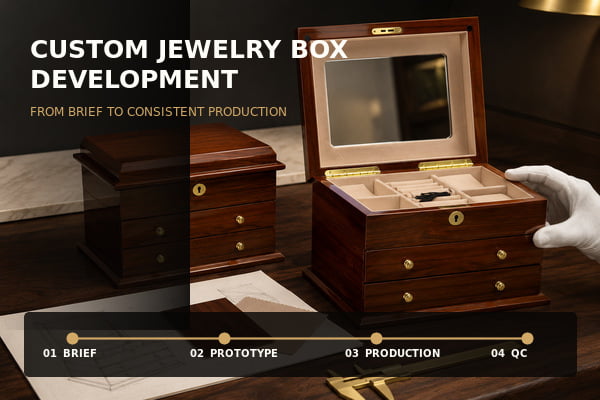
Customization may range from applying a logo to an existing structure to developing new dimensions, compartments, and hardware.
The broader the change, the more information and validation the project usually requires.
Prepare the following before requesting a quotation:
- Jewelry types, dimensions, and quantities per box
- Preferred structure and approximate external size
- Exterior material, finish, and color direction
- Interior layout, lining, and color
- Required mirror, window, lock, drawer, or removable tray
- Logo artwork, application method, size, and position
- Packaging requirements
- Estimated order quantity and target schedule
- Destination market and any project-specific documentation needs
Ezicase supports custom jewelry storage development using existing structures or project-based configurations.
Customization generally starts from 50 units, but the applicable MOQ, sample process, cost, and production schedule depend on the product structure, materials, and requested changes.
Use the Sample as an Approval Standard
Review a sample as a working product, not only as a visual reference. Place the intended jewelry inside and test:
- Compartment fit and accessibility
- Ring-roll compression
- Necklace length and hook placement
- Tray and drawer movement
- Lid opening angle and hinge support
- Lock, handle, and hardware operation
- Material, color, logo, and finish
- Protective packaging
Record approved details in drawings, specifications, reference samples, or an inspection checklist before production. For a complete review process, follow our custom jewelry box sample approval guide before confirming mass production.
Common Jewelry Box Buying Mistakes
Avoid these recurring problems:
- Choosing the exterior before defining the jewelry assortment
- Using one compartment style for every jewelry category
- Assuming a wood appearance means solid wood
- Treating all leather-labelled materials as equivalent
- Selecting lining color without testing the jewelry against it
- Adding drawers or trays without checking access and clearance
- Approving only renderings instead of evaluating a physical sample
- Using decorative locks as if they provide certified security
- Confirming appearance without reviewing export packaging
- Assuming MOQ and lead time are identical for every configuration
Final Jewelry Box Buying Checklist
Before making a final decision, confirm:
- [ ] The jewelry assortment and dimensions are documented
- [ ] Every interior component has a defined purpose
- [ ] Exterior core and surface materials are clearly specified
- [ ] Lining material and color have been sampled
- [ ] Drawers, trays, hinges, and closures have been tested
- [ ] Logo size, method, and placement are approved
- [ ] Packaging matches the product weight, finish, and shipping method
- [ ] MOQ, quotation scope, and schedule are confirmed for the selected configuration
- [ ] The physical sample has been tested with the intended jewelry
- [ ] Final specifications are recorded before production
Frequently Asked Questions
What is the best material for a jewelry box?
There is no single best material. Lacquered or veneered MDF offers a rigid structure and diverse finish options, while leather-covered constructions provide a softer accessory appearance.
The right choice depends on the target market, desired finish, budget, structure, and expected use.
What interior layout should I choose?
Choose the layout according to the jewelry assortment. Rings need padded rolls, necklaces benefit from hooks or channels, earrings require appropriately sized sections, and bracelets or bangles need wider support.
Mixed collections often work best with a combination of compartments, trays, and drawers.
Should a jewelry box have a mirror or lock?
Only when the use scenario supports it. A mirror can improve convenience, while a closure can help control access. Both affect construction, weight, and cost.
A standard jewelry-box lock should not be presented as certified security protection.
Can I customize an existing jewelry box design?
Selected existing structures may support changes to color, lining, logo, compartments, or packaging.
More extensive changes to dimensions, structure, or hardware usually require additional evaluation and sampling.
What is the MOQ for custom jewelry boxes?
Ezicase OEM/ODM projects generally start from 50 units. The applicable MOQ depends on the structure, materials, customization scope, and production process.
Selected ready-stock storage models may support smaller trial orders, subject to current availability.
How long does custom production take?
There is no universal lead time. The schedule depends on design development, sample approval, material availability, order quantity, production process, and packaging.
Confirm the project schedule with the final quotation rather than relying on a general online estimate.
Conclusion
A successful jewelry box begins with the contents. Once the jewelry types, sizes, and access requirements are clear, buyers can make better decisions about structure, compartments, exterior finish, lining, hardware, and branding.
For B2B projects, the most reliable approach is to test the intended jewelry in a physical sample and document the approved construction before production.
This turns the jewelry box from a decorative container into a coordinated storage and presentation solution.
Once you have selected a suitable box format, our jewelry box manufacturer evaluation guide can help you compare suppliers for your sourcing project.
Explore Ezicase jewelry cases or contact our team to discuss an existing model, private-label modification, or custom jewelry storage project.
