Navigating watch winder sourcing can be difficult for businesses entering a new category or expanding an established collection. Should you begin with products that are already available, or invest directly in a custom program built around your brand?
The better choice depends on your current business stage. Ready-stock watch winders are generally better suited to market testing, smaller initial orders and faster replenishment, while custom production supports deeper brand integration, differentiated finishes and longer-term product development. Some buyers may benefit from using both approaches in stages.
As Sales Manager at Goochy, I have guided many B2B clients through this decision. The goal is not to prove that one sourcing route is universally superior. It is to match order commitment, preparation time, branding requirements and product development depth to a realistic commercial plan.
What Are Ready-Stock Watch Winders, and When Do They Make Sense?
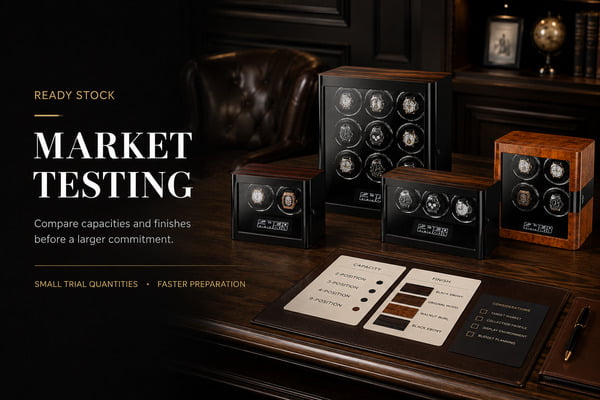
Ready-stock watch winders are completed products held in current inventory and available for faster preparation, subject to final confirmation of the model, quantity and condition. They can help retailers, distributors and e-commerce sellers test demand without beginning with a full custom production run.
Unlike custom production, the main manufacturing work has already been completed. Buyers select from available capacities, finishes and configurations rather than defining every detail from the beginning. Selected Ezicase stock models may be ordered from one unit, although the actual stock MOQ, available quantity and preparation time must be confirmed for each model.
Faster Entry Without a Full Production Commitment
Ready stock can be useful when a buyer needs to launch a category, replenish products or evaluate a new market within a shorter timeframe. Because the products already exist, the process normally focuses on model selection, quantity confirmation, inspection, packing and shipment preparation.
This route can be particularly practical for:
- Retailers introducing watch winders for the first time;
- Distributors testing several capacities or finishes;
- E-commerce sellers building an initial product range;
- Buyers preparing for seasonal demand;
- Existing customers needing faster replenishment;
- Businesses that want sales feedback before committing to custom production.
Ready stock does not eliminate commercial risk, but it can reduce the initial inventory commitment. A buyer might compare two-watch, four-watch and larger-capacity models, for example, and use real customer response to decide which direction deserves further investment.
What Can Usually Be Changed on a Stock Product?
A ready-stock product is not the same as a fully custom product. Some secondary customization may be possible, but it depends heavily on the surface material, product construction and available processing space.
Logo methods may include silk printing, laser marking, a metal badge or another suitable application. However, not every method works on every finish. A logo treatment suitable for one lacquered, leather-wrapped or metal surface may not be suitable for another. Packaging changes may also be possible on selected orders, but the scope must be checked before quotation.
For current availability, buyers can review the Ezicase ready-stock watch winders and watch cases and request confirmation using the model number and required quantity.
What Do Custom Watch Winders Offer for Your Brand?
Custom watch winders allow a business to coordinate the product more closely with its brand, target customer and intended price position. The project may involve capacity, structure, wood-grain effect, lacquer finish, wrapping material, interior color, logo, packaging and selected functional options.
Customization is most valuable when a buyer has already defined the role of the product. A watch brand may need a winder that complements its presentation system. A distributor may want an exclusive exterior combination for its market. A premium gift company may need coordinated branding and packaging. In these cases, differentiation extends beyond placing a logo on an existing item.
Ezicase commonly works with MDF structures finished in lacquer, wood veneer or wood-grain effects, as well as PU leather, genuine leather, microfiber leather, carbon-fiber-style surfaces and other project-appropriate materials. Solid wood can also be considered for suitable projects, but it is not the primary construction material across the range.
Customizing Appearance, Structure and Functions
The available choices depend on the base model and project feasibility. They may include:
- Exterior finish and wood-grain effect;
- Interior color and lining treatment;
- Winding capacity and storage configuration;
- Drawer, lighting or control-panel options;
- Door-open stop, remote control, fingerprint lock or touch-screen control on suitable models;
- A motor system with an optional 12 o'clock alignment function where applicable;
- Logo application and custom packaging.
Ezicase watch winders generally use Mabuchi motor systems. The motor is not presented as an open menu of interchangeable brands. The relevant project decision is more often the product configuration and whether an applicable system requires functions such as 12 o'clock alignment.
Compatibility and operating settings still need to be considered responsibly. A watch winder should not be described as compatible with every automatic watch. Buyers and users should consult the watch or movement manufacturer's guidance for rotation direction and winding requirements. For a foundation on operation and settings, see What Is a Watch Winder and How Does It Work?.
From Requirement Review to a Physical Sample
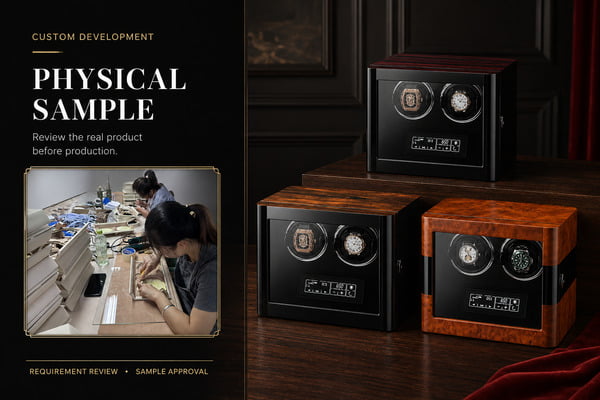
Custom development does not always begin with detailed internal 3D renderings. In many Ezicase projects, the practical route is to review the buyer's brief, reference images, sample or an existing model, then create a physical sample for evaluation.
A typical project may follow these stages:
- Confirm the target market, quantity, capacity, finish, functions, logo and packaging requirements.
- Select an existing construction direction or review the buyer's reference product, image or sample.
- Prepare a physical sample using the agreed materials and configuration.
- Review the sample and make necessary adjustments.
- Confirm the approved version before production.
This process keeps discussion connected to a real, manufacturable product. It also gives the buyer an opportunity to evaluate proportions, appearance, interior fit, controls and presentation before a production order proceeds.
How Does a Hybrid Watch Winder Sourcing Strategy Work?
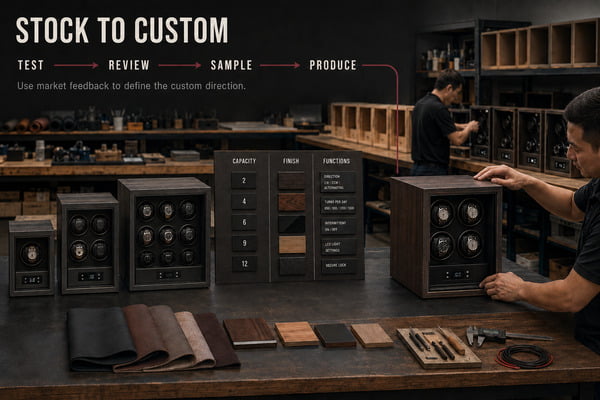
A hybrid strategy uses ready stock to enter or test the market, then applies the resulting feedback to a custom program. It can help a buyer avoid making every product-development decision before learning which capacities, finishes and features are commercially relevant.
My clients often use this kind of progression when they want both speed and long-term differentiation. Rather than treating stock and custom production as competing choices, they assign each route a different role.
Phase 1: Test with Ready Stock
Choose a focused selection of available models rather than ordering many unrelated products. The selection might compare capacity, finish or control style. The purpose is to learn what the target customer actually responds to.
Phase 2: Review Market Feedback
Evaluate sales performance, buyer questions, preferred capacities, color response and any recurring concerns. This information is more useful when the test has a clear objective instead of simply listing as many models as possible.
Phase 3: Develop a Physical Sample
Use the strongest findings to define a sample. The custom direction may be based on a proven structure with revised wood-grain effect, lacquer color, interior, branding, packaging or selected functions. This can create meaningful differentiation without assuming that every part must be designed from zero.
Phase 4: Move to Custom Production
After the sample and commercial direction are confirmed, the buyer can plan a custom production order. Ezicase customization generally starts from 50 units, while the final MOQ depends on the model, material, structure and project requirements.
This phased route is not mandatory. An established brand with a complete brief may move directly to customization, while a retailer with an urgent replenishment need may continue purchasing stock. The appropriate path depends on the buyer's resources and objectives.
Ready Stock vs Custom Watch Winders: Key Differences
Choose Ready Stock When You Need:
- A smaller initial quantity;
- Faster preparation than a new production run;
- Existing models for market testing;
- Seasonal or short-term replenishment;
- Less product-development work before launch.
Choose Custom Production When You Need:
- Coordinated brand colors, finishes and packaging;
- A defined capacity or product configuration;
- Selected functional options for a suitable model;
- A differentiated private-label collection;
- A repeatable direction for longer-term sourcing.
Consider a Hybrid Strategy When You Need:
- Faster entry now and stronger differentiation later;
- Real market feedback before finalizing a custom product;
- A staged transition from trial quantities to planned production;
- Different sourcing routes for entry-level and premium product lines.
What Should You Confirm Before Choosing a Supplier?
Before placing an order, confirm the exact model, quantity, preparation or production time, logo method, packaging scope, functional configuration and applicable compliance documentation. These details should be verified for the specific product or project rather than assumed from a supplier's general marketing statements.
For ready stock, ask for current availability and product-condition confirmation. For custom orders, clarify what is included in sampling, which elements can be changed and how the approved sample will be recorded for production.
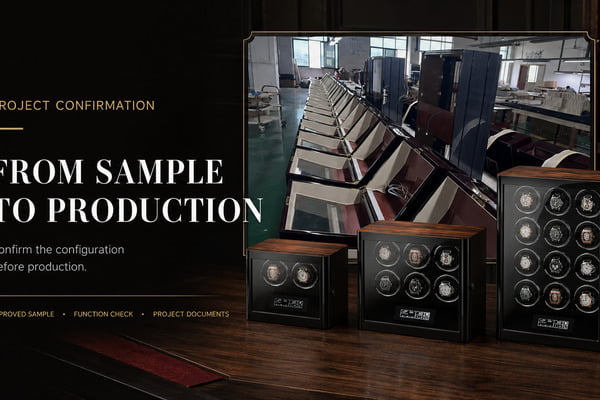
Quality review should also match the real manufacturing process. Ezicase checks product appearance and operation during production and assembly. Completed units undergo functional checks, while operating noise is assessed by listening during inspection rather than being presented as a laboratory acoustic test.
Ezicase watch winder units have CE certification. Other documents such as UL, FCC, PSE, GS or KC may relate to applicable materials or electronic components; buyers should confirm which documentation applies to the selected product and destination market.
If you are still defining capacities and operating features, the Watch Winder Buying Guide provides a broader product-selection framework. Buyers with a defined custom brief can also review Ezicase OEM/ODM customization support.
Frequently Asked Questions
Can I Order One Ready-Stock Watch Winder?
Selected Ezicase stock models can generally be ordered from one unit. The actual MOQ, available quantity and preparation time must be confirmed against the current inventory for the specific model.
Can I Add My Logo to a Ready-Stock Watch Winder?
Logo customization may be available, but the appropriate method depends mainly on the product's exterior material, surface finish, structure and available logo area. Silk printing, laser marking, metal badges and other methods are not suitable for every product, so feasibility should be confirmed by model.
What Is the MOQ for Custom Watch Winders?
Ezicase custom production generally starts from 50 units. The final MOQ depends on the selected model, material, construction, functions, packaging and extent of modification.
Are Ready-Stock and Custom Watch Winders Functionally Identical?
Not necessarily. A stock model has an existing confirmed configuration. A custom project may allow selected changes, but feasibility depends on the model and project requirements. Buyers should not assume that every stock product can accept every optional function.
Which Sourcing Route Is Right for Your Business?
Ready stock is usually the more practical route when speed, smaller trial quantities and market learning are the priorities. Custom production becomes more valuable when the buyer has a defined brand direction, configuration and repeat-order plan. A hybrid route can connect the two: test with available products, learn from the market, approve a physical sample and then move into a more differentiated production program.
The most important step is to define what the first order needs to accomplish. Tell Ezicase your target market, preferred models or capacities, required quantity, logo needs and target timing. We can then help you compare current stock options with a suitable custom development route.
