
Wooden and leather jewelry boxes can both support premium retail collections, private-label programs, and branded gift projects. However, they create different visual impressions and involve different surface treatments, production processes, and purchasing considerations.
Neither material is automatically better. Wooden jewelry boxes are often selected for their rigid appearance, lacquered or wood-grain finishes, and substantial presentation. Leather-covered jewelry boxes offer a softer accessory-inspired look, a wide range of colors and textures, and flexible branding options. The right choice depends on the intended product, brand identity, target price position, interior layout, order requirements, and expected use.
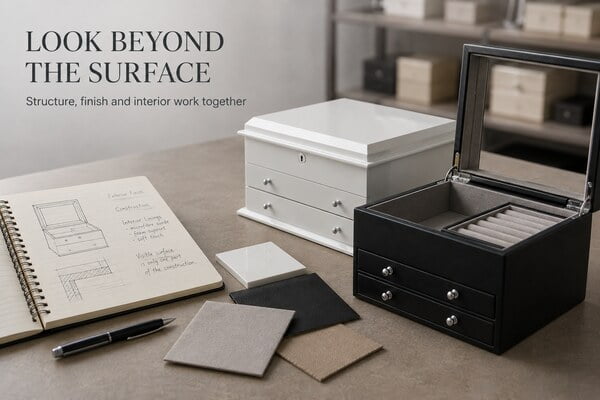
For buyers, the most important point is that these labels describe a product category, not the complete construction. A “wooden jewelry box” is not necessarily made from solid timber, and a “leather jewelry box” does not necessarily use genuine leather. The supporting structure, exterior finish, interior, hardware, and workmanship must be evaluated together.
For a broader overview of product types, materials, and layouts, begin with our jewelry box buying guide.
What Is the Real Difference Between Wooden and Leather Jewelry Boxes?
The most visible difference is the exterior presentation.
A wooden-style jewelry box usually presents a clean, structured form. Depending on the model, the exterior may use lacquer, a wood-grain effect, veneer, or another decorative finish over a rigid wood-based structure. This approach works well for tabletop organizers, multi-level cases, and products designed to create a substantial display presence.
A leather jewelry box normally uses leather, PU leather, microfiber leather, or another specified covering material over a supporting structure. The wrapped surface can create a softer and more tactile appearance, while stitching, edge treatment, embossing, and color become important design details.
In both categories, the internal frame may be rigid. Therefore, buyers should not assume that a leather-covered box is soft-sided or that every wooden box is solid wood. A useful comparison starts with five separate questions:
- What is the supporting structure?
- What is the exterior material or finish?
- How is the surface applied and finished?
- What interior layout and lining are required?
- Which details will communicate the intended brand position?
How Are Wooden Jewelry Boxes Constructed?
The term “wooden jewelry box” covers several construction and finishing approaches. Product descriptions should state the actual specification rather than using “wood” as a general quality claim.
MDF and Other Wood-Based Structures
Many jewelry organizers use MDF or another wood-based material to create a stable body, lid, drawers, trays, or internal partitions. MDF provides a consistent base for painting, lacquering, wrapping, or applying decorative surfaces. It also supports repeatable dimensions in production.
This construction should not be marketed as solid wood. For B2B sourcing, an accurate description such as high-gloss lacquered MDF or wood-grain-finished MDF is more useful because it tells the buyer both the structural material and the visible finish.
Lacquered and Wood-Grain Finishes
A lacquered surface can create a smooth, high-gloss, satin, or matte presentation, depending on the confirmed finishing process. Wood-grain effects can introduce visual warmth without implying that the complete box is made from the named timber species.
For example, a camphor-grain appearance describes the decorative look. Buyers should still confirm whether the surface uses printed wood-grain material, veneer, or another finishing method. Color, gloss level, grain direction, edge quality, and consistency between production batches should be reviewed during sampling.
Veneer and Other Surface Options
Wood veneer may be used on suitable structures when a project requires a natural wood surface. Because veneer, printed wood grain, and lacquered imitation effects are different material systems, they should not be grouped under one vague description.
The selected surface affects:
- Visual variation and grain character
- Color consistency between units
- Logo application options
- Edge and corner finishing
- Cleaning and handling requirements
- Cost and production feasibility
Brands comparing wooden jewelry cases should request a complete material specification instead of selecting from a photograph alone.
How Are Leather Jewelry Boxes Constructed?
Leather jewelry boxes also vary widely. The exterior may use genuine leather, PU leather, microfiber leather, or another suitable wrapped material. Each option has its own appearance, texture, availability, cost, and processing requirements.
PU Leather-Wrapped MDF
PU leather-wrapped MDF is a common construction for rigid jewelry organizers. The MDF body defines the shape and provides structural support, while the PU leather creates the visible color and texture.
This combination can support:
- Multiple exterior colors and grains
- Coordinated or contrasting stitching
- Wrapped lids, drawers, and internal sections
- Hot-stamped, debossed, or applied logo details where suitable
- Tabletop, multi-level, and selected portable formats
It should be described as PU leather-covered or PU leather-wrapped construction—not as genuine leather.
Microfiber and Genuine Leather Options
Microfiber leather and genuine leather may be considered for suitable projects, but availability and application must be confirmed. Genuine leather can contain natural surface variation, while engineered materials may offer different levels of consistency in color and texture.
Neither label alone proves how the finished box will perform. Buyers should examine the actual material sample, backing, thickness, grain, color tolerance, wrapping method, seams, corners, adhesive application, and edge treatment.
Why the Supporting Structure Still Matters
The exterior covering does not determine the complete strength of a leather jewelry box. A rigid wrapped box may use an MDF or other firm internal structure, while a compact travel case may use a different construction to reduce size or weight.
When comparing leather jewelry cases, review the internal frame together with the covering material. This prevents an inaccurate comparison between a rigid wooden organizer and a leather-covered product whose intended use is entirely different.
Wooden vs Leather Jewelry Boxes: Key Buying Differences
The following comparison is a starting point. The actual result depends on the confirmed design and specification.
| Buying Factor | Wooden or Lacquered Structure | Leather-Covered Structure |
|---|---|---|
| Visual direction | Structured, architectural, polished, or wood-grain presentation | Softer, tactile, accessory-inspired presentation |
| Common surfaces | Lacquer, wood-grain effect, veneer, or other confirmed finish | PU leather, microfiber leather, genuine leather, or other confirmed covering |
| Supporting body | Often MDF or another wood-based rigid structure | Often a rigid structure wrapped with the selected covering material |
| Brand details | Printing, plaques, metal badges, or other methods suited to the finish | Hot stamping, debossing, printing, plaques, or other methods suited to the surface |
| Color and texture | Controlled by paint, grain, veneer, and gloss specification | Controlled by covering color, grain, stitching, and edge treatment |
| Typical formats | Tabletop organizers, drawer boxes, display-focused cases | Tabletop organizers, multi-level cases, and selected portable designs |
| Main sampling focus | Surface flatness, gloss, grain consistency, edges, drawers, and hardware | Wrapping, seams, corners, stitching, edges, adhesion, and hardware |
Brand Appearance and Market Positioning
Wooden or lacquered boxes can suit brands seeking a formal, architectural, or display-led appearance. High-gloss surfaces and decorative wood grains can create strong shelf presence, while matte or restrained finishes can support a more contemporary direction.
Leather-covered boxes can suit fashion, lifestyle, gift, and accessory collections that benefit from a softer visual language. Color, texture, stitching, and tactile presentation can be coordinated with handbags, travel accessories, or other products in a brand range.
These are not fixed rules. A black high-gloss wooden box can appear highly modern, while a brown leather-covered box can support a traditional presentation. The correct decision depends on the whole design rather than the material name.
Surface Durability and Maintenance
It is not accurate to state that one category is always more durable.
A high-gloss lacquered surface may show fingerprints, dust, or fine marks more easily than a textured finish. A wood-grain or matte surface may respond differently to handling. Likewise, a leather or PU surface can react differently to friction, moisture, sharp objects, cleaning products, or prolonged pressure depending on its specification.
Before ordering, buyers should define the expected environment:
- Is the box intended for retail display, home storage, gifting, or travel?
- How frequently will it be handled?
- Will samples be transported between stores or exhibitions?
- Which cleaning method will be used?
- Which visible areas are most likely to contact other objects?
Relevant surface and assembled-product tests should be agreed according to the project rather than inferred from the category name.
Structure, Weight, and Shipping Considerations
Weight depends on size, wall thickness, drawers, mirrors, windows, hardware, inserts, and supporting materials. A large leather-wrapped MDF organizer may weigh more than a small lacquered box, so “leather is lighter” is not a reliable purchasing rule.
Buyers should compare the finished product dimensions and gross packed weight. Protective packaging must also be considered: a delicate high-gloss surface may require additional separation and protection, while corners, handles, mirrors, and drawer fronts can influence the packaging design for either category.
The protective method should be confirmed against the actual product structure and finish. Our guide to export packaging for jewelry cases explains how the non-woven bag, EPE end protectors, individual carton and master carton work together.
Interior Layout Flexibility
Both wooden and leather-covered boxes can support ring rolls, earring areas, necklace hooks, open compartments, removable trays, mirrors, and drawers when the structure allows.
The exterior material should therefore be selected together with the interior—not before it. A visually suitable box can still fail if necklaces tangle, ring settings touch the lid, trays are difficult to lift, or drawers do not provide enough usable depth.
Once the exterior direction is selected, use our jewelry box compartment sizing guide to plan usable dimensions, clearance, access, and movement around the intended jewelry collection.
Logo and Branding Options
Logo suitability depends on the selected surface, artwork, size, position, quantity, and required finish.
For lacquered or wood-grain surfaces, possible approaches may include suitable printing, a metal plate, or a custom badge. For compatible leather or PU surfaces, options may include hot stamping, debossing, embossing, or applied brand elements. Every method should be sampled on the actual material because fine artwork, metallic color, grain depth, and surface curvature can affect the result.
Branding should also be coordinated with interior labels, lining color, hardware finish, gift packaging, and shipping protection. A logo is only one part of a consistent private-label presentation.
MOQ, Sampling, and Production Feasibility
MOQ should not be predicted from “wooden” or “leather” alone. It may depend on the existing model, material availability, custom color, hardware, logo method, structural changes, packaging, and production process.
Sampling should confirm:
- Exterior material and color
- Surface finish, grain, gloss, or texture
- Seams, edges, corners, and alignment
- Lid, hinge, lock, drawer, and tray movement
- Interior dimensions and jewelry fit
- Logo appearance and position
- Gift box and protective packaging
Ezicase custom jewelry box development can begin from an existing structure or a more extensively tailored concept, subject to project requirements and feasibility review.
When Should a Brand Choose a Wooden Jewelry Box?
A wooden, lacquered, or wood-grain jewelry box may be suitable when the project requires:
- A rigid, display-focused tabletop presentation
- High-gloss, matte, wood-grain, or veneer visual effects
- A substantial multi-level structure with trays or drawers
- A product aligned with formal, architectural, or furniture-inspired styling
- A surface designed around suitable printed or applied branding details
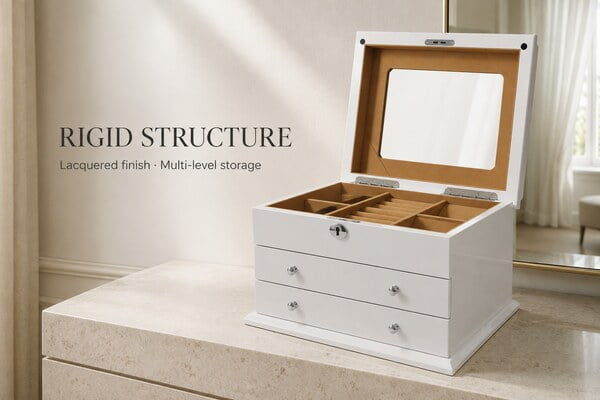
For example, this High Glossy White Jewelry Collection Box with Drawers and Mirror demonstrates how a lacquered MDF body can combine necklace storage, divided organization, and multi-level access. It should be evaluated as a complete structure rather than simply as a “wood box.”
When Should a Brand Choose a Leather Jewelry Box?
A leather or PU leather-covered jewelry box may be suitable when the project requires:
- A softer, tactile, or accessory-inspired exterior
- A broad choice of colors and surface grains
- Stitching, edge details, hot stamping, or debossing where applicable
- A coordinated collection with fashion, travel, gifting, or lifestyle products
- A rigid organizer with a wrapped appearance rather than an exposed lacquered finish
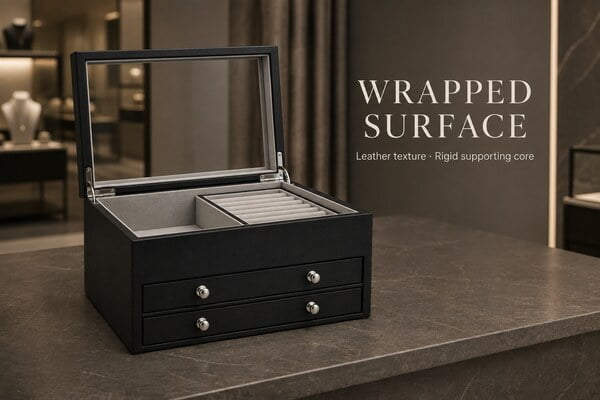
The black PU leather jewelry collection box with drawers and mirror (model GC02-JB-03BG-T) demonstrates how a rigid PU leather-wrapped MDF structure can combine a grey velvet-lined interior with ring rolls, divided storage, pull-out drawers, an integrated mirror, and silver hardware. Its exterior covering and supporting structure should both be included in the product specification; describing it only as a leather box would omit important construction details.
What Should Buyers Check Before Confirming the Material?
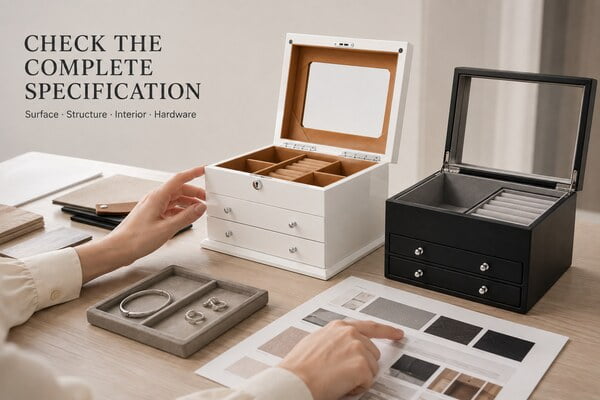
Do not approve a project using only a material name or digital color reference. Ask the supplier to identify each layer and visible component.
A useful confirmation list includes:
- Supporting body material
- Exterior surface or covering material
- Finish, grain, texture, and color reference
- Interior lining and insert materials
- Stitching or edge treatment, if applicable
- Hardware material, color, and operation
- Mirror or display-window specification
- Drawer, tray, and compartment dimensions
- Logo method and approved artwork
- Gift packaging and shipping protection
The physical sample should be tested with representative jewelry. Open and close the lid, remove trays, operate drawers, place necklaces on hooks, fit raised rings into rolls, and confirm that earrings and bracelets can be removed without difficulty.
Can Wooden and Leather Elements Be Combined?
Yes, where the structure and production process support the combination. A project may use a lacquered or wood-grain exterior with leather or PU details, or a leather-wrapped body with a contrasting wood-effect panel, metal badge, or lacquered component.
Combining materials can create stronger differentiation, but it also introduces more interfaces to control. The sample should confirm:
- Alignment between materials
- Clean transitions and edges
- Color coordination
- Adhesion and surface compatibility
- Hardware and logo placement
- Repeatability in production
Material combinations should serve a clear design purpose. Adding multiple finishes without a hierarchy can make a jewelry box look unnecessarily complex and increase production risk.
Frequently Asked Questions
Are wooden jewelry boxes always made from solid wood?
No. Many products use MDF or another wood-based structure with lacquer, wood-grain material, veneer, or another decorative finish. Buyers should request the exact structural and surface specification.
Are leather jewelry boxes always made from genuine leather?
No. They may use PU leather, microfiber leather, genuine leather, or another confirmed covering material. The product description should identify the actual material rather than using “leather” as a general term.
Which type provides better protection for jewelry?
Protection depends on the complete structure, closure, lining, inserts, clearances, and intended use. A rigid leather-wrapped MDF box may provide a similar structural format to a lacquered MDF box. Jewelry fit and internal movement should be tested in the physical sample.
Can both types include drawers, trays, and necklace hooks?
Yes, both categories can support these features when the selected structure allows. The compartment design should be planned around the intended jewelry rather than determined by the exterior material.
Which material is better for a private-label collection?
The better choice is the one that matches the brand identity, target market, product format, price position, use environment, and customization scope. Buyers should compare physical samples and complete specifications before deciding.
Can wooden and leather jewelry boxes use custom logos?
Yes. Possible methods vary by surface and may include suitable printing, hot stamping, debossing, embossing, metal plates, or badges. The selected method must be tested against the actual material, artwork, and product shape.
Final Recommendation
The decision between wooden vs leather jewelry boxes should not be reduced to which material appears more luxurious. Both can support premium branded collections when the structure, surface, interior, hardware, and manufacturing quality are properly coordinated.
Choose a wooden, lacquered, or wood-grain structure when its rigid visual language and finish suit the collection. Choose a leather or PU leather-covered structure when color, texture, stitching, and a softer accessory-inspired appearance better support the brand. If neither standard direction fully meets the brief, consider a carefully controlled combination of materials.
Before placing an order, confirm the complete material specification, test the intended jewelry inside the sample, review daily access and movement, and evaluate packaging for the finished product. This process provides a more reliable basis for B2B purchasing than selecting from surface appearance alone.
Explore Ezicase jewelry case solutions or discuss an OEM/ODM project through our customization service.
