
When a jewelry brand, retailer or e-commerce seller plans a branded jewelry box collection, the first question is often simple: “Can you add our logo to this box?”
Logo application matters, but a successful private label jewelry box project involves much more. Buyers also need to define the intended jewelry, box structure, exterior and interior materials, compartment layout, hardware, packaging and approval requirements. These decisions affect whether the manufacturer can evaluate feasibility, quote accurately and prepare a representative sample.
This guide focuses on reusable jewelry storage boxes, organizers and cases. It does not focus on disposable paper ring boxes, small cardboard gift boxes or mailing packaging.
What Is a Private Label Jewelry Storage Box?
A private label jewelry storage box is a reusable product manufactured for sale under the buyer’s brand. It may be based on an existing factory structure or developed with a greater degree of customization.
In practice, private-label projects can follow several routes:
- Select an existing structure and customize the logo, colors, lining or packaging.
- Modify an existing structure, such as changing the compartment layout, hardware or dimensions.
- Develop a more extensively customized structure for a specific jewelry collection or brand concept.
Private label and completely original product development are therefore not the same. Starting from an existing structure may reduce development work, while deeper customization requires more sampling, specification control and production preparation.
Buyers can review Ezicase’s customization options to understand the types of product and branding decisions that may be discussed during development.
Should You Start With an Existing Structure or Develop a New Design?
The most suitable route depends on the intended function, order quantity, budget, launch schedule and degree of differentiation required.
Existing structure with brand customization
An existing structure can be a practical starting point when its size, opening method and storage arrangement already suit the intended collection. Depending on the project, the buyer may change the exterior color or material, lining, hardware finish, logo and packaging without redesigning the complete box.
This route still requires a sample. The selected materials, colors and branding method must be reviewed on the physical product rather than assumed from photographs.
Modified existing structure
A proven structure may need changes when the buyer’s jewelry does not fit the original layout. Examples include adjusting ring-roll space, changing the number of dividers, adding a removable tray or revising a drawer arrangement.
Even apparently small changes can affect usable depth, clearance and assembly. The manufacturer should evaluate the complete structure before confirming feasibility.
More extensively customized design
A new product direction may be appropriate when the required dimensions, opening method, interior arrangement or visual concept cannot be achieved with an existing model. Additional sampling, material preparation or project-specific tooling may be required depending on the design.
The jewelry box buying guide provides a broader introduction to common structures, materials and interior layouts.
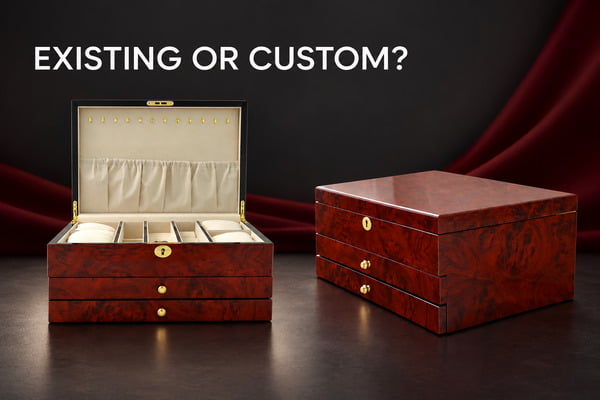
The product shown in this comparison is Ezicase’s high-gloss camphor jewelry box with 2 drawers. Its open and closed views help buyers evaluate the relationship between the exterior form, upper storage area and lower drawers before deciding whether an existing structure suits the project.
What Jewelry and Customer Use Case Will the Box Serve?
Before selecting a box, identify what the end user will store and how the product will be used. A large home organizer, compact travel case and presentation-oriented storage box require different proportions and internal arrangements.
Consider the following jewelry groups:
- Rings: Ring rolls need to suit the intended ring sizes and raised settings without excessive looseness or pressure.
- Earrings: Small pieces need accessible compartments that reduce unnecessary movement and make pairs easy to organize.
- Necklaces: The layout may use hooks, pockets, dividers or separate sections according to chain length and the intended storage method.
- Bracelets and bangles: Wider jewelry requires enough width, depth and access space.
- Watches: Watch sections need suitable cushions and compartment clearance for the intended watch sizes.
- Mixed collections: The interior must balance several types of jewelry without allowing one category to make the others difficult to access.
There is no universal compartment size that works for every brand. Buyers should provide representative jewelry, accurate dimensions or clear reference information and validate the proposed layout with a physical sample. Our jewelry box compartment sizing guide explains this process in more detail.
Which Exterior Structure and Materials Should Be Confirmed?
The exterior affects appearance, handling, manufacturing method and cost. Buyers should confirm the structural base and surface treatment separately rather than using “wooden jewelry box” as a general description for every rigid product.
MDF-based lacquered structures
MDF can provide a stable base for painted jewelry boxes with gloss or matte finishes. These products should be described as MDF-based or engineered-wood structures, not automatically as solid wood.
Woodgrain appearance also needs accurate wording. A veneer, printed grain or lacquered woodgrain effect should not be presented as a particular solid wood species unless that material has been confirmed.
PU leather-covered structures
PU leather is available in different colors, textures and surface effects. During sampling, buyers should review wrapping, seams, corners, joint positions and the way the selected color works with the lining and hardware.
Genuine leather for specific projects
Genuine leather can be sourced according to the requirements of a specific project. It should not be treated as a standard stocked material for every private-label order. Leather type, surface, color, availability and order requirements need to be evaluated before quotation.
The comparison between wooden and leather jewelry boxes can help buyers decide which construction direction better suits their collection.
Hardware and visible details
Confirm the required hinges, locks, handles, drawer pulls, feet and decorative fittings. Hardware color should be reviewed with the exterior and logo rather than selected independently. Samples should also be checked for alignment, smooth operation and contact between moving parts.
How Should the Interior Layout Be Defined?
The interior should be planned around the actual jewelry, not around an empty compartment drawing. Ring rolls, necklace sections, drawers, removable trays, dividers, cushions, mirrors and pockets all affect usable space.
Important points include:
- vertical clearance between trays, drawers and the closed lid;
- access to jewelry placed near corners or under another layer;
- stability of removable trays and dividers;
- drawer movement and front alignment;
- possible contact between jewelry and adjacent components;
- ease of removing cushions or small pieces;
- the relationship between lining color, jewelry color and presentation.
Interior material names should also be accurate. Velvet, microfiber, faux suede and other fabrics are not interchangeable descriptions. The selected material should be confirmed for the project. See the jewelry box lining material guide for a closer comparison.
Examples of different reusable storage formats can be found in the Ezicase jewelry case collection.
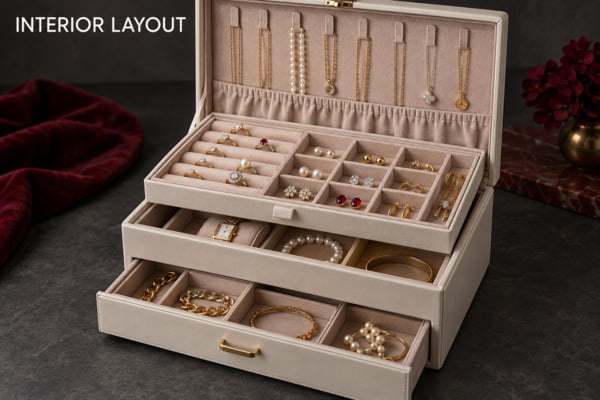
A multi-layer layout may combine necklace storage in the lid, ring rolls, divided earring sections, removable trays and drawers for larger pieces. Buyers should evaluate the complete open structure, access to each layer and the relationship between compartments rather than judging capacity from the closed exterior alone.
Which Branding Methods Can Be Used?
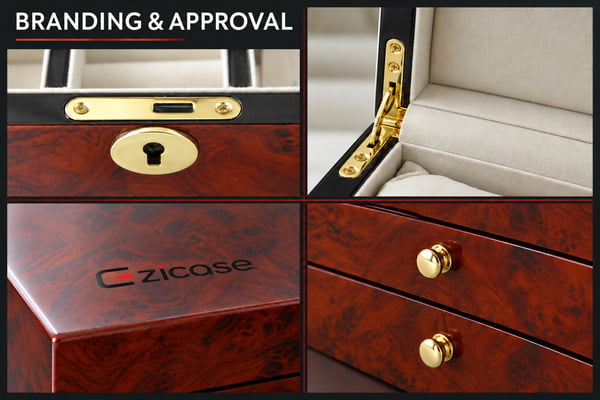
Branding should be evaluated on the actual surface. Ezicase can support methods including hot stamping, laser engraving and silk screen printing. Metal logo nameplates can also be customized, although they generally involve quantity requirements.
The appropriate method depends on the exterior material, surface texture, logo artwork, line thickness, size, position and intended visual effect. A method that produces a clear result on a smooth surface may behave differently on deeply textured PU leather or another uneven material.
During sampling, confirm:
- logo artwork and orientation;
- position and dimensions;
- color or metal finish;
- contrast against the surface;
- edge definition and legibility;
- consistency between product and packaging branding.
Do not approve the logo only from a digital rendering. Review its appearance on the physical sample whenever possible.
What Should Be Confirmed During Sample Approval?
The sample is the point where the brand’s written requirements become a physical product. Buyers should check the complete box rather than approving isolated materials or photographs.
A practical sample review should cover:
- overall dimensions and proportions;
- exterior material, finish and color;
- lining material and interior color;
- compartment arrangement and usable space;
- lid, drawer and removable-tray operation;
- hardware placement and finish;
- logo method, size and position;
- individual and transport packaging;
- all requested revisions and the final approved version.
Testing the sample with representative jewelry is particularly important. It can reveal access, clearance and fit issues that are difficult to judge from drawings or measurements alone.
Once the approved version is confirmed, a physical sample is normally retained at the factory as a production reference. Its identification and retention should still be confirmed for the specific project. Engineering drawings are not a universal deliverable for every Ezicase project.
For a more detailed procedure, see how to review a custom jewelry box sample before mass production.
How Do Quantity and Customization Affect the Project?
MOQ, sample cost, unit price and production schedule depend on the selected product and customization scope. They should be confirmed after the main specifications are defined.
Factors that may affect the commercial proposal include:
- whether the project uses an existing or modified structure;
- exterior and lining material availability;
- structural changes and sampling requirements;
- hardware and logo method;
- packaging scope;
- order quantity and color allocation;
- number of sample revisions;
- inspection and documentation requirements.
An existing model does not automatically guarantee a particular MOQ or delivery time. Similarly, a custom project does not always require the same tooling or development route. Each proposal should be evaluated according to its actual requirements.
What Packaging Should Be Confirmed?
Packaging should be reviewed with the actual jewelry box because product dimensions, surface finish, weight and opening structure affect the protection required.
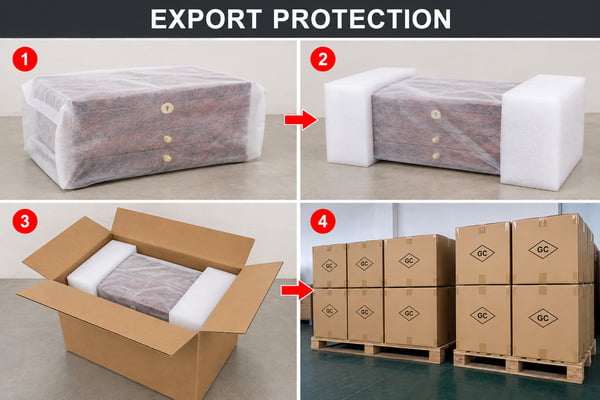
For Ezicase premium products, a standard protective packing method can include:
- A spunlace nonwoven bag around the product to reduce surface rubbing and snagging.
- EPE protective end caps on both ends for cushioning.
- An individual kraft carton.
- A master shipping carton for bulk transport.
For leather-covered products, a nonwoven protective bag is commonly used. A branded gift box or another project-specific packaging layer can be developed when required.
Packaging appearance alone does not prove transport performance. Any project-specific drop test or other packaging test should be agreed according to the product and shipping requirements. For more detail, see the jewelry box shipping packaging guide.
What Quality Requirements Should Be Agreed Before Shipment?
Quality requirements should be discussed before production so that the buyer and manufacturer are working from the same reference.
Relevant checks may cover:
- exterior finish, wrapping, seams, edges and corners;
- interior lining, dividers, ring rolls and removable parts;
- lid, drawer, hinge, lock and handle operation;
- dimensions and compartment layout;
- logo position, clarity and finish;
- individual packaging and master-carton condition.
Ezicase can conduct final full inspection, and pre-shipment sampling inspection can be arranged according to the project. AQL levels such as 0/2.5/4.0 may be used when agreed. A formal inspection report can be provided when requested, but its format and required records should be confirmed for the specific order.
The jewelry box quality control checklist provides a structured review of materials, workmanship, function, branding and packaging.
What Information Should Buyers Include in an RFQ?
A useful request for quotation should give the manufacturer enough information to understand both the product and the expected project scope.
Include:
- product type and intended use;
- target jewelry assortment;
- approximate external dimensions;
- required quantity and number of colors;
- preferred existing model or requested structural changes;
- exterior material and finish;
- lining material and color direction;
- compartment, drawer and tray requirements;
- hardware and closure preferences;
- logo artwork and preferred branding method;
- standard protective or gift-box packaging requirements;
- target market and requested timing;
- inspection, testing or documentation requirements.
If important details are missing, the supplier may only be able to provide a preliminary estimate. A final quotation normally requires a clearer specification or an agreed sample direction.
Frequently Asked Questions
Can a brand add its logo to an existing jewelry box design?
Yes, subject to the selected product, surface material, logo method and quantity. An existing structure may also allow changes to color, lining, hardware or packaging, depending on the project.
Is private label the same as a completely custom jewelry box?
No. Private labeling may use an existing product with branding and material changes. A more extensively customized project can include revised dimensions, structure, compartment layout or hardware.
What is the MOQ for private label jewelry boxes?
There is no single MOQ for every jewelry box. It depends on the model, materials, colors, branding method, packaging and degree of structural modification. Buyers should confirm MOQ after defining the project scope.
Can buyers customize both the product and its packaging?
Yes. Product branding and packaging can be discussed as part of the same project. The standard protective packing method and any branded gift packaging should be specified separately.
Should the box be tested with actual jewelry before production?
Yes. Representative jewelry helps confirm compartment fit, access, clearance and the way items are held. This is more reliable than approving the layout from an empty sample alone.
Plan Your Private Label Jewelry Box Project
A successful private label jewelry box project begins with a clear use case and a complete specification. Confirm the intended jewelry, structure, materials, interior layout, branding, packaging and quality requirements before bulk production. Before shortlisting suppliers, review our guide to choosing a jewelry box manufacturer for practical checks on product experience, materials, sampling, quality control and packaging. To discuss a project with Ezicase, send the target product type, approximate dimensions, quantity, material preferences, compartment requirements, logo artwork and packaging scope. Our team can then evaluate a suitable existing structure or a more customized development route.
