
Choosing a custom watch box manufacturer can feel complex, as differences in materials, construction, communication, and production planning can affect both product quality and delivery. Many businesses need a partner who understands the balance between aesthetic appeal, practical protection, and efficient production. A mismatch between the project requirements and a supplier's capabilities can lead to rework, delays, or inconsistent results.
Choosing the right custom watch box manufacturer involves evaluating their material experience, structural development capabilities, quality control procedures, and transparency throughout the custom manufacturing process. A suitable manufacturer should help translate your requirements into a manufacturable product while balancing appearance, protection, cost, and expected use.
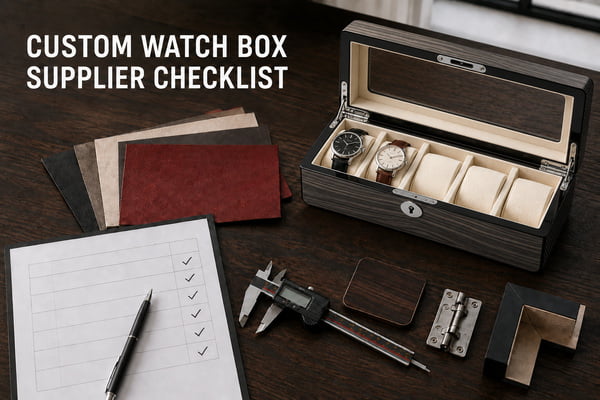
This decision involves more than comparing quotations; it can affect product presentation, consistency, and the protection provided during normal storage and handling. Let's explore the practical factors that can help you assess whether a supplier is suitable for your project.
How Do Material Choices Impact a Custom Watch Box?
Have you ever considered that the selection of materials for a custom watch box goes far beyond just its appearance? Many brands mistakenly focus solely on aesthetics, overlooking how material choices fundamentally dictate durability, tactile experience, and the long-term value of the watch box itself. This oversight can lead to products that look good initially but fail to perform over time, undermining your brand's reputation for quality.
Material choices affect a custom watch box's structural performance, appearance, tactile experience, cost, and suitability for its intended use. Solid wood, MDF-based structures, veneers, leather, PU leather, microfiber leather, fabrics, and different finishes each involve distinct trade-offs. The most suitable combination depends on the design, budget, order quantity, target market, and performance requirements.
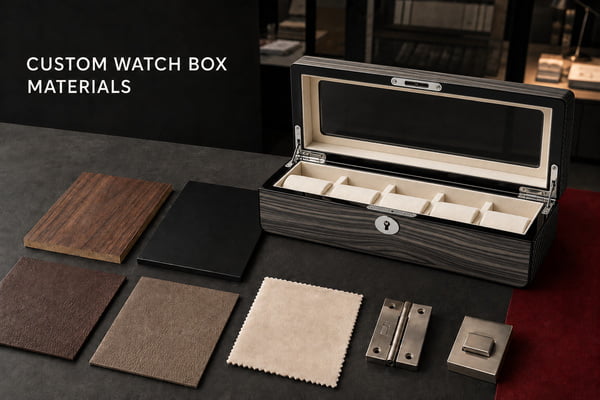
Beyond Surface Aesthetics – The Science of Materials and Craftsmanship
From my experience coordinating custom projects with clients and our factory teams, material selection is a foundational part of any luxury storage solution. It is not only about appearance; the manufacturer should understand how the selected substrate, surface material, lining, adhesive, and hardware work together in the finished product. When evaluating a custom watch box manufacturer, ask how its material recommendations relate to your intended design, use, and price range. Reviewing a manufacturer's existing custom watch box options can also help you understand the structures and finishes it already produces.
Consider solid wood, one possible choice for luxury watch boxes. Different wood species can have distinct characteristics, although performance also depends on drying, construction, finishing, and storage conditions:
- Walnut: Often selected for its rich, dark grain and refined appearance.
- Maple: A lighter-colored hardwood with a fine, relatively even grain that can suit smooth finishes.
- Cherry: Known for its warm reddish-brown tone, which may deepen over time with exposure to light.
Beyond the substrate itself, finishing techniques are important. A high-gloss lacquer, for instance, may involve multiple application, curing, sanding, and polishing stages. The finish can improve appearance and provide a surface layer, but its resistance to scratching, moisture, and light depends on the coating system, application quality, and conditions of use. At Goochy, finishing and polishing are controlled production stages, and the required process is selected according to the product specification.
Leather wrapping is another area where material quality and workmanship are visible. Genuine leather, PU leather, and microfiber leather offer different appearances, tactile qualities, consistency, maintenance requirements, and price points; genuine leather is not automatically the best choice for every project. The material must be cut, positioned, and adhered carefully to control wrinkles, bubbles, and uneven seams. Ask the manufacturer to identify the exact material grade and provide a relevant sample rather than relying only on a broad label such as "leather."
Metal fittings – hinges, locks, and clasps – are functional components that also influence the box's appearance. The hardware material, plating, dimensions, and installation method should suit the lid weight and intended frequency of use. Relevant samples or agreed test criteria can help buyers assess operation, finish consistency, and durability without relying on appearance alone.
- Material Selection Checklist for Manufacturers:
- Wood Species: Are they using solid wood or MDF? What is the quality and sourcing of their wood?
- Finishes: What types of finishes do they offer (lacquer, veneer, painting)? What is their process for application and curing?
- Leather/Fabric: Do they use genuine leather or high-quality synthetic alternatives? How is it applied?
- Hardware: What metal alloys and finishes are used for hinges, locks, and clasps? Are they durable?
- Lining Material: What materials are used for the interior lining (e.g., velvet or microfiber)? Is the surface suitable for contact with the watches, and can the supplier provide the relevant material information when required?
Ultimately, material knowledge and consistent workmanship both influence the quality of a custom watch box. The objective is to create a product that presents the watch well and provides appropriate protection for its intended use. A reliable custom watch box manufacturer should be able to explain its recommendations and confirm important details through specifications and samples.
Why is Structural Integrity Critical for a Custom Watch Box Manufacturer?
Have you ever considered that a beautifully designed watch box might still fail to protect your valuable timepieces if its underlying structure is weak? Many businesses, driven by visual appeal, might overlook the critical importance of a manufacturer's structural engineering capabilities. This oversight can lead to boxes that warp, break, or simply do not adequately safeguard the delicate mechanisms of a luxury watch, transforming an investment into a liability.
Structural integrity is important because it influences a watch box's durability, alignment, closure performance, and ability to protect its contents during normal use and handling. The structure should be developed around the box size, lid weight, interior layout, hardware, materials, and expected use. Magnetic protection should not be assumed unless it is specifically designed, tested, and documented for the relevant product.
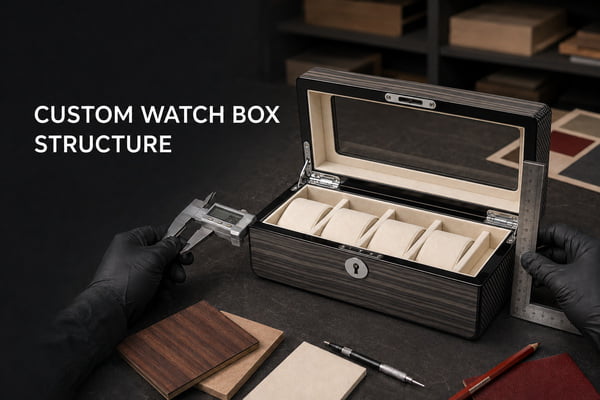
Structural Integrity and Production Feasibility are Paramount
When we talk about a custom watch box manufacturer, we are not discussing aesthetics alone. From my experience coordinating customer requirements with Goochy's product development, sampling, production, and quality teams, a design concept must also be structurally practical and suitable for repeat production. This is where prototype review and manufacturing experience become especially valuable.
A watch box designed for valuable timepieces should provide suitable support, separation, and surface protection for its intended use. This may involve:
- Cushioning and Movement Control: Internal cushions, compartment dimensions, lining materials, and the outer structure should work together to limit unnecessary movement during normal handling. If transport protection is required, it should be addressed through the product and packaging specification and verified using agreed test methods.
- Magnetic Considerations: Mechanical watches can be affected by sufficiently strong magnetic fields, but a conventional watch box should not be described as anti-magnetic without supporting design and test evidence. For selected watch winder configurations, motor placement, shielding measures, and relevant test information should be reviewed for the specific model.
- Ergonomic Design: Beyond protection, the box must be easy to use. This means hinges that open smoothly and hold the lid securely, closures that are robust yet simple to operate, and interiors that allow for easy placement and retrieval of watches. Small misalignments in production, such as slightly off-center hinge placement, can lead to uneven lid closing, causing stress on the wood and eventually damaging the box or even the watch if it's caught.
Consider the complexity of integrating a watch winder mechanism into a box. This may involve motor placement, wiring channels, power components, controls, and a display window. Each element must fit the approved structure and specification. Dimensional or assembly inconsistencies can lead to:
- Noise or Vibration Issues: Incorrect motor mounting can increase operating noise or vibration and affect the user's experience.
- Power Problems: Wiring or power-component issues can compromise the winder's functionality and should be checked against the approved configuration.
- Aesthetic Flaws: Gaps around display windows or misaligned components diminish the luxury appeal.
Production feasibility is another important aspect. A visually attractive design may still require adjustment if it cannot be produced consistently at the target quantity or budget. Our product development and engineering staff review projects for manufacturability and may recommend practical changes to materials, structure, dimensions, or processes. This often involves:
- Joint Strength: How are the substrate panels joined or reinforced, and is the selected construction suitable for the box size and load?
- Panel Thickness: Is the selected thickness appropriate for the dimensions, hardware, finish, and expected conditions of use?
- Internal Support Structures: Sometimes, internal bracing or dividers are necessary to distribute weight and stress evenly.
During prototype review, our teams examine more than the finish. Depending on the project, the review may cover dimensions, alignment, lid and closure operation, cushion fit, compartment layout, hardware installation, and overall rigidity. Identifying issues before mass production helps reduce avoidable inconsistencies in the finished batch. You can learn more about Ezicase's customization process and available options, while the final checks should always be confirmed for the specific project.
What Role Does Quality Control Play in Custom Watch Box Production?
Are you confident that your chosen manufacturer's quality control extends beyond a quick visual check at the end of the production line? Inadequate inspection or unclear acceptance criteria can contribute to inconsistent products, avoidable rework, returns, and delivery disputes. This is especially relevant for presentation products, where visible details and functional consistency matter to the buyer's brand.
Quality control helps a manufacturer monitor whether materials, dimensions, finishes, assembly, functions, and packaging conform to the approved requirements. Appropriate checkpoints can identify issues earlier and improve consistency, but the inspection plan, sampling level, test methods, and acceptance criteria should be agreed for the specific product and order.
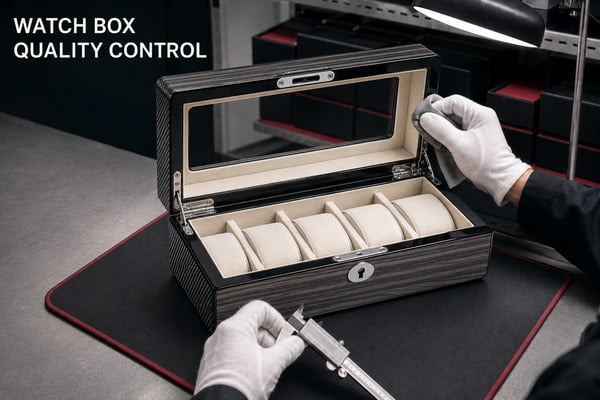
The Hidden Value of Robust Quality Control Systems
From my perspective in sales and project coordination, quality control should not be limited to a final visual check. It needs to connect the approved sample and specifications with the relevant production stages. At Goochy, quality checks are incorporated into production according to the product and project requirements. Compliance documents must be assessed carefully: CE, UL, FCC, PSE, or other reports may apply to a complete electrical product, an adapter, a motor, another component, or a particular market configuration. They should never be assumed to cover every watch box or every model.
Quality control can begin before assembly, at the incoming-material stage. The scope of inspection depends on the material, supplier, product risk, and agreed requirements.
- Material Inspection:
- Wood or MDF-Based Components: Checks may include dimensions, surface condition, moisture-related requirements where relevant, and consistency with the approved specification.
- Leather or Wrapping Materials: Checks may include thickness, color, texture, and visible surface condition against the approved sample.
- Hardware: Checks may include finish quality, dimensions, fit, and operation.
- Adhesives and Finishes: Specifications, storage conditions, and process parameters should be controlled where they affect adhesion or curing.
After incoming materials are accepted, appropriate QC checkpoints can be incorporated into relevant production stages:
- Mid-Production Checks (In-Process Quality Control):
- Cutting and Shaping: After wood is cut, we verify dimensions, angles, and precision of cuts. Any deviation here will cascade into problems during assembly.
- Sanding and Polishing: Surface smoothness is checked before finishing. Imperfections left at this stage will be magnified by lacquer or paint.
- Finishing Application: During painting or lacquering, we monitor dust particles, evenness of coats, and curing times. Each layer undergoes inspection.
- Leather Wrapping: The tautness of the leather, precision of corners, and absence of bubbles or wrinkles are inspected immediately after application.
- Assembly: Alignment of components, tightness of screws, smooth operation of hinges and locks, and secure internal fittings are all verified. For watch winders, motor functionality and noise levels are tested.
One common challenge in high-gloss lacquer production is controlling dust, surface preparation, coating consistency, curing, sanding, and polishing. A visible particle or surface defect may require rework. In-process inspection helps identify such issues before final assembly, although the acceptable finish standard should be established through the approved sample and inspection criteria.
- Final Quality Assurance (FQA):
- Visual Inspection: Comprehensive check for any surface blemishes, scratches, dents, or inconsistencies in color and finish.
- Functional Testing: For watch winders, checks may cover the specified rotation program, direction, controls, lighting, locks, sensors, power supply, or noise criteria, depending on the model. For non-powered boxes, relevant hinges, locks, and clasps can be checked for operation.
- Structural Check: The agreed inspection may cover joints, alignment, rigidity, and moving components.
- Packaging Inspection: The packaging configuration and its application should match the approved requirements. Transport testing should only be claimed when a defined method and result are available.
At Goochy, the applicable inspection and test items are determined by the product configuration and project requirements. Buyers should ask which checks are routine, which require special arrangements, what sampling plan will be used, and what records can be provided. This is more reliable than assuming that every product undergoes the same aging, transport, electrical, or durability tests. More information about the company and its manufacturing background is available on the About Goochy and Ezicase page.
What Should You Expect in the Custom Watch Box Manufacturing Journey?
Are you entering the custom manufacturing process with unrealistic expectations about timelines or potential complexities? Many businesses anticipate a swift, straightforward journey, only to be met with unforeseen delays or technical challenges, leading to frustration and project setbacks. This often stems from a lack of transparency or experience on the manufacturer's part, creating avoidable misunderstandings about the custom production cycle.
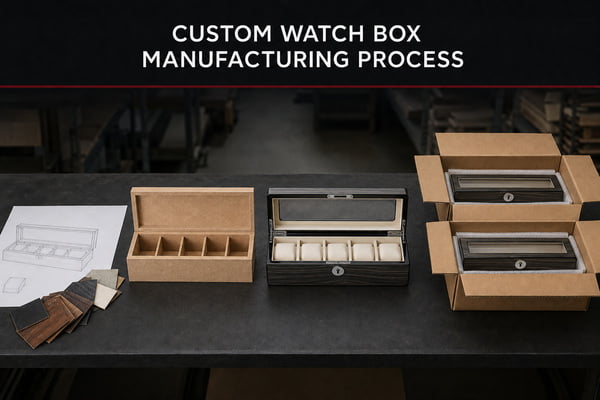
The custom watch box manufacturing journey usually includes requirement review, specification development, sampling, sample approval, material preparation, production, inspection, packaging, and delivery. The exact stages and timeline depend on the design, materials, functions, quantity, revision rounds, and required tests. A reliable manufacturer should explain these variables and document the approved requirements before production.
Setting Realistic Expectations for the Custom Journey
Embarking on a custom manufacturing project, especially for a detailed product such as a luxury watch box, involves several coordinated decisions. From my experience as a sales manager working with clients and Goochy's factory teams, setting realistic expectations from the outset is important. Understanding the typical stages and variables can help you plan more effectively with your chosen custom watch box manufacturer.
Here’s a breakdown of what you should expect:
-
Concept Development and Design Refinement (Timing Depends on Project Readiness):
- This stage begins with your initial ideas, sketches, reference images, target dimensions, or an existing product. Depending on the project, these inputs may be developed into drawings, specifications, material selections, or renderings for confirmation.
- Complexity: This often involves iterative discussions. You might envision a specific finish, but our engineers might suggest an alternative material or structural tweak for better durability or cost-effectiveness. For instance, a very intricate carving might require specialized CNC milling which adds to cost and lead time, and we would advise on simpler but equally elegant alternatives if needed.
- Communication: Frequent communication is useful here. Important details, from hinge type to interior lining color, should be recorded so that both parties share the same production reference.
-
Prototyping/Sampling (Timing Depends on Complexity and Materials):
- A physical sample is produced based on the confirmed requirements. It may be a complete functional sample or a partial sample used to confirm a particular material, finish, structure, or process. Any substitutions or differences from the intended production version should be documented.
- Challenges: A sample can require materials, hardware, tooling, and several manual processes before a production line is established. The review should focus on the agreed requirements, including:
- Fit and Finish: Does the lacquer or wrapping match the approved appearance and acceptance standard?
- Functionality: Do the hinges, winder mechanism, controls, and lock operate according to the agreed specification?
- Structural Integrity: Does the box feel solid? Will it hold up to repeated use?
- Revisions: One or more revision rounds may be required. You might decide that the internal compartments need to be deeper or that a closure needs adjustment. Each revision can affect timing and cost, so the approved sample and final specifications should be recorded before mass production. Sample lead time should be quoted for the specific project rather than treated as a fixed 15-20-day commitment.
-
Tooling and Material Procurement (Timing Varies):
- Once the sample is approved, we begin preparing for mass production. This involves ordering bulk materials, which can have their own lead times, especially for specialized wood veneers or custom-dyed leathers.
- Tooling: If custom molds or specialized cutting dies are required (less common for standard watch boxes but possible for very unique designs), this process also takes time.
-
Mass Production (Timing Depends on Quantity and Complexity):
- During production, materials are processed, components are assembled, and the watch boxes move through the applicable woodworking, wrapping, finishing, polishing, and assembly stages.
- Capacity: Goochy operates a 3,000-square-meter facility. Eligible custom projects may start from 50 units, but the actual MOQ depends on the materials, structure, hardware, functions, packaging, and process requirements. Our broader product categories illustrate the range of storage and presentation products we produce.
- QC Integration: As mentioned earlier, quality checkpoints are applied at relevant production stages according to the product and agreed requirements.
- Transparency: We keep clients informed of production progress, highlighting milestones and addressing any unforeseen issues promptly.
-
Final Quality Inspection and Packaging (Timing Depends on the Inspection Plan):
- Finished products are inspected according to the agreed inspection scope and sampling plan. Critical functions or requirements may call for different checks from general appearance items.
- Packaging is applied according to the approved configuration. If specific transport performance is required, the test method and acceptance criteria should be agreed separately.
-
Shipping (Varies):
- Depending on the destination and shipping method (air vs. sea freight), transit times can range from a few days to several weeks.
Understanding this journey helps you plan timelines and decision points more effectively. A reputable custom watch box manufacturer should explain the relevant steps, dependencies, approval points, and changes that may affect the quotation or schedule. Clear records and timely communication reduce surprises, although no custom project is entirely free from variables.
Frequently Asked Questions
What is the typical Minimum Order Quantity (MOQ) for custom watch boxes?
For eligible Goochy custom projects, MOQ may start from 50 units. The actual MOQ depends on the materials, structure, hardware, functions, logo process, packaging, and production setup. For smaller or faster orders, buyers can also ask about current ready-stock options, which remain subject to final stock confirmation and may offer more limited customization.
How long does it take to get a custom watch box prototype?
Prototype timing depends on design readiness, materials, hardware, functions, tooling, and revision rounds. The supplier should quote the estimated sample lead time after reviewing the project rather than relying on a universal 3-to-8-week range. Sample approval helps establish the production reference, but any approved limitations or differences should also be documented.
Can custom watch boxes incorporate anti-magnetic features?
Anti-magnetic performance should not be assumed for a conventional watch box. For a watch winder project, motor placement, shielding measures, components, and test requirements can be discussed for the specific configuration. Any anti-magnetic claim should be supported by a defined test method and relevant result.
What certifications should I look for in a custom watch box manufacturer?
The relevant compliance documents depend on whether the product is a non-powered box or an electrical watch winder, as well as the power supply, components, destination market, and buyer requirements. CE, UL, FCC, PSE, GS, or material-related documents are not interchangeable. Ask the supplier to identify the certificate or report holder, model or component covered, applicable standard, issuing body, and target market before treating a document as relevant to your product.
What are the main benefits of working with a direct manufacturer versus a trading company?
Working directly with a manufacturer can make it easier to discuss manufacturing feasibility, samples, specifications, production progress, and quality requirements with the relevant teams. However, it does not automatically guarantee lower prices, better quality, or faster resolution. Buyers should still evaluate communication, documentation, technical fit, quality procedures, capacity, and commercial terms.
Conclusion
Selecting the right custom watch box manufacturer can affect product quality, consistency, timing, and how effectively the finished box supports your brand presentation. Look beyond surface appearance by reviewing material suitability, structural development, approved samples, quality procedures, communication, and the realities of the custom manufacturing process. These factors help you set clearer expectations and compare suppliers on evidence rather than marketing claims alone.
Ezicase is a brand of Guangxi Goochy Craftworks Co., Ltd., which has produced watch winders, watch cases, and other storage and presentation products for international customers since 2013. Our product development, sampling, production, and quality teams work with clients to review materials, structure, finishes, functions, and manufacturability according to each project's requirements. Contact Goochy to discuss your custom watch box project and confirm the applicable options, MOQ, lead time, testing, and compliance documentation.
