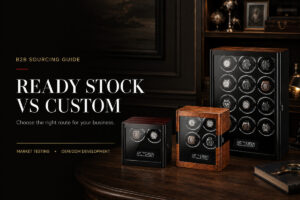
Product names such as “4+6 watch winder” often focus on capacity, but the value of additional storage goes beyond holding more watches. Buyers should consider how the cabinet supports the wider collection, including watches that do not require winding, jewelry, cufflinks, straps and other personal accessories.
A watch winder with storage combines automatic watch winding with organized space for additional watches, jewelry and accessories. The winding positions support compatible automatic watches, while static compartments and drawers can serve a broader collection—provided that each storage area is designed and confirmed for its intended contents.
For B2B buyers, this creates an opportunity to offer more than a standalone winding device. The right configuration can bring watch maintenance, collection display and personal-accessory organization into one coordinated cabinet. The choice should begin with what the target customer wants to store, not simply the largest capacity number in a product title.
Why Add Storage to a Watch Winder?
A collector who owns automatic watches often owns other items that belong to the same daily routine or presentation environment. These may include quartz and manual-wind watches, replacement straps, cufflinks, rings, bracelets, tie clips and small jewelry pieces. Without integrated storage, these items may be divided among a watch winder, a separate watch box and several smaller cases.
A combined product can reduce that fragmentation. Powered positions keep selected compatible automatic watches in a winding program, while non-powered sections organize the rest of the collection. Depending on its layout, one cabinet may function as:
- an automatic watch winder;
- a static watch display;
- a drawer for watch straps and tools;
- a cufflink or men’s-accessory organizer;
- a compact jewelry-storage area;
- a coordinated presentation piece for a dressing room, bedroom or executive setting.
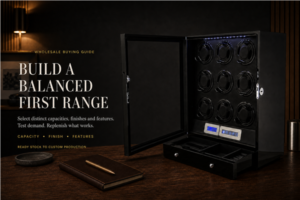
This broader use is especially relevant to brands, retailers and gift companies developing products around a lifestyle collection rather than a single function. Buyers can review the wider range of watch winder configurations before deciding how much winding and additional storage their product line requires.
What Can the Additional Storage Hold?
The word “storage” does not describe one standardized interior. Its real function depends on whether the cabinet contains visible watch positions, a divided drawer, an open drawer or a combination of these structures.
Watches That Do Not Need Active Winding
Static watch positions can hold quartz watches, manual-wind watches or automatic watches that are not currently being kept wound. These areas usually use watch cushions or defined compartments, allowing the cabinet to present a mixed collection instead of only the automatic watches placed on rotators.
For practical use, buyers should check cushion width and compression, bracelet or strap circumference, spacing between adjacent watches, case thickness and access. Static positions should be identified separately from powered winding capacity so retailers and end users understand exactly what the product does.
Watch Straps, Tools and Small Accessories
A divided drawer can organize replacement straps, spring-bar tools, cleaning cloths, spare buckles or other compact watch accessories. The compartment sizes should reflect the intended contents. Long straps require a different layout from small tools, while hard metal components may need separation from polished or soft items.
For private-label development, this is a useful point of differentiation. A buyer can plan the drawer around the accessories commonly sold with its watches rather than accepting a generic empty compartment.
Jewelry, Cufflinks and Personal Accessories
Storage can also extend beyond watches. Subject to the confirmed internal structure, drawers may be arranged for cufflinks, rings, bracelets, tie clips and other small personal items. This can make the product relevant to executive gifts, men’s accessory collections, jewelry-and-watch ranges or coordinated luxury storage programs.
Different contents require different interiors. Rings benefit from dedicated slots; cufflinks need small divided sections; bracelets and tie clips require longer spaces; mixed jewelry may need removable dividers or a more flexible layout. The lining, compartment depth and hardware clearance should therefore be evaluated around the actual storage plan.
Integrated storage helps organize and present these items, but a normal watch winder cabinet should not be described as a safe or as guaranteed theft protection. A standard lock, where included on a confirmed model, does not turn the product into a security safe.

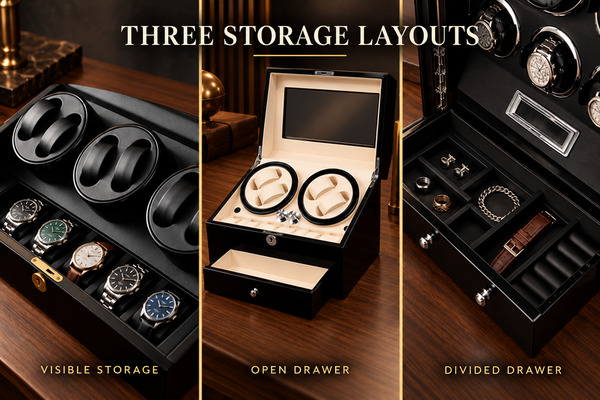
Visible Storage, Divided Drawers and Open Drawers
The format of the storage changes how the product is used and presented.
Visible Static Storage
Visible watch positions keep the broader collection on display, often within the same viewing area as the winding positions. This approach suits products where watch presentation is central. Buyers should confirm spacing, cushion fit and whether watches remain easy to remove without touching nearby pieces.
Divided Drawer
A divided drawer creates defined locations for watches, jewelry or accessories. It can improve organization and communicate a clearer function at retail. However, the drawer should only be promoted for items supported by its actual compartment design. A few small sections do not automatically make it a complete jewelry organizer.
Open Drawer
An open drawer provides flexible space for larger or changing contents. It may work well for straps, documents, cleaning accessories or personal items selected by the user. Its flexibility is useful, but it offers less separation than a divided layout.
Combined Storage
Some cabinets combine visible watch storage with an additional drawer. This provides immediate display for watches and concealed organization for other items. It can create a more complete collection station, but it also increases cabinet height, material use, packaging volume and shipping weight. The additional structure should serve a clear market need rather than being added only to make the product look larger.
Winding Capacity Still Needs a Clear Definition
Although this article focuses on broader storage value, buyers still need to distinguish powered winding positions from non-powered spaces.
A rotator is the physical component that turns. Winding capacity is the number of watches that the powered configuration is designed to accommodate. Static watch positions and drawer compartments are not part of winding capacity.
Some rotators hold one watch, while others may hold more than one in a model-specific arrangement. Product descriptions should therefore state rotator count and winding capacity separately. A cabinet that winds four watches and stores six additional watches should not be described in a way that suggests all ten watches receive powered winding.
Control grouping also matters. Buyers should confirm whether rotators operate individually or in groups, which preset TPD settings are available, and whether direction can be selected clockwise, counter-clockwise or bidirectionally. Different movements may require different settings, so the watch or movement manufacturer should be consulted when selecting an appropriate program.
Compare Common Watch Winder Storage Configurations
| Configuration | What it combines | Suitable product direction | Main points to confirm |
|---|---|---|---|
| Winding only | Powered winding without additional storage | Compact ranges and customers who already own separate storage | Winding capacity, programs and footprint |
| Winding plus visible watch storage | Powered positions with non-powered watch display | Mixed watch collections and display-focused products | Separate capacities, cushion fit, spacing and access |
| Winding plus divided drawer | Powered winding with organized concealed storage | Executive gifts, accessory ranges and coordinated watch-and-jewelry products | Drawer purpose, compartment layout and usable depth |
| Winding plus open drawer | Powered winding with flexible additional space | Products intended for changing accessories or less structured storage | Drawer dimensions, lining and intended contents |
| Winding plus visible storage and drawer | Winding, watch display and accessory organization | Larger collector systems and multi-function private-label ranges | All capacities, cabinet size, usability, packaging and price position |
No configuration is universally better. A compact unit can be more suitable for a focused retail range, while a larger cabinet only adds value when its additional compartments match the target customer’s collection and habits.
For higher-capacity projects, the multiple watch winder cabinet collection provides useful reference points for comparing powered positions, visible watch storage and additional cabinet functions.
Match Storage to the Target Customer
The most effective product brief starts with the customer’s belongings and routine.
Watch-Focused Collector
This customer may need several active winding positions plus static cushions for quartz, manual-wind or less frequently worn watches. Visible watch storage and easy access may matter more than jewelry compartments.
Executive or Gift Customer
A smaller number of winding positions may be combined with organized space for cufflinks, rings, tie clips or watch straps. Presentation, finish and the experience of opening the drawer may be as important as maximum capacity.
Jewelry-and-Watch Customer
This layout may need ring slots, divided jewelry sections and longer compartments for bracelets alongside watch winding. The storage structure should be designed around the intended jewelry types rather than described broadly as “jewelry storage.”
Private-Label Product Range
A brand can build a coordinated series rather than forcing every function into one model. For example:
- a compact winding-only model;
- a mid-size model with visible watch storage;
- a winding cabinet with an accessory drawer;
- a larger watch-and-jewelry storage model.
The products can share exterior finishes, interior colors and branding while serving different customer needs and price positions. A larger configuration is not automatically more premium; thoughtful layout and ease of use remain essential.
Real Configuration Examples
Existing products help illustrate how cabinet space can be allocated, although the final use of every drawer must be confirmed from its actual interior.
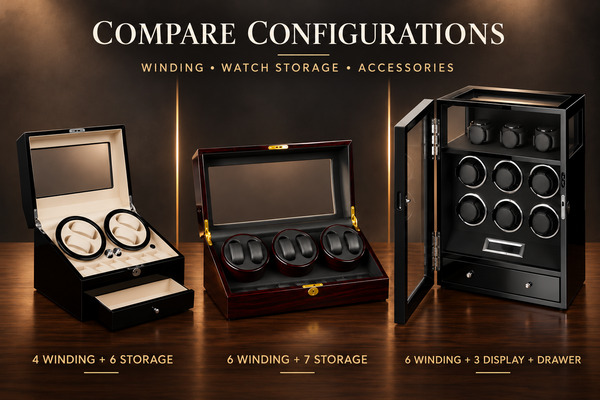
Four Winding Positions Plus Six Watch Storage Positions
This 4-winding and 6-storage configuration combines four powered positions with six non-powered watch positions. It supports active winding and visible organization in one cabinet. Where a drawer is included, buyers should confirm whether it is open, divided for accessories or fitted for another defined purpose before marketing its storage capacity.
Six Winding Positions Plus Seven Watch Storage Positions
The 6-winding and 7-storage configuration offers a different balance between active winding and static watch storage. It may suit a broader watch collection, while its suitability still depends on cushion dimensions, control grouping, cabinet size and the target retail position.
Six Winding Positions, Three Display Positions and One Drawer
This 6-position watch winder with display storage and a drawer combines six powered winding positions, three non-powered display positions and one integrated drawer. It demonstrates the broader value of a storage configuration: selected automatic watches can remain on the winding system, three additional watches can be displayed below, and the drawer provides a separate area for accessories. The intended drawer contents should still be confirmed from its actual compartments before it is promoted for watches, jewelry or specific personal items.
These examples focus mainly on watch storage. For a project intended to hold jewelry, cufflinks or other personal items, the drawer and compartment structure should be planned and confirmed separately.
What B2B Buyers Should Confirm Before Ordering
Before choosing or customizing a watch winder with storage, prepare a list of everything the target user needs to organize. Then confirm:
- rotator count and actual winding capacity;
- required static watch-storage capacity;
- the types and quantities of jewelry or accessories;
- whether the drawer should be open, fixed or divided;
- compartment dimensions and removable-divider requirements;
- representative watch, bracelet and strap sizes;
- control grouping, required TPD presets and rotation directions;
- cabinet dimensions and intended placement;
- exterior finish, interior material and colors;
- logo and packaging requirements;
- target quantity and purchasing route.
Reference images and representative item dimensions help the supplier evaluate the layout. If the project depends on a particular watch, jewelry set or accessory arrangement, physical samples may be required before the interior is finalized. Materials, functions and compartment sizes should be confirmed for the selected model and project.
Choose the Collection Before the Cabinet
A watch winder with storage should be selected as a collection system, not only as a motorized box. First determine which automatic watches need powered winding. Then identify the other watches, jewelry, cufflinks, straps and personal accessories that need an organized place.
Once the contents are clear, buyers can decide whether visible cushions, a divided drawer, an open drawer or a combined layout provides the right balance of function, presentation, cabinet size and cost. Ezicase can evaluate existing models and OEM/ODM options based on the intended collection, winding requirements, storage layout, branding and order needs. To discuss a project, contact Ezicase with the target configuration and reference information.