
For automatic watch collectors, one of the most common questions when choosing a watch winder is:
How many turns per day (TPD) does an automatic watch actually need?
The answer is not simply choosing the highest number.
Different mechanical watches have different winding requirements depending on:
- Movement design
- Rotor efficiency
- Power reserve
- Winding direction
- Manufacturer specifications
Choosing the correct TPD setting helps maintain the watch's power reserve efficiently while avoiding unnecessary operation.
Quick Answer
There is no universal TPD setting that works for every automatic watch.
The ideal turns per day depends on the specific movement, winding mechanism, and recommended operating conditions.
Professional watch winders usually provide multiple preset TPD programs to accommodate different automatic movements.
Common preset options include:
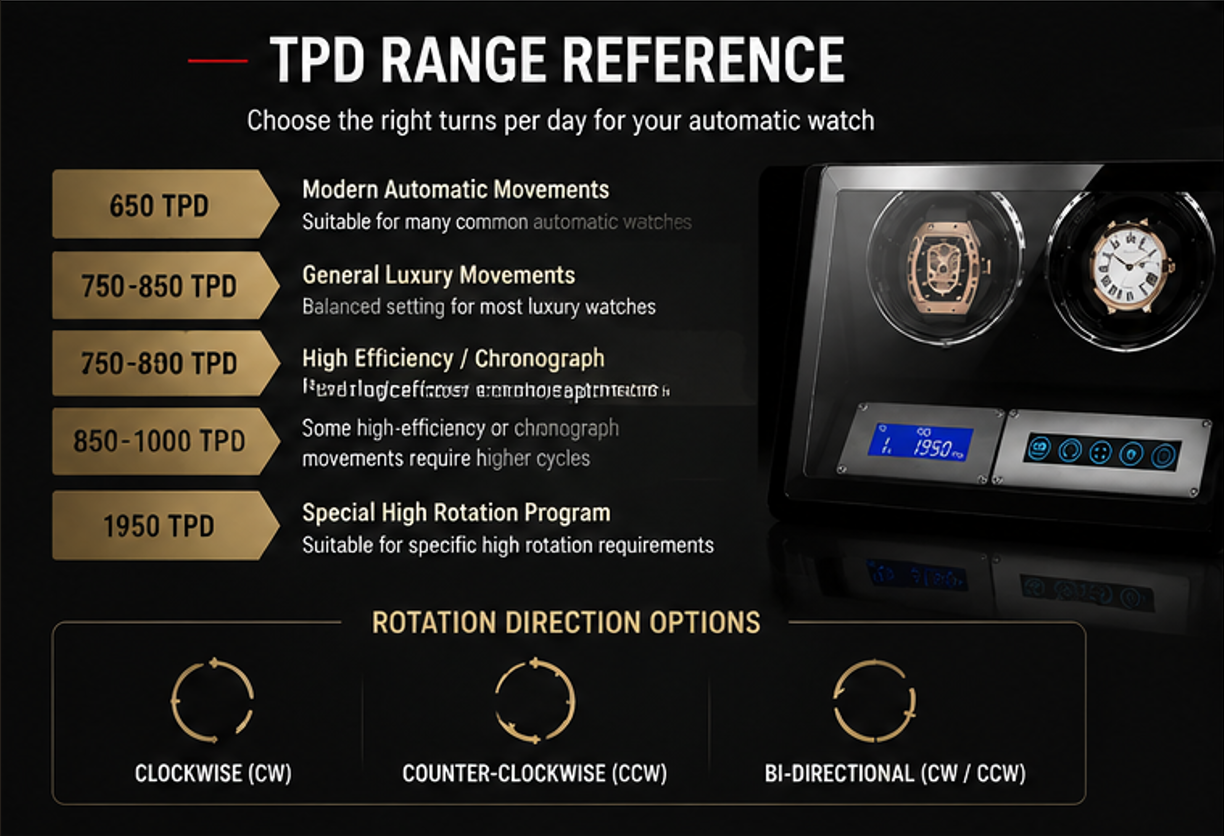
- 650 TPD
- 750 TPD
- 850 TPD
- 1000 TPD
- 1950 TPD
along with different rotation directions:
- Clockwise
- Counter-clockwise
- Bi-directional
The goal of a watch winder is not maximum rotation, but providing the appropriate winding cycles for the specific movement.
1. What Is TPD on a Watch Winder?
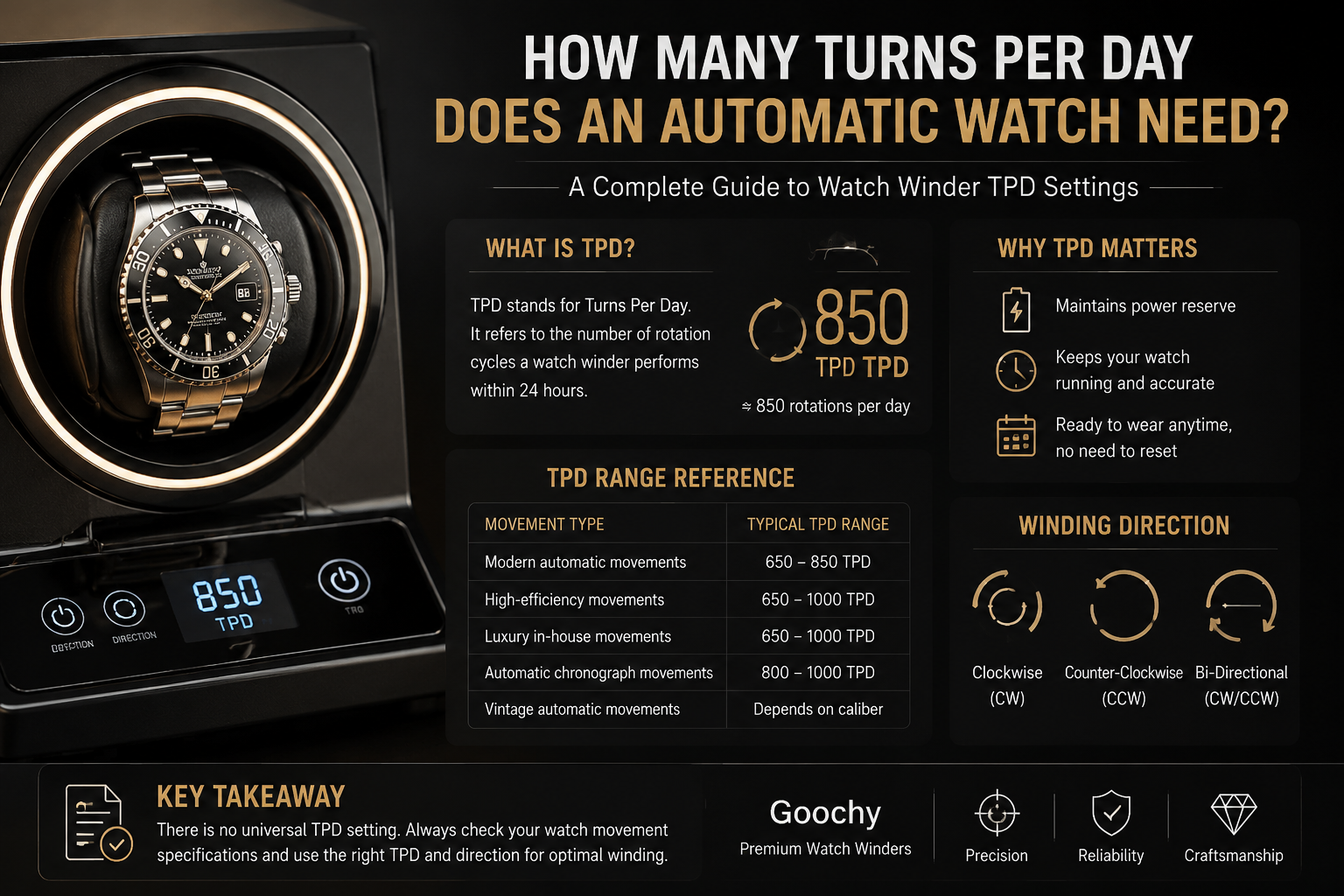
TPD stands for Turns Per Day.
It refers to the approximate number of rotation cycles a watch winder performs within 24 hours.
For example:
- 650 TPD means approximately 650 rotation cycles per day
- 1000 TPD means approximately 1000 rotation cycles per day
A watch winder simulates the natural movement of the wrist by rotating the watch holder and allowing the automatic rotor inside the watch movement to generate energy.
However, a watch winder does not simply need to rotate continuously.
A properly designed watch winder needs to provide:
- Suitable winding cycles
- Correct rotation direction
- Proper rest intervals
- Stable operation
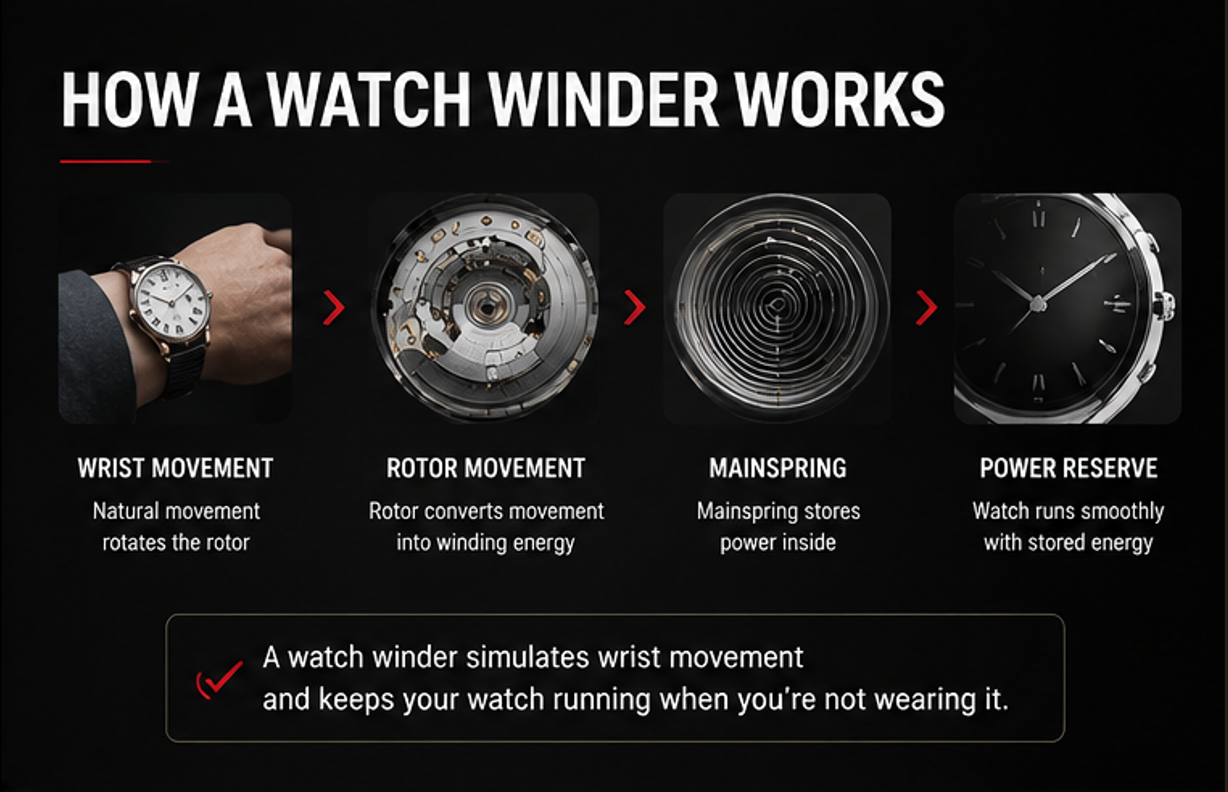
How a watch winder simulates wrist movement and maintains the power reserve of an automatic watch.
1.1 Understanding Turns Per Day (TPD)
An automatic mechanical watch contains a rotor that moves when the watch is worn.
The process works as follows:
- Natural wrist movement rotates the rotor
- The rotor transfers energy into the mainspring
- The mainspring stores power
- The movement continues operating
A watch winder performs a similar function when the watch is not being worn.
This is especially useful for collectors who own multiple automatic watches and rotate between different models.
Instead of manually resetting:
- Time
- Date
- Calendar functions
- Other complications
a properly configured watch winder keeps selected watches ready to wear.
1.2 Why TPD Matters for Automatic Watches
Different automatic movements have different winding characteristics.
The required TPD depends on factors such as:
Rotor Efficiency
Some movements have highly efficient winding systems, allowing them to maintain power with fewer rotation cycles.
Other movements may require additional winding cycles depending on their design.
Power Reserve
A watch with a longer power reserve can continue running for a longer period after being fully wound.
For example:
- Around 40 hours
- Around 60 hours
- 70+ hours
The relationship between power reserve and TPD should be considered together when selecting watch winder settings.
Movement Architecture
Different manufacturers design movements differently.
Examples include:
- Swiss automatic movements
- Japanese automatic movements
- Luxury in-house calibers
- Chronograph movements
Because of these differences, the correct TPD setting should always be selected according to the specific movement rather than only the watch brand.
2. Is There a Universal TPD Setting for All Automatic Watches?
A common misunderstanding is that all automatic watches can use the same TPD setting.
This is not correct.
A Rolex movement, ETA movement, Miyota movement, or chronograph movement may have different winding characteristics.
A suitable TPD setting depends on the movement inside the watch, not simply the brand name or appearance of the watch.
2.1 Movement Differences and Winding Efficiency
Every automatic movement has its own technical characteristics.
Important differences include:
Rotor Design
The rotor is responsible for converting movement into winding energy.
Factors affecting efficiency include:
- Rotor weight
- Rotor bearing design
- Winding mechanism structure
Winding Mechanism
Automatic movements may use different winding systems.
Some movements are designed for:
- Bi-directional winding
- Single-direction winding
- Optimized high-efficiency winding
Therefore, the same TPD program may not produce identical results on every movement.
2.2 Winding Direction: Clockwise, Counter-Clockwise, and Bi-Directional
Besides TPD, rotation direction is another important setting.
A professional watch winder should support different winding directions.
Clockwise (CW)
The watch winder rotates in a direction that allows certain movements to wind effectively.
Counter-Clockwise (CCW)
Some movements require the opposite rotation direction.
Bi-Directional
Some automatic movements can wind in both directions.
Many modern automatic watches use bi-directional winding systems, but users should still confirm the requirements of their specific caliber.
Correct TPD and correct rotation direction work together to achieve efficient winding performance.
Most professional watch winders provide selectable direction options:
- Clockwise
- Counter-clockwise
- Bi-directional
3. Common TPD Ranges for Automatic Watches
Although there is no single TPD value suitable for every automatic watch, professional watch winders usually provide multiple preset programs to cover a wide range of mechanical movements.
These preset programs are designed based on common winding requirements found in automatic watches.
However, it is important to understand:
TPD values are reference guidelines, not fixed rules. The correct setting depends on the specific movement, winding efficiency, and manufacturer recommendations.
Typical TPD ranges and winding direction references for different automatic watch movements.
3.1 Typical TPD Guidelines by Movement Type
The following table provides general reference ranges for selecting a watch winder program.
| Movement Type | Typical TPD Range | Notes |
|---|---|---|
| Modern automatic movements | 650-850 TPD | Suitable for many common automatic watches |
| High-efficiency automatic movements | 650-1000 TPD | Some movements may benefit from additional winding cycles |
| Luxury in-house movements | 650-1000 TPD | Requirements vary depending on the specific caliber |
| Automatic chronograph movements | 800-1000 TPD | Some chronograph movements may require higher winding cycles |
| Vintage automatic movements | Depends on caliber | Always confirm specific movement requirements |
| Manual-winding movements | Not applicable | Manual watches do not use an automatic rotor system |
3.2 Why These Values Are Only Reference Settings
Many watch enthusiasts search online for recommended TPD settings for specific brands and models.
While these resources can be useful, they should be treated as general references.
The reason is that:
- One brand may use multiple different movements
- Different generations may have different calibers
- The same model family may contain technical variations
- Winding efficiency differs between movement designs
For example, two watches from the same brand may require different watch winder settings because their internal movements are different.
The best approach is:
- Identify the movement or caliber
- Confirm the winding direction
- Select the closest suitable preset TPD program
4. Why Manufacturer Specifications Matter for TPD Settings
With so many different automatic movements available, choosing the correct TPD setting can sometimes be confusing.
The most reliable source of information is the watch manufacturer's technical recommendation.
The manufacturer understands the movement design, winding system, and operating requirements better than general online recommendations.
4.1 Why the Watch Movement Matters More Than the Brand
A common mistake is choosing TPD settings based only on the watch brand.
However, the same brand may produce watches with:
- Different calibers
- Different movement generations
- Different winding mechanisms
Therefore, the watch model name alone may not always provide enough information.
Professional users should consider:
- Movement caliber
- Winding direction
- Power reserve
- Recommended operating conditions
before selecting a watch winder setting.
4.2 How to Find the Correct TPD Information
Reliable sources include:
Watch Manufacturer Documentation
The original watch manual or technical documentation is usually the best reference.
It may include:
- Movement information
- Operating instructions
- Maintenance recommendations
Official Brand Support
Some manufacturers provide technical support through:
- Customer service
- Authorized service centers
- Official documentation
Professional Watch Databases
Online watch databases can provide useful reference information.
However, users should understand their limitations:
- Information may not always be officially verified
- Updates may vary
- Movement differences may not always be included
5. What Happens When the TPD Setting Is Incorrect?
Using an unsuitable TPD setting usually does not immediately damage a modern automatic watch.
However, incorrect settings may reduce winding efficiency and affect the convenience of using a watch winder.
The two main situations are:
- Insufficient winding cycles
- Excessive unnecessary winding cycles
5.1 Under-Winding
When the TPD setting is too low, or the rotation direction does not match the movement, the watch may not receive enough winding cycles.
Possible results include:
The Watch Stops
If the watch does not receive enough energy, it may eventually stop after the power reserve is depleted.
The user may then need to reset:
- Time
- Date
- Calendar functions
- Other complications
Reduced Convenience
The main advantage of a watch winder is keeping selected watches ready to wear.
If the setting is insufficient, the watch may stop between uses and require manual adjustment.
This reduces the convenience that a watch winder is designed to provide.
Incorrect Rotation Direction
Even with an appropriate TPD value, incorrect rotation direction may reduce winding effectiveness.
For example:
- A movement requiring clockwise winding may not benefit from a counter-clockwise setting
- A bi-directional movement may operate differently depending on the programmed cycle
Therefore:
TPD and winding direction should always be considered together.
5.2 Excessive Winding Cycles
Modern automatic watches generally include protection mechanisms that prevent traditional over-winding problems.
Most automatic movements use a slipping mainspring system, which allows the mainspring to release additional tension after reaching full wind.
However, selecting an unnecessarily high TPD setting may still create:
- More operating cycles than required
- Longer motor running time
- Additional energy consumption
The purpose of a watch winder is efficient maintenance, not maximum rotation.
The best setting is the one that matches the movement requirement, not simply the highest available TPD value.
5.3 How Professional Watch Winders Handle TPD Selection
A well-designed watch winder should make correct settings easier for users.
Professional models typically provide:
- Multiple preset TPD programs
- Different rotation directions
- Rest intervals between cycles
- Independent control options on selected models
For example, Goochy watch winders provide selectable preset programs including:
- 650 TPD
- 750 TPD
- 850 TPD
- 1000 TPD
- 1950 TPD
These preset options are designed to support a wide range of automatic watch movements.
6. How to Choose the Right Watch Winder Settings?
Selecting the correct watch winder setting requires more than simply choosing a TPD number.
A suitable configuration should consider:
- The specific watch movement
- Required winding direction
- Rotation cycles
- The user's wearing habits
The goal is to maintain the watch's power reserve efficiently while providing convenient daily use.
A higher TPD setting does not always mean better performance. The best setting is the one that matches the movement's actual requirements.
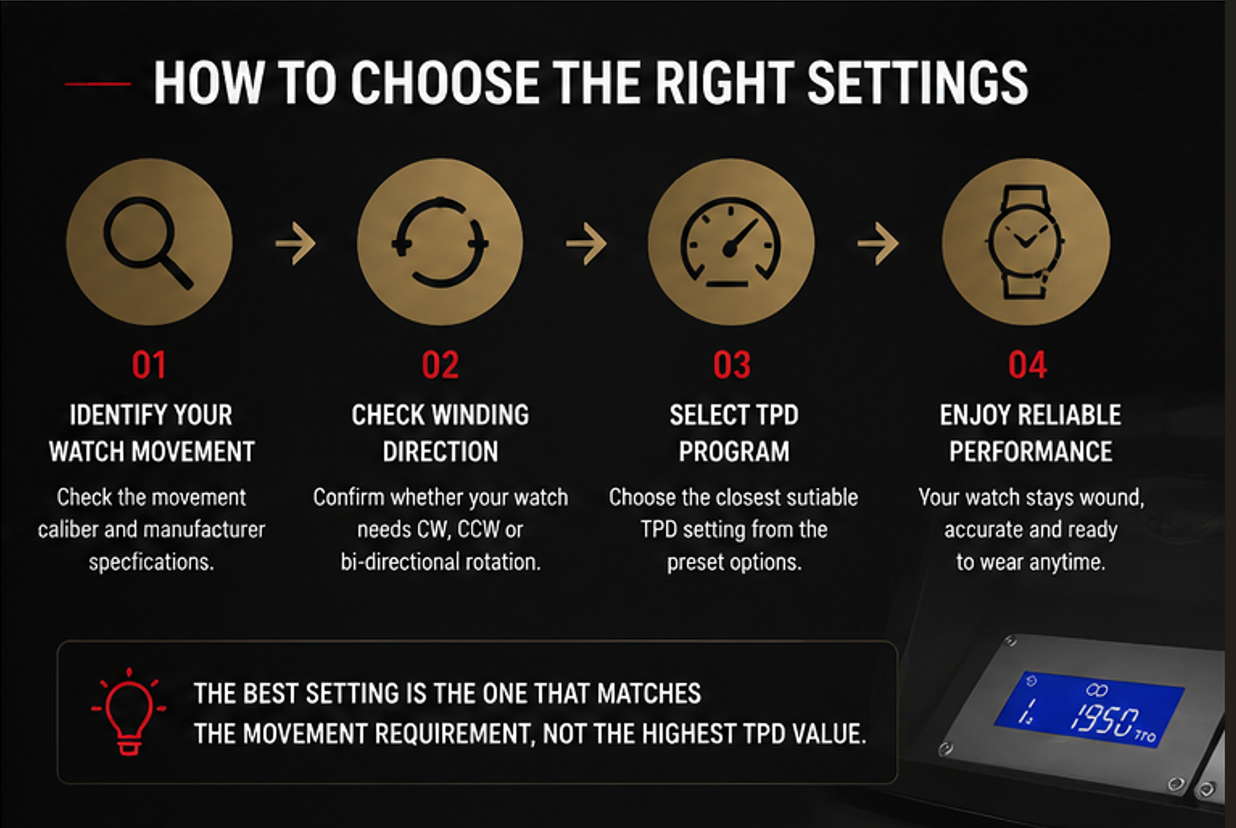
Step-by-step guide for selecting the correct watch winder TPD and rotation settings.
6.1 Selecting the Correct TPD Program
Most professional watch winders provide multiple preset TPD programs to support different automatic movements.
Common preset options include:
- 650 TPD
- 750 TPD
- 850 TPD
- 1000 TPD
- 1950 TPD
For many modern automatic watches, lower and medium TPD settings are sufficient.
Higher settings may be suitable for certain movements that require additional winding cycles.
However, users should avoid selecting a setting simply because it has a higher number.
The correct selection should be based on:
- Movement characteristics
- Manufacturer recommendations
- Winding efficiency
6.2 Choosing the Correct Rotation Direction
TPD and rotation direction work together.
Even with the correct number of turns per day, a watch may not wind effectively if the rotation direction does not match the movement.
Professional watch winders usually provide:
Clockwise Rotation
The winder rotates in the direction required by certain automatic movements.
Counter-Clockwise Rotation
Some movements require counter-clockwise winding.
Bi-Directional Rotation
The winder alternates between clockwise and counter-clockwise rotation.
Many modern automatic movements support bi-directional winding, but users should still confirm the requirements of the specific caliber.
6.3 Single Watch Winder vs Multi-Watch Winder Settings
A common misunderstanding is that single watch winders always provide better control than multi-watch winders.
This is not necessarily true.
The level of control depends on the design of the watch winder.
Many professional multi-watch winders also provide:
- Independent winding control
- Individual TPD selection
- Separate rotation direction settings
This allows collectors to configure different watches according to their movement requirements.
For example:
| Watch | Setting Example |
|---|---|
| Watch A | 650 TPD + Bi-directional |
| Watch B | 850 TPD + Clockwise |
| Watch C | 1000 TPD + Counter-clockwise |
For collectors with multiple watches, a well-designed multi-watch winder can provide the same flexibility while offering greater storage capacity.
7. Frequently Asked Questions
What is the best TPD setting for an automatic watch?
There is no single best TPD setting for every automatic watch.
The correct setting depends on:
- The movement caliber
- Winding efficiency
- Rotation direction
- Manufacturer recommendations
For many automatic watches, preset programs between 650 and 1000 TPD are suitable reference options.
Can I use the same TPD setting for all my watches?
Not always.
Different watches may use different movements with different winding requirements.
If a collection contains multiple automatic watches, a watch winder with multiple preset programs and independent controls provides greater flexibility.
Does a higher TPD setting wind a watch faster?
Not necessarily.
TPD refers to the number of rotation cycles per day, not the speed of rotation.
A higher TPD does not automatically mean faster or better winding.
The efficiency depends on how the watch movement converts rotor movement into stored energy.
Can a watch winder damage an automatic watch?
A properly designed and correctly configured watch winder is unlikely to damage a modern automatic watch.
Potential issues are usually related to:
- Incorrect settings
- Poor-quality products
- Excessive unnecessary operation
- Incorrect rotation direction
Selecting a reliable watch winder and appropriate preset program is important.
How do I know which TPD setting my watch needs?
The recommended process is:
- Identify the movement caliber
- Check manufacturer information
- Confirm winding direction
- Select the closest suitable TPD program
If official information is unavailable, users can start with a moderate preset setting and observe performance.
Do manual watches need TPD settings?
No.
Manual-winding watches do not use an automatic rotor system.
Because they require hand winding, they do not benefit from an automatic watch winder.
Conclusion
Understanding how many turns per day an automatic watch needs is essential when selecting and using a watch winder.
There is no universal TPD setting that works for every automatic watch.
The correct configuration depends on:
✓ The specific movement
✓ Winding direction
✓ Movement efficiency
✓ Manufacturer recommendations
For collectors, retailers, and brands, choosing a watch winder with flexible preset programs provides better compatibility with different automatic watches.
At Goochy, we specialize in manufacturing premium watch winders and luxury collection storage solutions for global brands, retailers, and distributors.
Our watch winders feature:
- Selectable preset TPD programs
- Multiple rotation directions
- Independent control options on selected models
- Premium materials and craftsmanship
- OEM and ODM customization support
With:
- Over 10 years of manufacturing experience
- 3,000㎡ production facility
- More than 700 product designs developed
- International market experience
Goochy helps partners create reliable and premium watch storage solutions that combine technology, craftsmanship, and elegant design.
Looking for a professional watch winder manufacturer or OEM partner? Contact Goochy to discuss your next project.
