
Choosing a capacity is only the first step in developing a custom watch case. Buyers also need to consider the watches’ dimensions, bracelet or strap construction, pillow fit, compartment spacing and lid clearance. The most reliable approach is to define a representative watch range, review the proposed interior around that range and verify the result with a physical sample before mass production.
Why Isn’t Watch Case Capacity Enough?
A capacity label tells you how many watch positions a case is designed to hold, but it does not show whether those positions suit the intended watches. Two 10-watch cases can have different pillow dimensions, compartment widths, spacing and internal heights, even when their stated capacity is the same.
Watches do not occupy space in the same way. A slim watch on a flexible leather strap may suit a compact layout, while a larger chronograph or a watch with a substantial metal bracelet may need more width, height and space around the crown or pushers.
For B2B projects, the capacity should therefore be considered together with:
- the expected watch size range;
- the type and stiffness of the straps or bracelets;
- the intended display and access method;
- the pillow construction and degree of compression;
- the usable compartment dimensions;
- the clearance below the closed lid.
These details help determine whether an existing structure is suitable or needs adjustment. Buyers can review the available custom watch cases and compare a selected structure with the watches their customers are likely to store.
Which Watch Measurements Should Buyers Provide?
Buyers do not necessarily need to document every watch in a collection. A practical project brief can use representative small, typical and large watches to define the required fitting range. This gives the manufacturer a more useful reference than a general request such as “suitable for luxury watches.”
Important measurements and characteristics include:
- Case diameter: The main width of the watch case, normally measured without the crown.
- Lug-to-lug length: The distance across the watch from the end of one lug to the opposite lug.
- Case thickness: The total height from the case back to the highest point of the crystal or bezel.
- Crown and pusher projection: Any components that extend beyond the main case diameter.
- Bracelet circumference: Particularly important for closed metal bracelets and smaller wrist sizes.
- Clasp size and construction: A folding clasp or dive extension can affect how the bracelet wraps around the pillow.
- Strap stiffness: Leather, rubber and metal bracelets do not bend or compress in the same way.
When exact watch models are unavailable, buyers can provide a target range, photographs and a simple dimensioned sketch. The objective is to identify the measurements most likely to affect fit, not to create an unnecessarily complex specification.
How Should a Watch Pillow Fit?
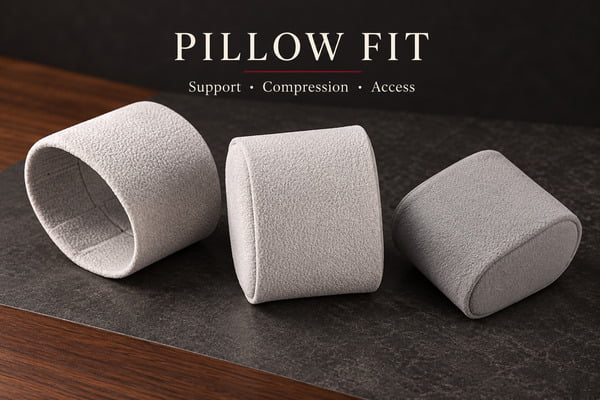
A watch pillow should support the watch in an orderly position without requiring excessive force to fasten the bracelet or allowing the watch to move too freely. The appropriate fit depends on the pillow’s width, circumference, shape, compressibility and relationship with the surrounding compartment.
Pillow circumference and compression
Bracelet circumference is especially important for watches with closed metal bracelets. If the pillow is too large or too firm, a smaller bracelet may be difficult to close around it. If it is too small or compresses too easily, a larger bracelet may sit loosely and the watch may shift from its intended presentation position.
Because pillow construction varies, there is no single circumference that fits every watch. The intended wrist-size range and smallest closed bracelet should be considered during sampling.
Pillow width and compartment fit
Pillow width influences both presentation and handling. The pillow needs enough lateral support to keep the watch aligned, while sufficient space should remain for the user to lift it out without scraping the surrounding divider.
Existing watch case structures illustrate how these measurements can vary. One developed layout uses a pillow approximately 50 mm wide, an individual compartment of about 82 × 52 mm and approximately 10 mm between adjacent positions. Another more compact layout uses a pillow approximately 45 mm wide, a compartment of about 75 × 48 mm and approximately 7 mm between positions.
These figures are examples from particular structures, not universal standards. The correct dimensions still depend on the watches, materials and presentation requirements of the project.
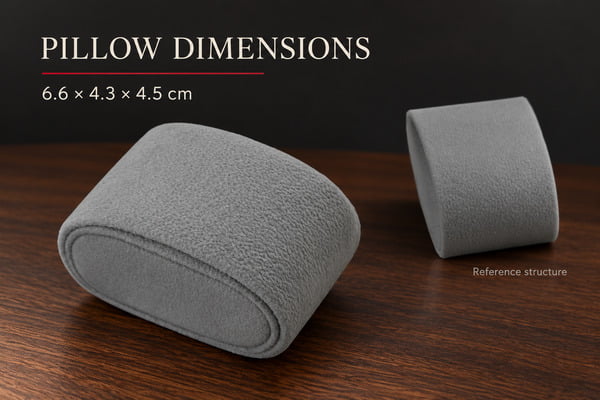
Removable pillow construction
For removable pillows, buyers should confirm that each pillow can be handled comfortably, remains stable when installed and does not create unnecessary bracelet pressure. Its covering and internal construction can change the effective size and compression, so materials and dimensions should be reviewed together.
How Much Space Is Needed Between Watches?
There should be enough space to keep neighboring watches from contacting one another during normal storage and handling, while also allowing users to place and remove them comfortably. The required spacing depends on the largest representative watch, its crown and pushers, the pillow orientation and the divider construction.
Increasing the number of positions inside the same exterior size may make the stated capacity more attractive, but a tighter layout can reduce usable space and make the display appear crowded. B2B buyers should evaluate the trade-off between capacity and presentation rather than maximizing the number of slots automatically.
Useful questions during layout review include:
- Does the largest watch remain within its intended compartment?
- Can crowns or pushers approach the divider or adjacent watch?
- Is there enough room for fingers to remove the pillow?
- Do watches remain visually separated when the case is fully loaded?
- Does the lining thickness reduce the usable width more than expected?
The layout should be assessed with the finished lining and actual pillows in place. An unlined internal frame does not represent the final usable dimensions.

How Much Lid Clearance Does a Watch Case Need?
A watch case needs enough internal clearance to prevent the crystal, bezel and other raised parts from contacting the lid when it is closed. The required clearance depends on the watch thickness, pillow height and compression, lid lining, display-window construction and any other components inside the lid, so it should be verified during sampling.
External product height cannot be used as a substitute for internal clearance. The base structure, lining, pillow and lid frame all occupy part of the total height. A transparent window, solid lid or internally lined lid may also create a different usable profile above the watches.
During sample review, the buyer should place the thickest representative watch on the intended pillow and close the case normally. The check should consider raised crystals, bezels, crowns and clasps rather than relying only on nominal case thickness.
There is no single clearance figure that applies to every watch case. A suitable margin must be built into the structure, but the final amount should be confirmed against the selected watches and approved physical sample.
How Does the Intended Use Change the Interior Layout?
The same watch range may require a different interior when the case is intended for retail display, home collection storage, branded presentation or travel. Defining the use case early helps the buyer prioritize visibility, capacity, access, portability or additional storage.
Retail, showroom and branded presentation
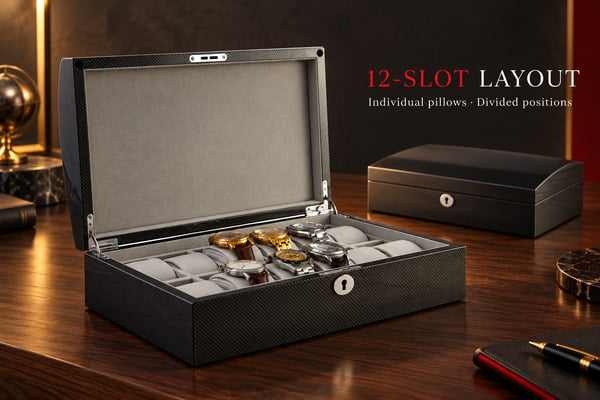
These projects usually benefit from clear alignment, balanced spacing and easy access. This 12-slot arc carbon-fiber-style watch case provides a real example of individual pillows arranged in divided positions within a presentation-focused structure. Its existing dimensions still need to be checked against the target watches. Logo placement, lining color and hardware should support the presentation without compromising the usable interior.
Home collection storage
Collection storage may combine watch positions with space for straps or accessories. A 10-watch display case with a storage drawer separates the main watch layout from a lower storage area. The two capacities should be described separately.
Travel-oriented storage
Travel products need to consider how the watch remains supported when the case is moved. Buyers can compare watch rolls and travel-oriented cases before deciding whether a rigid display box is the right starting point.
What Should Buyers Check During Sampling?
Sampling should test the case in its intended use with representative watches installed, confirming that the capacity, pillows, compartments and lid work together as expected.
A practical fit review should include:
- Place small, typical and large representative watches in the case.
- Check whether smaller closed bracelets can fasten around the pillows without excessive pressure.
- Confirm that larger watches remain inside their intended compartments.
- Check the space around crowns, pushers, clasps and neighboring watches.
- Remove and replace each pillow to evaluate access.
- Close the lid normally and confirm that watches do not contact it.
- Review the presentation with every compartment occupied.
- Test drawers, removable trays or accessory areas without interfering with the main watch positions.
Material or pillow samples can be provided when a project requires them, but they do not replace review of the complete product sample.
Approved details may be recorded through the confirmed sample, customer-provided drawings, dimension records, reference images, specifications or an agreed inspection checklist. Ezicase does not treat complete technical drawings as a default deliverable for every project; the confirmation method depends on the structure and information available.
The broader principles in our custom sample approval guide can also be applied to watch cases, with the inspection points adjusted for watch fit, pillow construction and lid clearance.
What Should Be Approved Before Mass Production?
Before production, both sides should have a clear reference for the appearance, construction and functional requirements that matter to the project.
Final confirmation should cover, where applicable:
- total watch capacity;
- representative watch dimensions and bracelet range;
- pillow dimensions, covering and compression characteristics;
- compartment size, spacing and layout;
- usable lid clearance;
- window or solid-lid construction;
- lining material and color;
- drawers, removable trays or accessory storage;
- exterior dimensions, finish and hardware;
- logo method and packaging requirements;
- approved sample and supporting specification records.
If the pillow construction, lining thickness or lid treatment changes after approval, related dimensions should be reviewed again because the usable fit may change even when the exterior size remains the same.
Buyers can begin with an existing structure or discuss a more extensive adjustment. The most useful starting information is the target capacity, representative watch dimensions, intended use, quantity and branding direction. Ezicase can then evaluate the available path before sampling. For broader guidance, review our customization options or learn how to choose a custom watch box manufacturer.
Frequently Asked Questions
Is there a standard watch box compartment size?
There is no single compartment size suitable for every watch case. The appropriate dimensions depend on the target watch diameter, thickness, crown projection, bracelet construction, pillow size, lining and intended presentation.
Can one watch pillow fit different wrist sizes?
A compressible pillow may accommodate a range of wrist sizes, but it should not be assumed to fit every bracelet. The smallest closed bracelet, larger bracelets and different strap types should be tested with the proposed pillow during sampling.
How do I know whether a watch case fits large watches?
Check the usable compartment width and length, space around the crown and pushers, pillow fit and clearance below the lid. Testing the largest and thickest representative watches in a physical sample provides the most reliable confirmation.
Can the internal layout of a watch case be customized?
Pillows, compartments, dividers, lining, drawers and other internal elements can be evaluated for customization. The available changes, MOQ, sampling requirements and production time depend on the selected structure, materials and project scope.
Build the Interior Around the Watches It Will Hold
A successful custom watch case starts with the watches rather than a capacity label alone. Representative dimensions, pillow fit, compartment spacing, lid clearance and intended use should be considered together, then verified with a complete physical sample.
Share your target capacity, representative watch dimensions, intended use and project quantity with Ezicase. We can review whether an existing watch case structure is suitable and discuss the practical customization path for your brand, retail collection or presentation project.
