Sourcing the right watch winder manufacturer can feel difficult when suppliers present similar products, features and factory claims. Without a clear evaluation framework, buyers may struggle to compare product quality, delivery terms and customization capability on an equal basis.
Choosing a watch winder manufacturer requires more than comparing initial prices. Buyers should evaluate relevant production capability, technical knowledge, quality-control procedures, customization feasibility, compliance-document scope, lead-time management and after-sales support. The right choice also depends on the buyer’s market, quantity, product position and sourcing route.
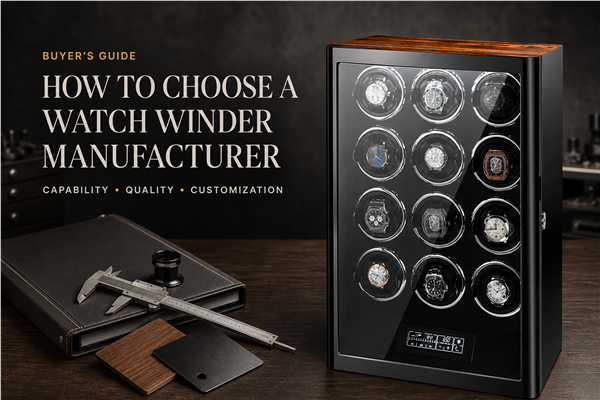
A manufacturing partner can influence not only unit cost but also product consistency, presentation, packaging and replenishment. The following factors provide a practical framework for comparing manufacturers before sampling or placing an order.
Beyond Price: How Can Buyers Evaluate Manufacturing Capability?
Price is important, but a low quotation has limited value if it does not represent the same product configuration, materials, functions and packaging as the competing offers.
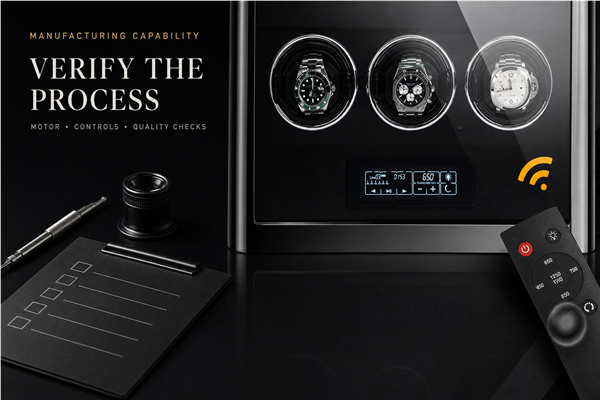
True manufacturing capability combines suitable equipment and production experience with the ability to coordinate mechanical, electronic and presentation details for the selected watch winder. Buyers should review relevant workshops, developed products, technical specifications, sample procedures and quality-control records rather than relying on a general factory description.
When I discuss sourcing with B2B buyers, I encourage them to compare what is included in each quotation before comparing the totals. Two similar-looking watch winders may differ in active capacity, control arrangement, motor, finish, interior, power adapter, packaging and selected functions.
Review Relevant Production Processes
A watch winder can involve cabinet construction, surface finishing, interior wrapping, hardware installation, electronics, final assembly and packaging. Ask which processes are completed internally and which are managed through component suppliers or external specialists.
The goal is not to require every operation to be performed in one building. It is to understand who controls each stage and how the manufacturer checks externally sourced materials and components.
Useful evidence may include:
- Workshop and equipment information relevant to the product
- Developed models with complete specifications
- Material and finish samples
- Production drawings where applicable
- Sample-development procedures
- Inspection checklists or quality records
- Packaging specifications
Examine Motor and Control Knowledge
All Ezicase watch winders use Japanese Mabuchi motors. Motor brand is therefore a consistent part of the Ezicase range, while TPD programs, control grouping and additional functions still vary by model. When comparing manufacturers, buyers should confirm both the motor source and the complete operating configuration rather than treating either point alone as proof of product quality.
Ask the manufacturer to confirm:
- Motor used in the selected product
- Preset TPD programs
- Clockwise, anticlockwise and bidirectional rotation options
- Whether multiple rotors are controlled independently or by group
- Door-open stop, LED lighting, remote control or 12 o’clock alignment where applicable
- Adapter, voltage and destination-market plug
- Functional test completed before shipment
Do not assume that products with a similar exterior use the same electronics or that every winding position can be programmed independently. Available TPD values are model-specific. Buyers can consult the watch winder TPD guide for additional background.
Assess Material Knowledge and Craftsmanship
Luxury presentation depends on accurate material selection and controlled finishing. Review the actual construction rather than relying only on appearance terms.
Most Ezicase watch winder structures are made primarily from MDF, with different surface processes used to create the required appearance. Depending on the model, a woodgrain effect may use veneer, decorative paper, lacquer or another finish over MDF. Selected products may use solid wood, but this should be stated only when it is part of the confirmed model specification. Likewise, a wrapped surface should not be described as genuine leather unless the approved model uses verified genuine leather.
Relevant checks include:
- MDF or selected solid-wood construction, together with the exterior finish
- Interior lining and watch-pillow material
- Color and gloss consistency
- Edge, seam and corner treatment
- Door, drawer, hinge and lock alignment
- Glass or acrylic specification where applicable
- Logo method and placement
At Goochy, woodworking, painting, polishing, assembly and related processes support the development of premium storage products. Buyers should still confirm the exact materials and processes for the selected model instead of assuming that every product follows the same construction route.
Review the Quality-Control Process
A useful QC discussion should explain what is inspected, when it is inspected and how the result is recorded.
Depending on the product, checks may include:
- Incoming materials and components
- Appearance during finishing and assembly
- Dimensions, fit and alignment
- Motor and control operation
- Rotation programs and selected functions
- Adapter and power checks
- Door, drawer, lock and hardware operation
- Final appearance
- Packaging and carton information
Ask whether a pre-shipment inspection record can be provided or whether the buyer may arrange an independent inspection when the order justifies it. Not every inspection applies to every model, so the agreed scope should follow the approved product.
Use Factory Audits Selectively
A physical or remote factory audit can help verify workshops, organization, process flow and production responsibility. For a smaller or standard order, however, a model-specific specification, physical sample and relevant inspection evidence may be more informative than a general tour.
For larger or long-term programs, the audit can review:
- Production areas related to the order
- Material and component storage
- Work instructions and inspection points
- Sample and revision control
- Finished-goods and packaging handling
- Responsibility for outsourced processes
How Should Buyers Evaluate Customization and Cost?
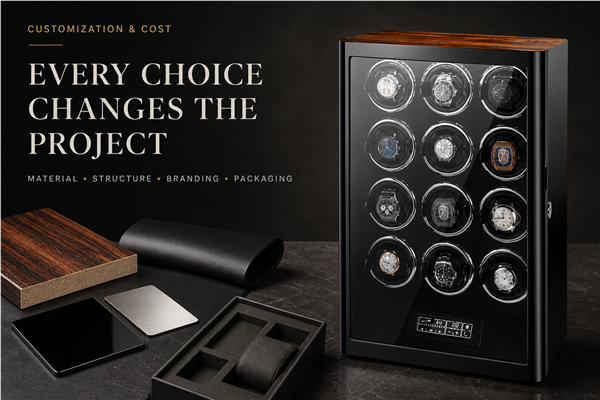
Customization can create a distinctive product, but every change affects feasibility, cost, MOQ or lead time differently.
Effective customization starts by selecting the appropriate sourcing route: ready stock, modification of an existing model or new-product development. Buyers should then confirm which materials, structures, functions, branding and packaging changes are feasible before treating the design as approved.
Distinguish Three Sourcing Routes
Ready Stock
Selected finished products can support lower-quantity market testing and faster preparation. Current model, quantity, branding feasibility and preparation time must be confirmed for each order. Buyers can review ready-stock watch winders for this sourcing route.
Existing-Model Customization
A developed model may support selected changes to exterior finish, interior material or color, logo application, packaging and compatible functions. Feasibility depends on the product structure and requested changes.
New-Product Development
New dimensions, structures, layouts or functional combinations require engineering review, sampling and production planning. These projects should not be compared directly with ready-stock pricing or timelines.
Ezicase custom production may start from 50 units for suitable products, but the applicable MOQ depends on structure, materials, finish, functions, branding and packaging. Buyers can review the available watch winder customization options and the differences between ready stock and custom watch winders.
Follow a Structured Development Process
A practical customization process may include:
- Requirement review
- Selection of an existing model or reference structure
- Material, finish, function and branding confirmation
- Drawing or visual confirmation where required
- Physical sample production
- Sample inspection and written revisions
- Final specification approval
- Mass production
Not every project requires the same design documents. The required drawings, renderings or engineering files depend on how far the requested product differs from an existing structure.
Understand the Main Cost Drivers
| Cost Driver | Why It Affects the Project |
|---|---|
| Structure and dimensions | New structures may require engineering, tooling or production fixtures. |
| Materials and finish | Special veneers, wrapped materials, color matching and multi-step finishes affect sourcing and processing. |
| Motor and controls | Rotor count, control grouping and selected functions affect components and testing. |
| Hardware | Custom hinges, locks, handles or access systems require compatibility review. |
| Interior layout | Holders, storage, drawers and lining affect structure and labor. |
| Branding | Method, artwork, surface, size and position affect setup and feasibility. |
| Packaging | Custom inserts, gift boxes and shipping protection add development and material requirements. |
| Testing | Buyer- or market-specific testing can add cost and lead time. |
Ask how each proposed change affects sample cost, unit cost, MOQ and timing. A manufacturer should identify which requirements are already developed and which need further evaluation.
How Can Buyers Review Compliance and Supply Reliability?
Compliance and delivery should be assessed according to the exact product and destination market rather than through a generic certificate list.
Buyers should verify the scope of product, adapter, battery, component and material documents; confirm the purchasing and production timeline; and understand how the manufacturer manages critical components, packaging and after-sales issues.
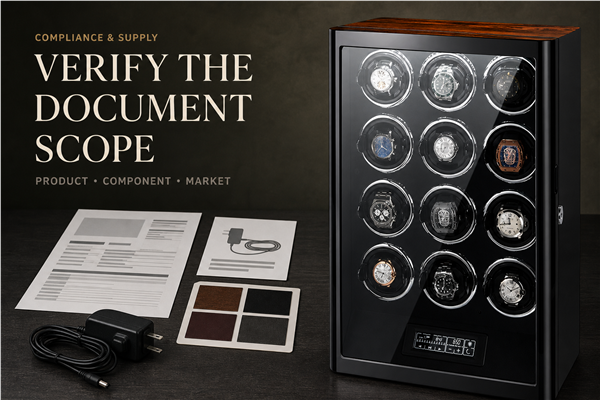
Verify Document Scope
Depending on the product and destination, relevant documentation may relate to CE, UL, FCC, PSE, KC, adapters, batteries or selected materials. Requirements vary by market and configuration.
When reviewing a document, confirm:
- Product, model or component named
- Standards or requirements covered
- Issuing organization
- Issue or validity information where applicable
- Relationship to the ordered configuration
- Relevance to the destination market
A document for an adapter or component should not automatically be described as certification for the complete watch winder. Similarly, documentation for one model should not be assumed to cover an entire product family.
Separate Different Time Periods
Ask the manufacturer to distinguish:
- Stock confirmation period
- Logo or packaging processing time
- Sample-development time
- Sample-revision time
- Custom-production lead time
- Pre-shipment inspection and preparation
- Shipping transit time
This prevents a short preparation estimate from being mistaken for the complete door-to-door schedule.
Discuss Component and Packaging Continuity
All Ezicase watch winders use Japanese Mabuchi motors. For repeat programs, buyers may still ask how the manufacturer manages the availability of motors, control boards, adapters and selected hardware. Any proposed component change should be reviewed for its effect on the approved product, operation and applicable documentation before it is accepted.
Packaging should also be reviewed before shipment. Confirm unit protection, carton dimensions and weight, glass or high-gloss surface protection and any buyer-specific shipping requirements.
Confirm After-Sales Procedures
Even with inspection, issues can occur. Before ordering, discuss:
- How problems should be documented
- Response and review process
- Availability of applicable spare parts
- Handling of confirmed defects
- Warranty or remedy terms stated in the quotation or agreement
The appropriate solution may differ by problem and order. It should be agreed rather than assumed.
How Should Different Buyers Choose a Manufacturer?
The ideal manufacturing partner depends on the buyer’s business model. A single checklist should therefore be adjusted according to commercial priorities.
Luxury Watch Brands
Priorities often include:
- Finish and color consistency
- Brand presentation
- Sample approval
- Custom materials and packaging
- Repeat-order control
- Relevant audit and documentation requirements
E-Commerce Sellers
Priorities may include:
- Accurate product information
- Packaging suitable for the intended fulfillment route
- Manageable initial inventory
- Replenishment planning
- Clear handling of replacement parts or confirmed defects
In one project I supported, an Amazon seller placed greater importance on quick market entry than on developing a fully customized product from the beginning. The more suitable manufacturing route was therefore one that combined available finished models with packaging appropriate for direct-to-consumer shipping. This did not remove the need to confirm specifications or packaging performance, but it changed which supplier capabilities mattered most at that stage of the business.
Ready stock may support faster testing, but availability and quantity remain subject to confirmation.
Gift Companies
Priorities often include:
- Logo feasibility
- Presentation packaging
- Campaign deadlines
- Approval time
- Coordination of colors and branded elements
Logo method should be confirmed according to surface, artwork, size and placement. Silk printing, metal badges, laser engraving or other methods are not interchangeable across every product.
Importers and Wholesalers
Priorities may include:
- Range breadth
- Consistent model specifications
- Volume pricing
- Repeat supply
- Carton and shipping data
- Destination-market documents
- Export paperwork and purchasing terms
Buyers who are still deciding which capacities and finishes to introduce can first review how to choose wholesale watch winders.
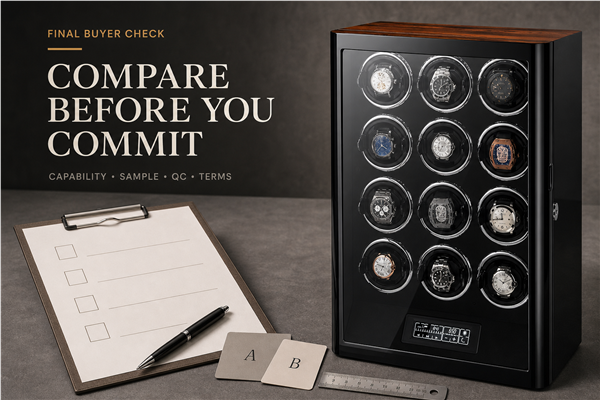
Questions to Ask a Watch Winder Manufacturer
Before approving a supplier, ask:
- Which exact model or structure matches our requirements?
- What are the active winding and static storage capacities?
- Which motor, TPD programs and control arrangement apply?
- Which materials and finishes are used?
- Which customization requests are already feasible?
- Which requests require engineering or material review?
- What physical sample will be provided?
- How will sample revisions be recorded?
- What inspections apply to this product?
- Which compliance documents relate to the selected configuration and market?
- What are the MOQ, sample time, production time and preparation time?
- What packaging and shipping information will be confirmed?
- How are product changes approved?
- How are after-sales issues documented and reviewed?
Frequently Asked Questions
What certifications should a watch winder manufacturer provide?
The relevant documents depend on the product, components, power supply and destination market. Ask for documents connected to the exact ordered configuration and verify their scope instead of relying on a general list of certification names.
What is a typical MOQ for custom watch winders?
MOQ varies according to structure, materials and customization. Suitable Ezicase custom projects may start from 50 units, while other configurations may require a different quantity. Selected stock products may support lower trial quantities, subject to current inventory.
Can a manufacturer help with design and prototyping?
Yes, depending on the project. Support may include requirement review, material selection, drawings or visual confirmation and physical sampling. The scope should be agreed according to whether the buyer is adapting an existing model or developing a new structure.
Choose According to Evidence, Not Claims Alone
Choosing a watch winder manufacturer is a strategic purchasing decision, but it does not need to rely on broad promises. Compare manufacturers using evidence that relates to the actual project: developed products, clear specifications, samples, inspection procedures, customization feasibility, relevant documents and realistic purchasing terms.
Price remains part of the decision. It becomes meaningful when every quotation represents the same approved configuration and scope.
To discuss a project with Ezicase, share the product type, quantity, target market, preferred finish, required functions, branding, packaging and schedule. Our team can review suitable products from the watch winder collection and confirm which requirements are available or require further evaluation.
