
It's a common dilemma for automatic watch owners: you love your timepiece, but life gets busy, or your collection grows, and suddenly, your cherished automatic watch sits unworn. This often leads to a common question: is it harmful for the watch to simply stop, and if so, how long can it safely remain unworn?
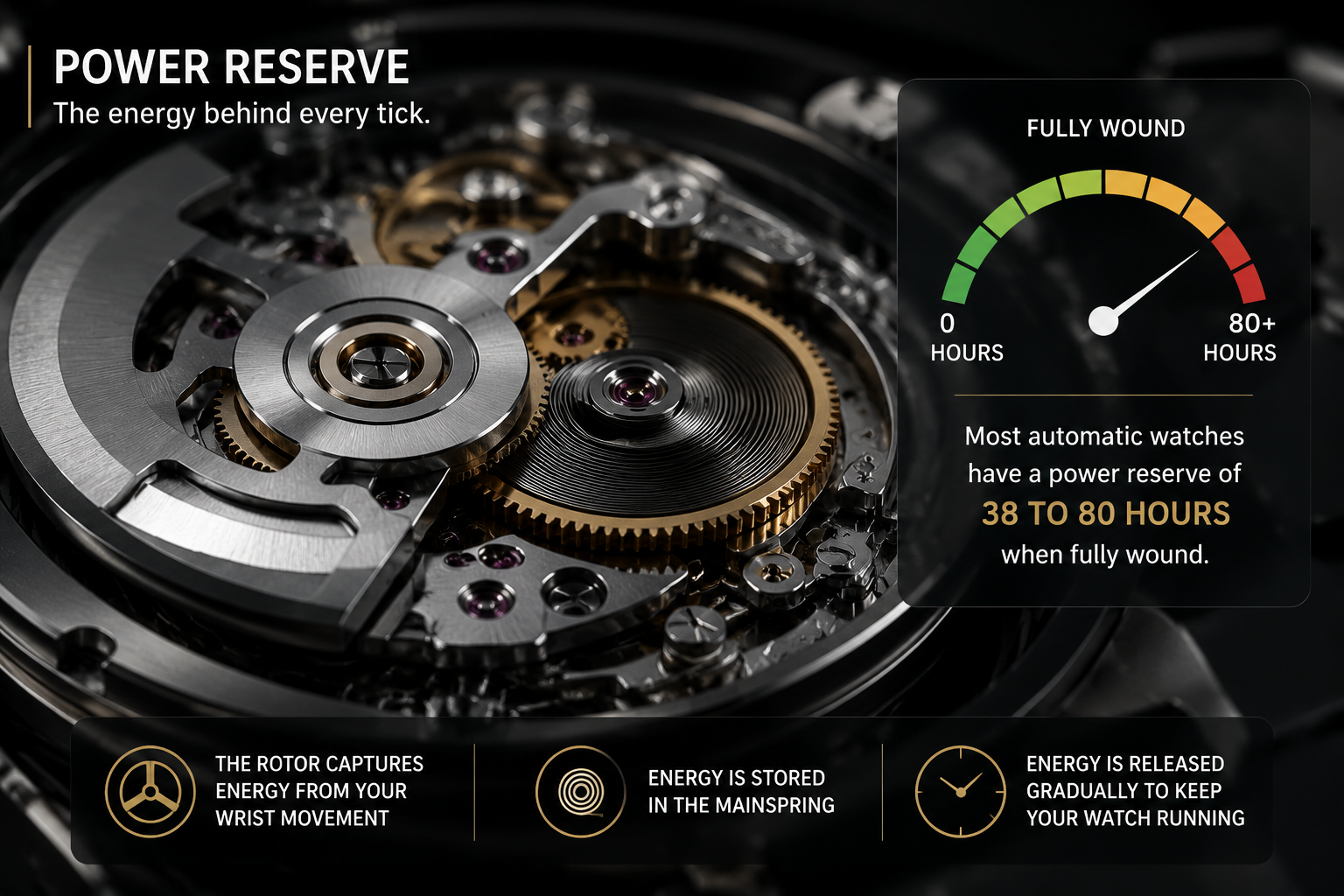
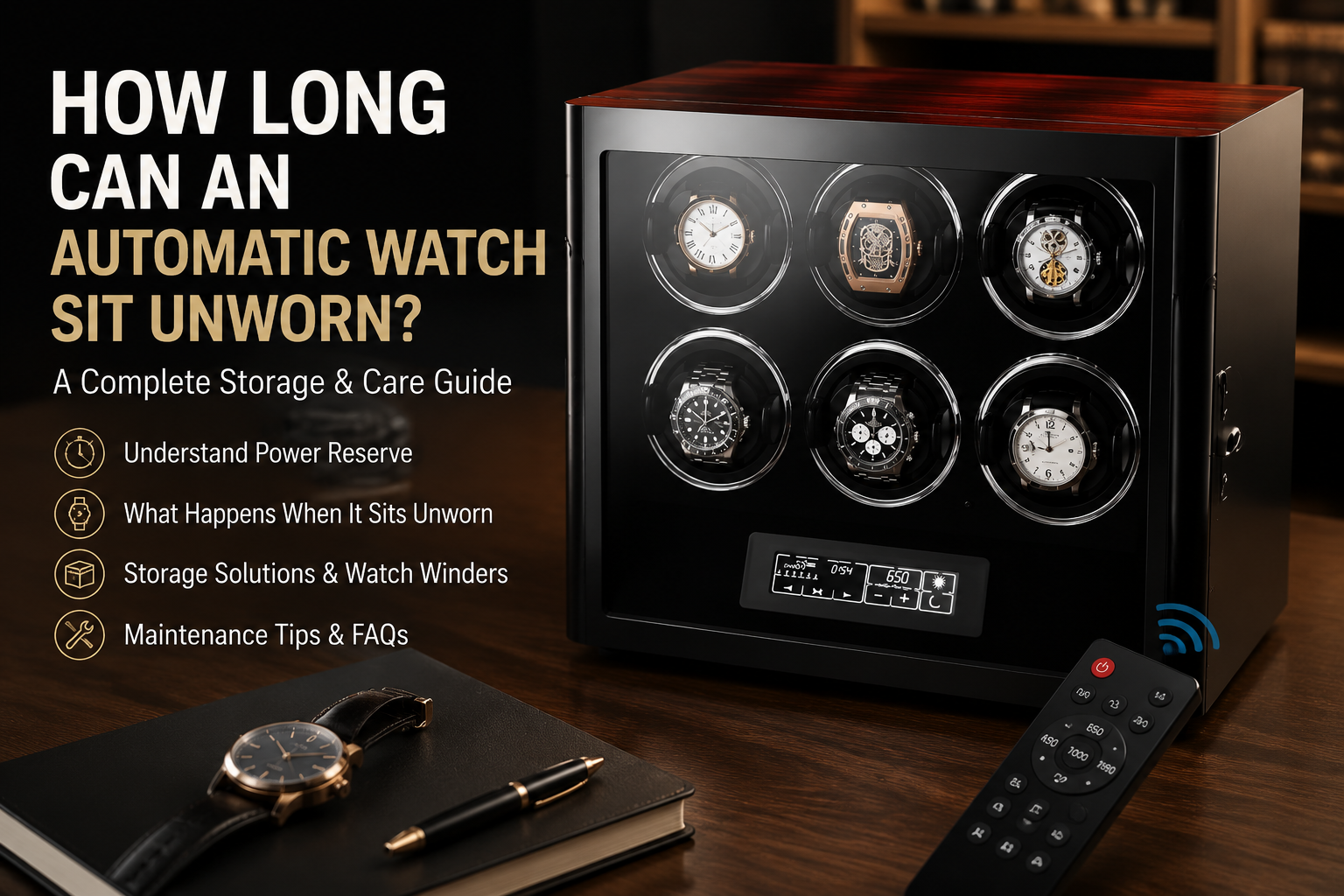
An automatic watch can typically sit unworn for the duration of its power reserve, which ranges from around 38 to 80 hours for many modern movements, and sometimes longer. Once the power reserve is depleted, the watch will simply stop. Extended periods of inactivity do not usually cause immediate damage, but factors such as lubricant condition, service history, movement design, and storage environment may influence long-term performance.
Understanding the intricacies of your automatic watch's internal mechanics and how they respond to inactivity is key to ensuring its longevity. Let's delve into the specifics, exploring what happens inside your watch and the best practices for its care when it’s not on your wrist.
What is an Automatic Watch's Power Reserve, and How Does It Affect How Long It Can Sit Unworn?
Many of us have experienced the momentary panic of picking up a favorite watch only to find it stopped, its hands still. This immediately brings up the question of the watch's power reserve. But what exactly is it, and how does this fundamental feature dictate how long an automatic watch sits unworn before it needs attention?
An automatic watch's power reserve refers to the amount of time it can continue to run once it has been fully wound and then removed from its power source (usually your wrist). This reserve directly determines how long an automatic watch can operate before its mainspring fully unwinds and the movement stops.
At its heart, an automatic watch is a marvel of miniature engineering, powered by the kinetic energy of your own movement. Inside, a rotor swings with the motion of your wrist, winding a mainspring. This mainspring is the power source, storing energy that is then slowly released to drive the gears and hands of the watch.
The "power reserve" is simply the capacity of this mainspring to hold and deliver that energy.
For most standard automatic watches, the power reserve typically falls in the range of 38 to 48 hours. This means if you take off your fully wound watch on Friday evening, it will likely still be ticking come Sunday morning, but it might stop sometime before Monday workday.
More advanced movements, particularly those found in higher-end or specialized timepieces, can boast power reserves of 70, 80, or even 100+ hours. This extended reserve is often a significant convenience for collectors who rotate their watches or simply appreciate not having to reset their watch after a few days off the wrist.
From my conversations with many clients at Goochy, a common concern arises when a watch with a standard power reserve is left unworn for more than a day or two.
"I took it off for the weekend, and now it's stopped," they might say.
This is perfectly normal; the watch has simply used up its stored energy.
The important consideration is not the fact that the watch stops, but rather how it is stored and maintained afterward.
When an automatic watch sits unworn and its power reserve runs out, the movement comes to a complete halt. The initial stop itself is not harmful; however, very long periods without proper maintenance may influence the movement's future performance.
What Happens to Your Automatic Watch When It Sits Unworn for Too Long?
The idea that letting your automatic watch stop might be detrimental can be unsettling.
We often hear advice about keeping watches running, but why?
What exactly transpires within that intricate mechanism when an automatic watch sits unworn for an extended period, moving beyond its power reserve and into true inactivity?
When an automatic watch sits unworn for a very long period, especially if the movement has not been serviced for many years, the lubricants designed to reduce friction within its delicate movement may gradually lose their optimal performance. This can affect friction levels, accuracy, and overall movement efficiency.
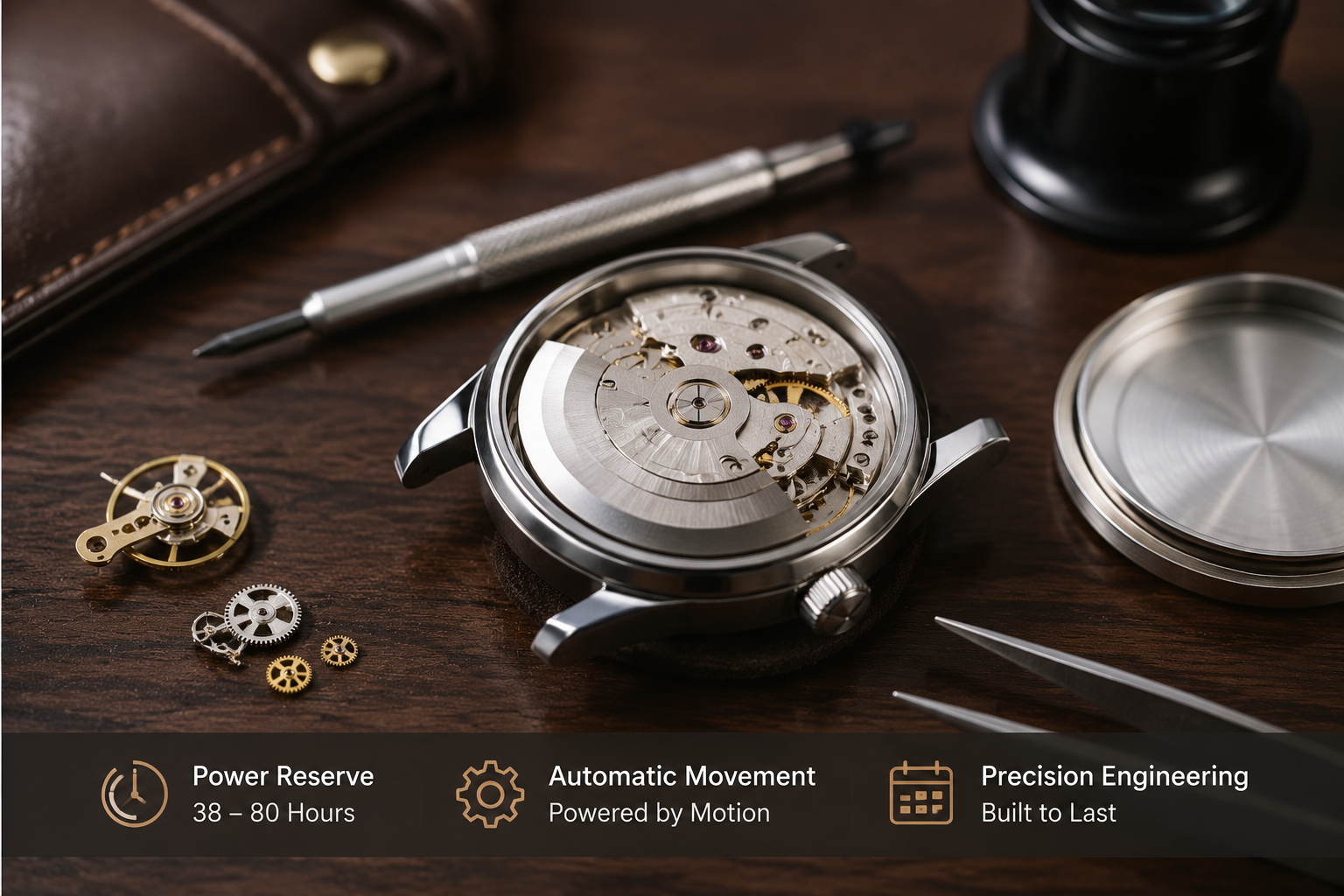
The internal workings of an automatic watch are a symphony of tiny gears, levers, and springs, all operating with incredible precision.
For this intricate system to perform smoothly and accurately, lubrication is important.
Tiny drops of specialized oils are applied to pivot points, jewels, and other areas where metal components interact.
These lubricants help reduce friction, minimize wear, and maintain stable performance.
Lubricant Settlement and Degradation
One of the primary concerns when an automatic watch sits unworn for an extended time is the condition of its lubricants.
These oils are designed to maintain their performance during normal operation, but their condition can gradually change over many years, especially in watches that are rarely worn or overdue for servicing.
-
Thickening and Gelling: Over time, especially in older watches or movements that have not been serviced for a long period, lubricants can lose their ideal viscosity. When the watch restarts, increased resistance may affect movement performance.
-
Migration: Lubricants may gradually move away from certain areas where they are needed most. Regular servicing helps ensure that critical components continue to receive proper lubrication.
-
Contamination: Dust and microscopic debris, though usually kept out by the watch's casing, can still accumulate over many years. Proper servicing helps inspect and maintain these internal components.
Accuracy Drift and Performance Issues
The impact of lubricant condition can directly affect the watch's core function: timekeeping accuracy.
-
Increased Friction: Changes in lubrication may increase resistance between moving parts. This can influence the balance wheel's performance.
-
Amplitude Reduction: Increased friction can reduce the amplitude of the balance wheel's swing, potentially affecting timekeeping stability.
-
Irregularity: The watch's rate may become less consistent, showing greater variation in daily accuracy.
Premature Wear and Component Damage
While not immediate, prolonged lack of maintenance during extended storage may contribute to long-term performance issues.
-
Restarting After Long-Term Storage: When a watch that has been stored for many years is restarted, the condition of its lubricants and overall maintenance history may influence how smoothly it operates. Regular servicing helps ensure that components continue working properly.
-
Gasket Deterioration: While not directly related to the movement stopping, seals and gaskets can age over time and lose elasticity, regardless of whether the watch is running. A watch that sits unworn might still require water resistance checks after long-term storage.
-
Magnetism (An External Factor): While a watch sitting unworn will not cause magnetism, it can still be affected by magnetic fields in its environment. If a watch becomes magnetized, its accuracy may be affected whether it is running or stopped.
| Consequence | Description | Impact on Watch Longevity & Performance |
|---|---|---|
| Lubricant Condition Changes | Lubricants may gradually lose optimal performance after many years, especially in watches that are overdue for servicing. | Increased friction and reduced movement efficiency may occur over time. |
| Accuracy Drift | Changes in lubrication and movement condition can affect balance wheel performance. | Watch may experience reduced accuracy or inconsistent timekeeping. |
| Component Wear | Long periods without maintenance may increase the need for inspection when the watch is restarted. | Professional servicing may be required to restore optimal performance. |
| Gasket Aging | Seals can dry out and lose elasticity over time, regardless of movement activity. | Water and dust resistance may require inspection or replacement. |
In essence, allowing an automatic watch to stop after its natural power reserve is exhausted is normal and does not immediately damage the movement.
However, when an automatic watch sits unworn for very long periods, especially without proper maintenance, storage conditions and service history become increasingly important factors in preserving performance.
Does an Automatic Watch Need to Run All the Time?
Many automatic watch owners believe that their watch needs to remain running continuously in order to stay healthy. However, this is a common misunderstanding.
An automatic watch is designed to start, stop, and restart throughout its lifetime.
When the power reserve is depleted, the movement simply stops, and this does not mean the watch has been damaged.
For collectors who own multiple watches, it is completely normal for some timepieces to remain unworn for days, weeks, or even longer periods.
Whether an automatic watch should remain running depends mainly on personal preference, wearing habits, and the type of movement.
For a simple three-hand automatic watch:
- Allowing the watch to stop is usually not a concern.
- Restarting and setting the time when needed is generally straightforward.
For watches with complex functions:
- Perpetual calendars
- Annual calendars
- Moon phase displays
keeping the movement running can be more convenient because resetting these functions may require additional time and adjustment.
This is one of the situations where a watch winder can provide practical value.
Rather than being a requirement for every automatic watch owner, a watch winder is mainly a convenience solution for collectors who want their watches ready to wear or want to avoid repeatedly adjusting complicated functions.
How Can You Keep Your Automatic Watch Running When It Sits Unworn?
For watch enthusiasts with multiple timepieces or those who simply don't wear their automatic watch daily, the challenge of keeping it running without constant wrist time is real.
The goal is not necessarily to prevent every period of inactivity, but to choose a storage and care method that fits your collection and lifestyle.
To keep an automatic watch running when it sits unworn, you have a few options: manually winding it when needed, wearing it periodically, or utilizing a watch winder. Each method offers different levels of convenience depending on your watch collection and personal preferences.

Let's explore each of these solutions in more detail, understanding their benefits and considerations.
Manual Winding: The Hands-On Approach
Manual winding is the most straightforward method.
Many modern automatic watches can also be hand-wound by turning the crown.
-
How To Do It: Follow the manufacturer's instructions for manual winding. Many automatic watches can be restarted with several crown rotations before being worn.
-
Pros: It's free, simple, and requires no additional equipment.
-
Cons:
- Crown Wear: Frequent manual winding may contribute to wear on the crown stem and seals over a long period.
- Over-winding Risk (Minimal for Automatics): Most modern automatic movements include mechanisms designed to prevent traditional over-winding.
- Inconvenience: It requires remembering to restart and adjust the watch when needed.
Regular Wear: The Ideal Scenario (When Possible)
Wearing your automatic watch is, of course, how it is designed to function and remain powered.
Your natural wrist movements keep the rotor spinning and the mainspring wound.
-
How To Do It: Simply wear the watch regularly. Depending on your activity level and the movement's efficiency, normal daily wear can maintain the power reserve.
-
Pros: It is the most natural way to keep the watch operating and enjoy wearing your timepiece.
-
Cons: Not always practical for collectors with many watches or individuals who rotate between different pieces.
Watch Winders: A Practical Solution for Collectors
A watch winder is an automated device designed to keep automatic watches wound by simulating the motion of wearing it on the wrist.
For a deeper explanation of how these devices operate, you can read our guide on how a watch winder works.
The main purpose of a watch winder is convenience rather than being a mandatory accessory for every automatic watch owner.
It can be especially useful for:
- Collectors with multiple automatic watches
- Watches with complex calendar functions
- Owners who prefer their watches to be ready to wear at any time
For collectors looking for a dedicated storage solution, explore our collection of automatic watch winders designed for different collection sizes and requirements.
-
How They Work: Winders use a motor that rotates a watch holder at specific intervals and directions (clockwise, counter-clockwise, or bi-directional), depending on the movement requirements.
-
Pros:
- Continuous Operation: Keeps your watch ready to wear without requiring frequent manual resetting.
- Convenience for Collectors: Especially useful for collectors with multiple automatic watches or watches with complicated functions.
- Collection Display: Many winders also serve as elegant display solutions.
- Protection Features: High-quality winders may include features such as secure holders, quiet motors, and anti-magnetic protection.
-
Cons:
- Cost: Quality watch winders require investment.
- Space: Multi-watch winders require dedicated storage space.
- Movement Compatibility: Different watches have different winding requirements, so selecting appropriate settings is important.
Does a Watch Winder Replace Regular Watch Servicing?
A watch winder can help keep an automatic watch running, but it does not replace professional maintenance.
Mechanical watches contain many small moving components that require periodic inspection, cleaning, and lubrication.
Service intervals vary depending on:
- The watch brand
- Movement design
- Usage frequency
- Storage conditions
- Manufacturer recommendations
Many manufacturers recommend servicing based on the specific movement and usage conditions rather than following one universal schedule.
Regular servicing helps ensure that the movement continues operating efficiently and accurately over time.
A watch winder should be considered a convenience and collection management accessory, not a substitute for proper mechanical watch care.
Does the Type of Movement or Watch Age Affect How Long an Automatic Watch Sits Unworn?
When considering how long an automatic watch sits unworn without issues, it's important to understand that not all movements are designed the same way.
The movement type, age, construction, and maintenance history can all influence how well a watch handles extended periods of inactivity.
Modern automatic movements often benefit from advanced synthetic lubricants, improved manufacturing tolerances, and longer power reserves. Older or vintage watches may require more attention because their lubrication systems and components may be more sensitive to long-term storage conditions.
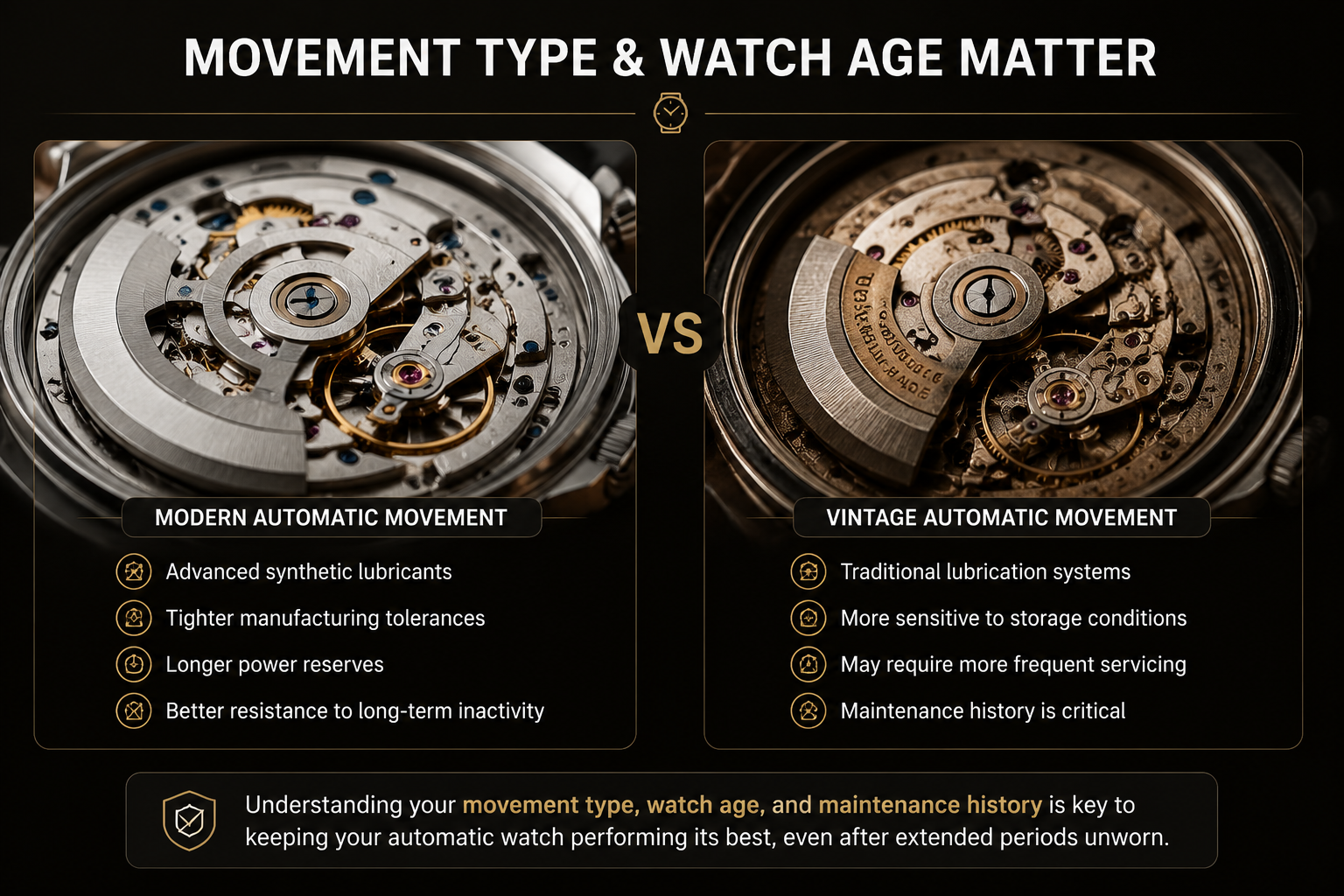
Let's break down how these factors come into play.
Modern vs. Vintage Movements: A Tale of Two Eras
The development of mechanical watchmaking has introduced significant improvements in materials, manufacturing, and lubrication technology.
-
Modern Movements:
- Advanced Lubricants: Contemporary watches generally use synthetic lubricants designed for improved stability and longer performance.
- Improved Manufacturing: Modern production methods allow for precise component fitting and reliable operation.
- Longer Power Reserves: Many newer movements offer extended power reserves, providing additional convenience for collectors.
- Improved Materials: Modern materials and engineering help improve durability.
-
Vintage Movements:
- Traditional Lubrication: Older watches may require more frequent attention because historical lubricants were often less stable than modern synthetic alternatives.
- Different Manufacturing Standards: Vintage movements were built with the technology and tolerances available at the time.
- Maintenance Importance: Service history becomes especially important for older watches that have been stored for long periods.
Specific Caliber Differences and Service History
Even among modern automatic watches, different movements may have different characteristics.
- Entry-Level vs. High-End Calibers: Higher-end movements may feature additional finishing, materials, or construction details, but proper maintenance remains important for all mechanical watches.
- Complications: Watches with multiple complications, such as perpetual calendars, chronographs, or moon phase displays, may be more convenient to keep running because resetting these functions can require additional adjustment.
- Service History: Maintenance history is one of the most important factors. A properly serviced watch with fresh lubrication is generally better prepared for periods of inactivity than a watch that is overdue for service.
When an automatic watch sits unworn, especially for weeks, months, or longer periods, its condition depends on many factors rather than inactivity alone.
Understanding your movement type and maintaining proper care habits can help preserve your timepiece for years to come.
Frequently Asked Questions
How often should I wear my automatic watch to keep it running?
To keep your automatic watch running, regular wear will usually maintain the power reserve as the rotor transfers energy from wrist movement.
However, the exact time required depends on:
- Your activity level
- The efficiency of the movement
- The watch's power reserve
If you do not wear the watch frequently, manual winding or a watch winder may provide additional convenience.
Is it bad if my automatic watch stops?
No. It is normal for an automatic watch to stop once its power reserve has been depleted.
Automatic movements are designed to start and stop throughout their lifetime. A stopped watch does not automatically mean the movement has been damaged.
For long-term storage, factors such as service history, lubrication condition, and storage environment are more important considerations.
Can a watch winder overwind my automatic watch?
No, a properly functioning watch winder cannot overwind a modern automatic watch.
Most automatic movements include a slipping mechanism that prevents the mainspring from being excessively tightened once fully wound.
However, choosing suitable rotation settings and direction for the specific movement is still important for efficient operation.
For more details, you can read our guide on whether a watch winder can overwind an automatic watch.
How long do watch lubricants last?
There is no single fixed lifespan for watch lubricants.
Their performance depends on:
- The lubricant type
- The movement design
- Environmental conditions
- Usage and maintenance history
Many modern watches are designed with longer-lasting synthetic lubricants, but regular inspection and servicing according to manufacturer recommendations remain important.
When should an automatic watch be serviced?
Service intervals vary depending on the watch brand, movement, usage, and manufacturer recommendations.
Many brands suggest inspection or servicing within several years, while some modern movements may have longer recommended intervals.
The best approach is to follow the guidance provided by the watch manufacturer and consider professional inspection if accuracy changes or performance issues appear.
Conclusion
The question of "how long can an automatic watch sit unworn?" does not have one universal answer.
An automatic watch can normally sit unworn after its power reserve has been exhausted, and stopping itself is a normal part of mechanical watch operation.
The more important factors are:
- The condition of the movement
- Service history
- Storage environment
- The complexity of the watch
For collectors with multiple timepieces, a watch winder can provide convenience by keeping selected watches ready to wear and reducing the need to repeatedly reset complicated functions.
However, a watch winder is a personal choice rather than a requirement for every automatic watch owner.
Whether you choose regular wear, manual winding, or a watch winder, proper storage and maintenance habits remain the foundation of preserving your timepiece.
At Goochy, we specialize in crafting luxury storage solutions including watch winders, watch boxes, and custom collection storage solutions for collectors and brands worldwide.
From single watch winders to multi-watch systems, our products combine practical functionality with refined craftsmanship, helping collectors organize and display their valuable timepieces.
As an OEM & ODM manufacturer, Goochy supports customized solutions including capacity, materials, finishes, and branding options for global partners.
Whether you are developing a private label watch accessory line or looking for a reliable manufacturing partner, our team provides complete solutions from concept development to production.
