
For watch collectors, finding suitable storage often presents a challenge: how can you organize and protect timepieces while also showcasing their design? Inadequate storage can increase exposure to dust, scratches, and accidental contact. Fortunately, navigating the diverse world of watch storage solutions for collectors does not have to be daunting when the decision starts with the collection's actual needs.
The best watch storage solution is not one-size-fits-all. The appropriate choice depends on watch movement types, collection size, wearing frequency, display preferences, travel needs, available space, and budget. Options include watch winders for compatible automatic watches, watch cases for organized static storage, and travel cases for portability.
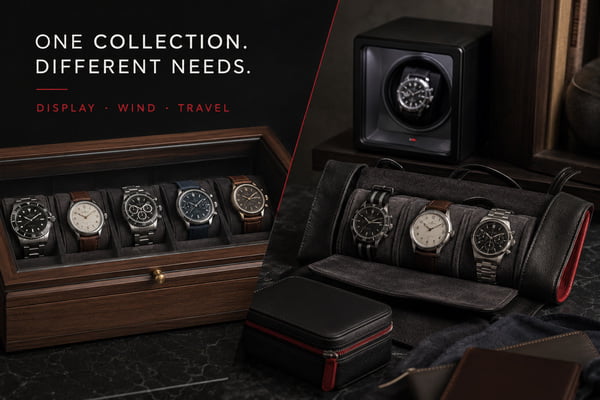
Understanding these principles is useful for any B2B buyer sourcing watch storage. But how do we move from general understanding to an informed product specification when the market contains many different options and claims? Let's examine the factors that distinguish suitable watch storage for collectors.
Why Isn't There One "Best" Watch Storage Solution for Collectors?
Many buyers search for the "best" watch storage solution, expecting a universal answer, but this approach often leads to dissatisfaction later. The real problem isn't a lack of options, but a failure to align the product with the client's actual needs, risking mismatched inventory and unhappy end-users. How can you ensure the solution you procure genuinely serves its purpose?
There isn't a single "best" watch storage solution for collectors because optimal choice is determined by specific factors like whether the watches are automatic or quartz, their value, how often they're worn, display preferences, and whether they need to be transported. Tailoring the solution to these distinct usage scenarios ensures both functionality and satisfaction.
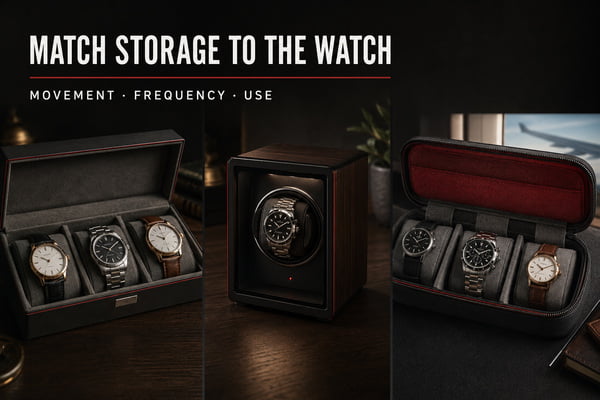
From our experience working with retailers and brand buyers, a common procurement mistake is neglecting the "why." Why does the end user need this storage? Is it for automatic watches that are rotated regularly, or for pieces intended primarily for static display? The answers directly affect which solution is most appropriate.
Consider the core usage scenarios:
-
Active Automatic Collections: For collectors who rotate several automatic watches, a watch winder can provide ready-to-wear convenience, but it is not essential for every watch. Buyers should compare motor and gearbox quality, operating noise, available preset Turns Per Day (TPD) programs, winding directions, rotor control, and rest cycles. Ezicase models use preset selectable TPD options rather than infinitely customizable settings, and available programs vary by model. Anti-magnetic design measures are also model-dependent and should be confirmed in the individual specification rather than assumed for every product. Learn more in our guide to what a watch winder is and how it works.
-
Static Display Collections: For collectors who primarily want to organize and showcase manual-wind, quartz, or infrequently worn automatic watches, a display case can be suitable. Buyers can evaluate exterior materials, lining, cushion fit, visibility, hinge operation, closure design, finish consistency, and uniform gap lines. UV-filtering glazing, ventilation, and locks are optional features, not universal requirements; they should be specified and verified when a project needs them.
-
Travel and Portability: For collectors who travel with timepieces, the priorities are compact size, secure individual compartments, suitable cushion fit, and resistance to ordinary knocks inside luggage. Reinforced shells, EVA structures, and leather-covered cases are possible constructions. Drop-test results, water resistance, or IP ratings should only be claimed when the specific product has been tested to a defined standard. A travel case should not be assumed to be waterproof or crush-proof without supporting documentation.
-
Archival/Long-Term Storage: For rarely worn pieces, buyers may prioritize separated compartments, appropriate lining, dust reduction, security, and compatibility with a safe or cabinet. Ordinary watch boxes and winders should not be described as climate-controlled, airtight, or humidity-regulating unless those functions are specifically designed and tested. For high-value or historically important watches, follow the watch manufacturer's or a qualified conservator's storage guidance.
Ultimately, understanding the client's requirements before engaging with suppliers is the first step toward successful procurement. A clear specification helps buyers avoid inventory that does not match the movement types, collection sizes, and usage habits of their target market.
How Does Material and Craftsmanship Define Quality Watch Storage Solutions for Collectors?
In the competitive market of luxury goods, discerning true quality in watch storage solutions for collectors can be a challenge; many products look good at first glance but fail to stand the test of time. How can B2B buyers reliably evaluate the materials and craftsmanship to ensure they're procuring durable, high-value items for their clients?
Quality in watch storage solutions is assessed through clear material specifications, appropriate construction, consistent finishes, secure hardware, suitable linings and cushions, and repeatable quality control. No single material automatically guarantees a better product; suitability depends on the design, manufacturing process, intended use, and target price.
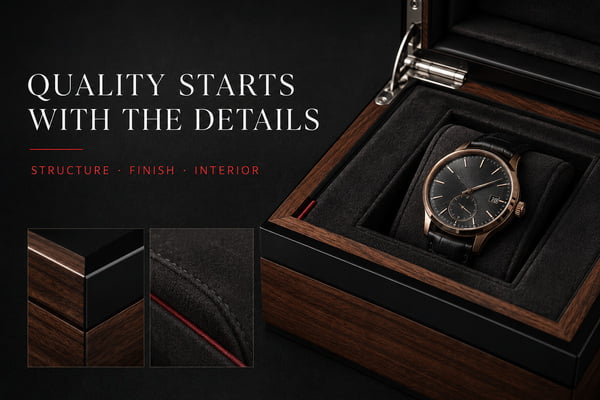
From a manufacturing insider's perspective, the difference between a passable product and a truly premium watch storage solution for collectors lies in the details of its materials and how those materials are handled. It's not just about what a supplier says they use, but what they can prove.
-
Wood Selection and Treatment: Buyers should confirm whether a case uses solid wood, MDF, plywood, or engineered wood with veneer. Solid wood offers natural variation, while MDF and veneered structures can provide dimensional stability and consistent surfaces for lacquer; the better choice depends on the product design. Buyers should also review substrate preparation, veneer matching, edge treatment, lacquer consistency, curing, and resistance requirements. Ezicase offers multiple wood, finish, interior, logo, and size customization options for OEM and ODM projects.
-
Leather and Fabric Interiors: Interior materials may include genuine leather, PU leather, velvet, suede-like fabric, or microfiber. Selection should consider appearance, abrasion, colorfastness, odor, cleaning requirements, and the surfaces that will contact the watch. Buyers should inspect bonding, seams, stretching, exposed adhesive, and cushion firmness. Relevant material test reports or safety documentation can be requested when required by the destination market or project.
-
Hardware and Components: Hinges, locks, clasps, and winding mechanisms affect usability and reliability. Buyers should confirm materials, finishes, alignment, operating feel, noise, and the relevant test method. Hardware weight alone is not a reliable measure of quality. For watch winders, motor, gearbox, controller, power supply, and rotor programming should be evaluated together.
-
Precision and Assembly: Buyers can inspect corner alignment, joint consistency, gap uniformity, edge finishing, stitching, lid movement, cushion fit, and surface cleanliness. Approved samples, specification sheets, inspection photos, factory videos, or an on-site audit can help establish measurable acceptance criteria before mass production.
By focusing on measurable material, construction, and finish criteria, B2B buyers can compare watch storage solutions for collectors more consistently and define a realistic quality standard for their market.
How Can B2B Buyers Assess Supplier Credibility for Watch Storage Solutions for Collectors?
Identifying truly reliable suppliers for watch storage solutions for collectors goes beyond just reviewing product samples; many manufacturers promise the moon but deliver less. How can B2B buyers effectively scrutinize supplier claims regarding customization, quality control, and post-sales support to ensure a trustworthy and long-term partnership?
B2B buyers assess supplier credibility for watch storage solutions by demanding transparency on customization capabilities, requesting detailed quality control documentation throughout the manufacturing process, and evaluating their responsiveness and track record for post-sales support. A reliable supplier provides clear communication, verifiable processes, and demonstrates commitment beyond the initial transaction.
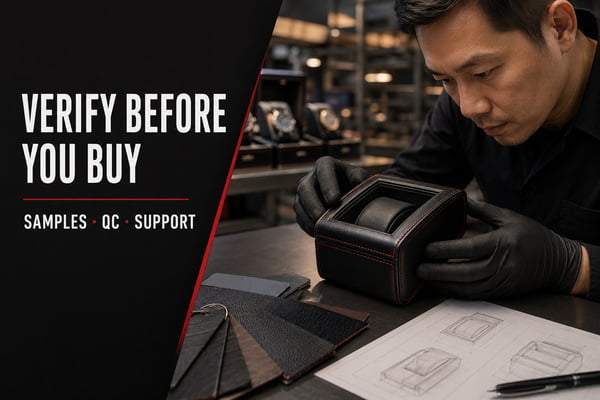
As a sales manager, I've seen firsthand how crucial supplier credibility is, especially in the luxury goods sector. It’s not just about the product, but about the entire procurement journey. When I engage with potential partners, I always guide them on what to look for beyond glossy brochures.
-
Transparency in Customization Capabilities: Many suppliers use the term "customization," so buyers should define whether it covers only logo application or also dimensions, materials, colors, interior layouts, functions, and new-product development. A capable supplier should explain the process for custom orders, including:
-
Design Consultation: Do they offer expert design advice, or just execute your drawings?
-
Prototyping: Can they provide physical prototypes for approval before mass production? What's the lead time and cost for prototypes?
-
Minimum Order Quantity (MOQ): Is the MOQ suitable for the project, and does it change with the material, structure, or branding method? Ezicase OEM/ODM projects can start from 50 units for applicable products, while requirements may vary by design. Early design and specification discussions can identify feasibility issues before tooling, sampling, or mass production.
-
Quality Control (QC) Processes: Buyers should ask not only whether QC exists, but how it is documented. Depending on the product and order, checks may include:
-
Incoming Material Inspection: Do they verify the quality of raw materials (wood, leather, hardware) before production begins?
-
In-Process Inspection: Are there checks during each manufacturing stage (cutting, assembly, finishing)?
-
Final Inspection: What criteria are used for the final product inspection? Do they provide detailed QC reports or even allow third-party inspections? Buyers can request sample checklists, inspection criteria, test reports, and approval records. CE, UL, FCC, PSE, and similar documentation applies only to the relevant finished product, power supply, component, or market requirement shown on the specific certificate; these marks should not be presented as blanket certification for every product.
-
Commitment to Project Delivery and After-Sales Support: Buyers should also evaluate how the supplier handles packaging, shipping documentation, production updates, and issues discovered after delivery.
-
Packaging: Is the export packaging appropriate for the product's weight, finish, glass components, and shipping method?
-
Warranty/Guarantees: Do they offer any warranty on their products? What's their process for handling defects or returns?
-
Communication: How responsive are they to post-delivery inquiries or feedback? Clear written responsibility, response procedures, and defect-resolution terms are more useful than general service promises. Buyers can also review the supplier's export experience, references where available, and consistency during sampling. Learn more about Guangxi Goochy Craftworks Co., Ltd. and its capabilities.
By systematically evaluating a supplier's transparency in customization, the rigor of their QC, and their commitment to long-term support, B2B buyers can confidently secure high-quality watch storage solutions for collectors and build enduring, trust-based relationships.
Frequently Asked Questions
What is the ideal humidity for storing watches?
Watches should generally be stored in a stable, clean, dry indoor environment and protected from condensation, prolonged high humidity, extreme heat, and rapid temperature changes. There is no single humidity range that is guaranteed to suit every watch, case material, and climate. Follow the watch manufacturer's guidance, and do not assume an ordinary watch box or winder provides climate control.
Can watch winders damage automatic watches?
A suitable, properly functioning watch winder used with an appropriate preset TPD and direction is designed for compatible automatic watches, but no product should be described as risk-free for every movement. Confirm the watch manufacturer's guidance, use a correctly fitting cushion, and stop operation if you notice abnormal noise, movement, or fit. Anti-magnetic shielding is not a universal requirement or feature of every winder.
How do I clean my watch storage case?
Cleaning depends on the finish and lining. Start with a clean, soft, dry microfiber cloth and follow the supplier's care instructions. Avoid applying liquid directly to wood, lacquer, leather, fabric, controls, or seams. Use only a compatible cleaner when the material specification permits it, and test it on an inconspicuous area first.
Is it better to store watches in individual compartments?
Individual padded compartments help keep watches separated and can reduce contact and scratching during storage or handling. The cushions should fit the bracelet or strap without excessive stretching or compression.
What certifications should I look for in watch storage solutions?
Required documentation depends on the destination market, product configuration, power supply, battery, and applicable regulations. CE, UL, FCC, PSE, KC, RoHS, or other reports may apply to different products or components, and a certificate should be checked for its exact holder, model number, scope, standard, and validity. Material reports and supplier declarations may also be relevant when specified by the buyer.
Conclusion
Choosing suitable watch storage solutions for collectors requires more than comparing appearance. B2B buyers should define the end-user scenario, confirm materials and functions, establish measurable acceptance criteria, and evaluate the supplier's communication and quality-control process. From selecting appropriate preset winding programs for compatible automatic watches to checking cushion fit and finish consistency, the specification should reflect the intended market and use. Ezicase is a brand of Guangxi Goochy Craftworks Co., Ltd., manufacturing watch winders, watch cases, and custom collection-storage products for wholesale, OEM, and ODM projects. Contact Ezicase to discuss product type, quantity, materials, functions, branding, and project requirements.
