
Finding the right watch winder cushion size can be challenging for watch collectors, retailers, and brands. A watch may fit around a cushion but still sit loosely or lack enough clearance inside the winder.
A properly fitted watch winder cushion holds the watch securely without forcing the bracelet or strap to close. It also allows enough clearance around the watch inside the winder. Fit depends on the closed bracelet circumference, cushion dimensions and design, watch case size and thickness, and the winder’s internal layout. Check the measurements and fitting instructions for the specific model.
Why Watch Winder Cushion Size Matters
The cushion supports the watch as the rotator moves through its programmed cycle. A suitable fit helps keep the watch in position without requiring excessive pressure on the bracelet, strap, or clasp. The cushion also needs to sit securely in the holder designed for it.
A watch that is loose on its cushion may shift during operation. At the other extreme, a bracelet that must be forced closed around an oversized cushion may be under unnecessary tension. Neither condition should be ignored. The aim is a secure fit that allows the clasp or buckle to close comfortably.
The watch and cushion must also fit within the available space. A large case, thick crystal, projecting crown, or bulky clasp can affect clearance even when the bracelet closes comfortably around the cushion.
Three Common Watch Winder Cushion Designs
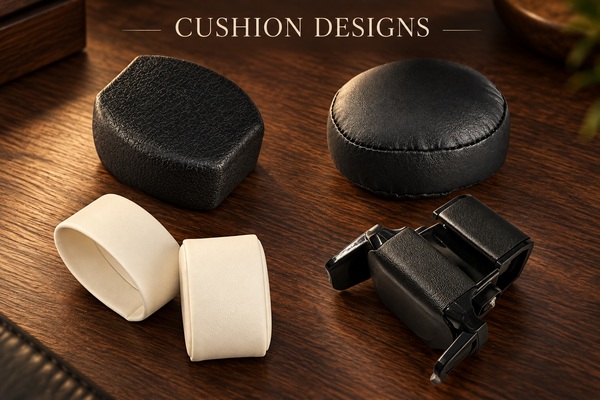
Different cushion structures accommodate bracelet sizes in different ways. At Ezicase, three designs we commonly use are spring-loaded cushions, compressible one-piece cushions, and two-layer cushions with a removable outer sleeve.
Spring-loaded cushions
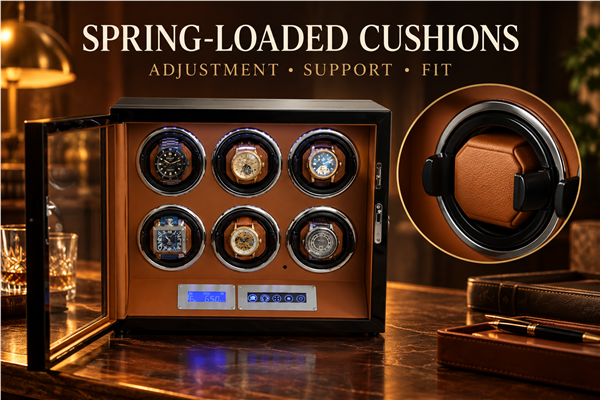
A spring-loaded cushion contracts and expands within the range permitted by its construction. It can accommodate different bracelet circumferences within that range, while the exact method of fitting and removing it depends on the design.
Check the minimum and maximum applicable circumference with the supplier, and follow the instructions for that specific cushion. Do not force its moving parts beyond their intended range.
Compressible one-piece cushions
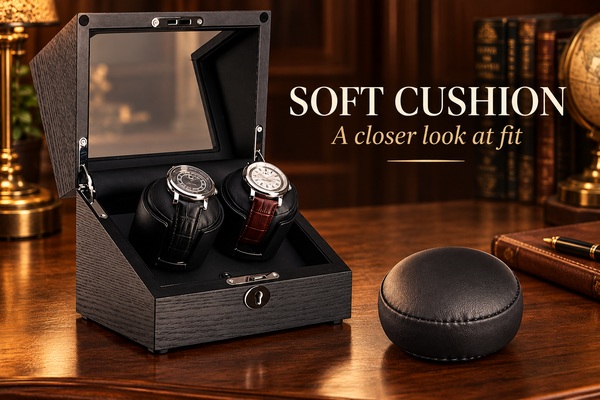
A soft one-piece cushion can compress as a watch is fitted around it. Its usable range depends on the cushion’s dimensions, construction, and material. A soft appearance alone does not establish how small it can safely compress or whether it will hold a particular bracelet securely.
Two-layer cushions
A two-layer cushion uses a removable outer sleeve to change its circumference. The cushion can be used with the sleeve in place or, where the design permits, with the outer layer removed. This provides two configurations to consider when matching different bracelet sizes.
The inner cushion and outer sleeve should be used according to the manufacturer’s instructions. Confirm that the selected configuration still fits securely in the intended holder.
In my work with our team, I have participated in the design of a watch cushion for which we hold a patent. That experience has reinforced how important it is to consider the watch, cushion, and holder together. A useful adjustment range is only one part of the decision: the cushion must also fit its intended mounting system and provide appropriate space for the watch.
These are different approaches to fit, not universal solutions. The available cushion type, dimensions, adjustment range, and mounting system depend on the model.
The Cushion and Its Matching Holder
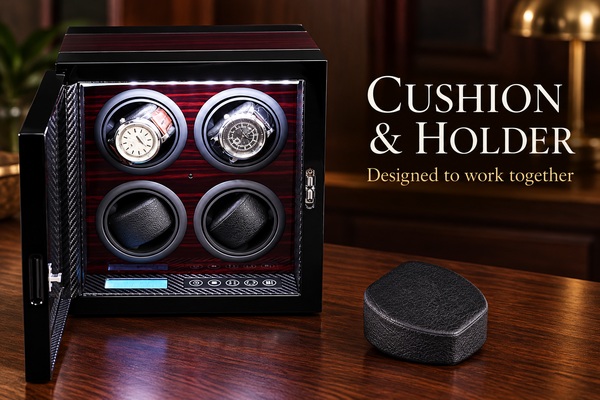
A watch winder cushion is only one part of the fitting system. Depending on the design, it must also work with a matching holder or molded plastic mounting component inside the rotator. The cushion’s shape, dimensions, and attachment method need to suit that structure so it can be installed securely.
This means a cushion that fits a watch bracelet will not necessarily fit every watch winder. When selecting an alternative or replacement, confirm both the watch-to-cushion fit and the cushion-to-holder compatibility for the specific model.
Signs That the Fit Needs Attention
The bracelet or strap will not close comfortably
If closing the clasp requires force, the cushion may be too large for the bracelet’s current setting. Do not force the clasp or stretch the strap around it. Check whether the cushion has an approved adjustment or whether a compatible alternative is available.
The watch moves on the cushion
If the closed bracelet is much larger than the cushion, the watch may move or slide. A secure-looking installation should still be checked according to the product instructions. Ask the supplier about a compatible cushion or approved solution if the watch cannot be held securely.
The case, crown, or clasp is close to the interior
Look at the watch after the cushion is installed. The case, crown, bracelet, and clasp all need appropriate space around surrounding components and the lid. A watch that fits on the cushion may still be unsuitable for the available space inside a particular winder.
There is visible rubbing or a concerning sound
Contact between a watch and the interior is one possible cause of rubbing or scraping, but a sound alone does not establish its source. Stop the winder if there is visible contact, abnormal movement, or a significant unexpected sound, and contact the seller or supplier with your observations.
Measurements That Help Determine Compatibility
Closed bracelet or strap circumference
Close the bracelet or buckle the strap at the setting normally used. Measure the inside circumference with a flexible measuring tape where practical. Avoid pulling the tape tight enough to distort the loop. If the shape makes an exact measurement difficult, tell the supplier how it was measured and provide a photograph if useful.
This measurement gives the supplier a starting point for comparing the watch with a cushion’s stated range. It should not be treated as the only factor in a fit decision.
Watch case dimensions
Provide the case diameter and thickness, and clarify how they were measured. Also mention any projecting crown, pushers, unusual case shape, or prominent clasp that may affect the space the watch occupies. A supplier may need a photograph or an actual watch to assess a difficult fit.
Cushion circumference and width
Ask for the cushion’s dimensions and its applicable circumference range, if available. The range must be verified for the specific cushion and its intended configuration.
For an adjustable or compressible cushion, ask how the minimum and maximum values were measured. For a two-layer design, ask whether the range refers to the cushion with or without the outer sleeve. Compare the width and shape with the actual watch and mounting arrangement as well; width alone does not prove compatibility.
Space inside the winder
The available space is affected by the installed cushion, the position of the watch, the rotator, surrounding dividers, and the lid. Ask the supplier what dimensions can be verified for the model and whether they can assess the watch and cushion together. A single maximum case diameter may not account for a thick case or prominent crown.
How to Check the Fit Safely
Important: Do not manually rotate the watch holder or rotator unless the manufacturer specifically instructs you to do so. Forcing the mechanism may damage the drive system. Use the winder’s normal operating cycle to observe clearance and contact.
- Stop the winder. Switch it off and wait until the rotator has stopped before inserting or removing the cushion. Follow the model’s instructions.
- Fit the watch to the cushion. Use the adjustment intended for that cushion, if applicable. Close the bracelet or strap without forcing it and check that the watch sits securely.
- Install the cushion. Fit it into its intended holder according to the product instructions. Mounting arrangements differ, so do not force an unfamiliar cushion into place.
- Inspect visible clearance. Check the watch, crown, bracelet, clasp, and nearby components. Close the lid carefully only if the instructions permit and there is no apparent obstruction.
- Observe normal operation. If the instructions allow, run the normal cycle and observe whether the watch remains secure and clear of surrounding parts. Do not reach into moving parts.
- Stop if something appears wrong. Visible rubbing, abnormal movement, or an unexpected sound warrants stopping the unit. Record the model, what happened, and a short video if useful, then contact the seller or supplier.
Common Fit Questions
What if the bracelet is too small for the cushion?
If the bracelet will not close comfortably, do not force it. Check whether the cushion is designed to contract, compress, or be used without an outer layer, and follow its instructions. If the fit remains too tight, ask the supplier whether a compatible alternative is available for that model.
What if the watch is loose on the cushion?
Confirm that the watch is fitted correctly and that any supplied cushion components are installed as intended. If it remains loose, ask the supplier about an approved, compatible solution. Do not assume that adding fabric or an unrelated accessory will provide a secure fit or sufficient clearance.
What about a large or thick watch?
Provide the case diameter, thickness, and details of any projecting crown or pushers. The bracelet may fit the cushion while the watch itself lacks clearance, so ask the supplier to assess both parts of the fit. Where possible, evaluate a sample with the actual watch.
Are replacement cushions universal?
No. Cushions differ in shape, dimensions, and mounting method. Some cushions may be compatible across specific models, but a similar appearance does not establish that they are interchangeable.
Before ordering, provide the winder model and clear photographs of the existing cushion and holder. Confirm the replacement’s mounting method and dimensions with the supplier. Availability of replacements or alternative sizes depends on the model and supplier.
What B2B Buyers Should Confirm
For retailers, distributors, importers, and private-label brands, cushion fit affects the information customers need before purchase. Discussing it during sample evaluation can help identify potential mismatches and support clearer product listings.
Ask the manufacturer or supplier to clarify:
- Cushion dimensions and method: What are the width and circumference, and how were the figures measured?
- Applicable range: Is there a verified bracelet circumference range for the specific cushion and configuration?
- Construction: Is the cushion spring-loaded, compressible, or supplied with a removable outer layer? How should customers use it?
- Mounting and alternatives: How does the cushion attach? Does it require a matching molded plastic holder or mounting component, and are compatible alternatives available for the particular model or project?
- Watch clearance: What can the supplier verify about case diameter, thickness, crown, and clasp clearance? Can a sample be checked with representative watches?
- Product information: Which measurements, fitting instructions, and limitations should appear in the listing or instruction manual?
- After-sales arrangements: How will fit questions and replacement requests be handled for the chosen model? Confirm availability before making a customer promise.
For a wholesale or OEM/ODM project, evaluate the sample with watches representative of the intended market, including different bracelet lengths and case profiles. Agree with the supplier on the watch dimensions and fit checks that matter to the project before approving the product.
Choosing a Cushion with Confidence
A suitable watch winder cushion should hold the watch securely, close comfortably around its bracelet or strap, and fit its intended holder. The assembled watch also needs sufficient clearance inside the winder. Confirm all of these factors rather than relying on one dimension.
For brands and retailers, documenting the cushion type, measurement method, and verified fit information can make it easier to discuss a product with customers. Ezicase supports B2B buyers with watch winder sourcing and project discussions. Share the intended product model, watch dimensions, and purchasing requirements so the relevant options can be evaluated.