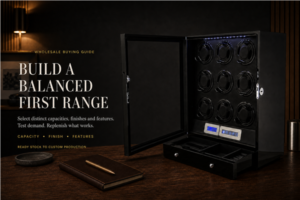
Planning a range of private label watch winders often starts with a product idea, a logo and a target price. To turn that idea into a suitable product, brands and retailers also need to communicate how the watch winder should look, operate and be presented to customers.
A useful private label watch winder brief should identify the intended customer, product design, winding and storage capacity, materials, branding, functional requirements, power supply, packaging and expected order quantity. The supplier can then assess which existing models or development options suit the project and confirm the details that affect sampling and production.
A brief does not need to be a complete engineering document. A reference photograph, an existing sample or a list of priorities can provide a starting point. The aim is to give the manufacturer enough information to understand your requirements and identify what still needs to be discussed.
Choose Your Private Label Development Route
Private label watch winders can be developed in different ways. The right approach depends on the desired appearance, functional requirements, order quantity and budget.
Add Branding to an Existing Design
A brand selects an existing watch winder and discusses where and how its logo can be applied. Packaging and other details may also be considered according to the project.
This route can suit retailers and distributors who want to introduce a branded product using an established structure. The buyer should still confirm the logo method, sample requirements, minimum order quantity and delivery schedule.
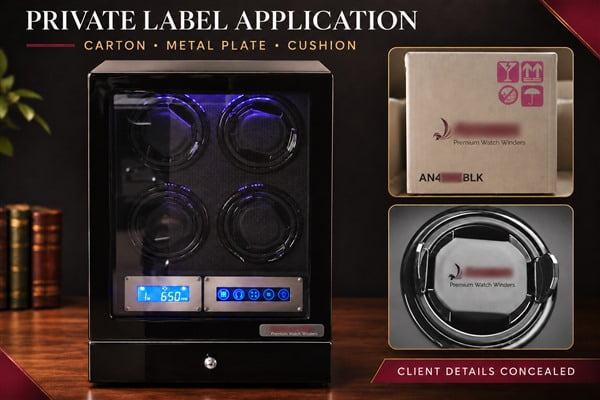
One practical example involved applying a buyer's branding to an existing watch winder through coordinated carton printing, an adhesive laser-marked metal plate on the cabinet, and branding on the watch cushions. The available branding positions and application methods should be confirmed for the selected product, surface and order requirements.
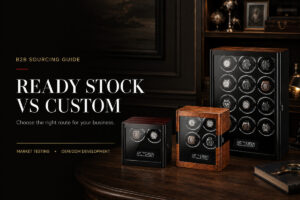
An existing design is not necessarily available from stock. Some models may be available as ready stock, while others are made to order. If stock is available, the quantity, color, plug and packaging should be confirmed before an order is placed.
Modify an Existing Design
A buyer starts with an existing structure and requests selected changes. Depending on the product and project, these may involve the exterior finish, interior color, logo, hardware or other configuration details.
In one of our modification project, an established six-position watch winder was retained while the original black leather was changed to red leather. The cabinet structure, winding layout and control arrangement remained unchanged, allowing the buyer to create a more distinctive visual direction without developing a new product structure.
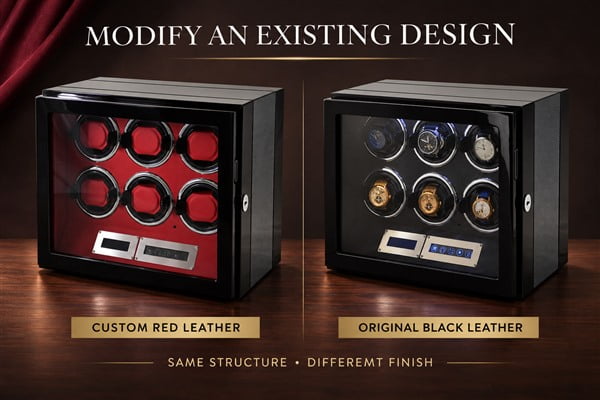
This route can give a collection a more distinctive appearance while using an established product as the starting point. The manufacturer still needs to review whether each requested change is suitable for the existing construction and commercially practical for the planned order quantity.
For example, changing a surface color and changing the size or shape of a cabinet do not necessarily involve the same development work. Provide reference images or samples and identify which details are essential and which are flexible.
Develop a New Design
A new design may be appropriate when the intended structure, presentation or combination of features cannot be achieved with an existing model.
Buyers can begin with sketches, reference photographs, a physical sample or a written brief. The manufacturer can review the concept, discuss feasible construction and prepare a physical sample for evaluation. Depending on the design, the project may involve additional development work, tooling or specialist processing.
The scope, costs, ownership and any exclusivity arrangements should be agreed separately. A new design should not automatically be assumed to be exclusive to one buyer.
Define the Target Customer and Product Positioning
Before choosing materials or functions, describe who the product is intended for and where it will be sold.
A watch brand may want a winder that coordinates with its existing collection. A retailer may need several capacities at different price points. A gift company may prioritize presentation, branding and packaging.
Useful information includes:
- Target customers and their likely watch collections.
- Intended sales channels, such as retail stores, online sales or corporate gifting.
- Desired product positioning and appearance.
- Target price range and the commercial basis used for comparison.
- Whether the product is intended as a standalone item or part of a coordinated collection.
This context helps the supplier recommend a suitable starting model and identify which features matter most to the project.
Specify Winding Capacity, Rotators and Storage
Capacity descriptions are easier to understand when winding and static storage are listed separately.
Winding Capacity and Rotator Count
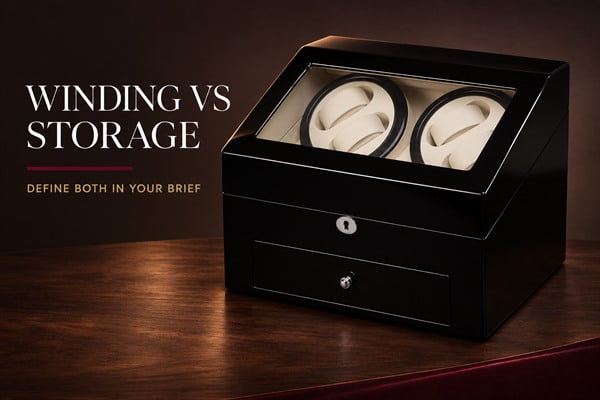
Winding capacity is the number of watches that can be placed in active winding positions. Rotator count is the number of rotating modules.
The two figures are not always the same. For example, a watch winder may have two rotators, each designed to hold two watches. Its winding capacity is four watches, while its rotator count is two.
If different watches need different settings, ask whether the selected product allows control by individual rotator or group. The control arrangement depends on the model.
Static Watch Storage and Drawers
Static positions provide storage for watches that do not need active winding. Drawers or compartments may be used for accessories when their layout is suitable.
For example, a 4+6 watch winder has four winding positions and six additional static watch positions. It does not mean that all ten watches are wound.
When preparing your brief, specify:
- Number of watches to be wound simultaneously.
- Desired number of rotators, if important.
- Number of additional static watch positions.
- Whether drawers or accessory compartments are required.
- Whether individual or grouped controls are needed.
The watch winder storage configuration guide explains how winding positions, static storage and drawers can be combined.
Consider Watch Fit and Cushion Compatibility
A product’s stated capacity does not establish that every watch will fit. Case dimensions, bracelet circumference and the space around the installed watch all affect compatibility.
Provide measurements or examples of the watches your customers are likely to use, including:
- Case diameter and thickness.
- Bracelet or strap circumference.
- Protruding crowns, pushers or unusual case shapes.
- Clasp and bracelet construction.
- Watch weight, where this may affect the selected arrangement.
The cushion must hold the watch securely without forcing the bracelet or clasp closed. It must also fit the matching holder or molded mounting component used in that particular watch winder. A cushion that fits a bracelet is not automatically interchangeable with every winding module.
For larger watches or an important customer application, ask the supplier to assess a physical sample with representative watches. See the watch winder cushion size guide for a more detailed explanation of fit and clearance.
Describe Materials, Finish and Construction
Reference photographs help communicate a style, but appearance alone does not fully describe how a watch winder is made. Where possible, distinguish the underlying construction from its visible finish.
Exterior
Describe the preferred shape, color and surface appearance. Depending on the project, the supplier can assess options such as:
- Lacquered or painted finishes.
- Wood veneer or woodgrain effects.
- PU leather wrapping.
- Genuine leather wrapping.
- Other surface treatments suitable for the chosen construction.
For example, a woodgrain appearance does not by itself establish that the cabinet is made from solid wood. Confirm the core material and surface treatment in the quotation and sample record.
Interior and Hardware
Specify the desired lining material and color, along with any requirements for cushions, dividers or storage areas. If a viewing window, lock or particular hardware finish is important, include it in the brief.
Provide a color reference or material sample where possible. Final choices should be confirmed on the physical product or agreed sample, since screens and photographs may not show colors and textures accurately.
Prepare Logo and Branding Requirements
A clear branding brief helps the manufacturer evaluate the artwork and recommend an application method suitable for the surface.
Provide:
- The logo file, preferably in a scalable vector format.
- The preferred logo position and approximate size.
- Required colors or finish.
- Whether the logo should appear on the exterior, interior, packaging or instructions.
- Any brand guidelines that affect spacing or presentation.
Possible methods may include silk printing, hot stamping, embossing or debossing, and metal logo plates, depending on the material and structure.
A method suitable for a flat painted surface may not be suitable for textured PU, fabric or curved hardware. The final method and its appearance should be reviewed on the actual sample surface.
Confirm Winding Functions and Controls
The functional brief should describe how the finished watch winder is expected to operate. Different models may use different programs and controls, so avoid assuming that every configuration offers the same settings.
Discuss the following with the supplier:
- Rotation direction: Clockwise, counterclockwise or bidirectional options, as required.
- TPD settings: The available preset turns per day and how they are selected.
- Control arrangement: Whether rotators or groups are controlled separately.
- User interface: The preferred control type, subject to the model.
- Additional features: Any requirements for lighting, locks, remote control or door-open stop.
Some products offer selectable preset settings rather than freely adjustable TPD. Confirm the actual settings and instructions for the chosen model.
If the product is intended for a particular range of watches, buyers should refer to the relevant watch or movement manufacturer’s guidance when assessing winding requirements.
State the Destination Market and Power Requirements
The destination market helps determine which power supply and plug arrangement should be discussed. If the product will be sold in more than one region, list the markets and expected quantities for each.
The project brief should include:
- Destination country or region.
- Preferred plug type and power arrangement.
- Any adapter, labeling or instruction requirements.
- Required product or component documentation.
- Any additional testing or certification requirements relevant to the project.
The applicable documentation depends on the product, components, configuration and market. Buyers and suppliers should confirm the scope of available documents and any additional requirements before production.
Include Packaging and Commercial Requirements
Packaging needs can differ between online retail, physical stores, corporate gifts and wholesale distribution. A project brief should identify the presentation expected by the buyer as well as the protection needed during transport.
Discuss the scope of:
- Individual product packaging.
- Retail or branded gift packaging, if required.
- Protective materials and master cartons.
- Instruction manuals and product labels.
- Branded inserts or other accessories.
Also provide the estimated order quantity, target price range, preferred trade terms and project schedule. If some details are still undecided, identify the priorities and ask the supplier which options have the greatest effect on cost or feasibility.
A target price is useful when its basis is clear. For example, the price should specify whether it includes the product only or also includes particular packaging, accessories or services.
Private Label Watch Winder Project Brief Checklist
Use the following checklist when preparing your inquiry. It is acceptable to leave a point open if you need the supplier’s recommendation.
- [ ] Project route: Existing design with branding, modified design or new development.
- [ ] Target market: Customer type, sales channel and destination countries.
- [ ] Product positioning: Intended appearance, application and target price range.
- [ ] Winding capacity: Number of watches to be wound at the same time.
- [ ] Rotators: Desired number of rotating modules and control arrangement.
- [ ] Additional storage: Static watch positions, drawers or accessory compartments.
- [ ] Watch fit: Representative watch dimensions, bracelet sizes and cushion requirements.
- [ ] Materials and finish: Exterior construction, color, lining, window and hardware.
- [ ] Branding: Logo file, size, placement and preferred method.
- [ ] Functions: Required programs, directions, controls and other features.
- [ ] Power and documents: Destination market, plug and documentation needs.
- [ ] Packaging: Individual packaging, retail presentation, instructions and transport protection.
- [ ] Commercial details: Estimated quantity, target price basis and desired schedule.
- [ ] Reference materials: Product photographs, sketches, color references or physical samples.
Review the Quotation and Physical Sample
After the supplier reviews your brief, compare the quotation with the requirements you provided. Check what is included and clarify any item that remains open.
Pay particular attention to:
- Product configuration and winding versus storage capacity.
- Materials, colors and surface finish.
- Logo method, size and position.
- Winding programs, controls and selected features.
- Power adapter, plug and included accessories.
- Packaging scope.
- Sample cost, tooling or setup charges, if applicable.
- Order quantity, trade terms and expected schedule.
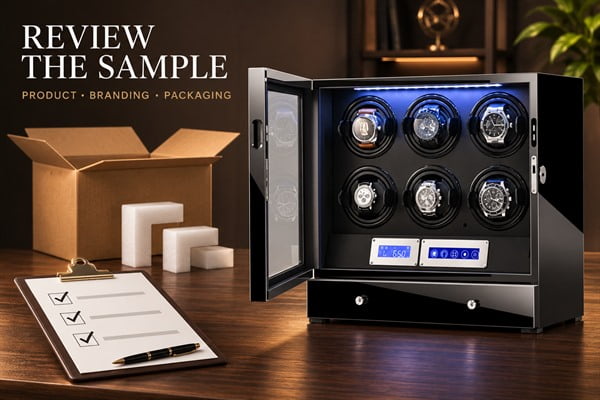
A physical sample allows the buyer to review how the details work together. Check the appearance, construction, watch fit, operation and included accessories against the agreed specification. Record any requested changes clearly and confirm how they will be addressed before approval.
Once a sample is approved, both parties should identify the agreed production reference and any remaining details in writing. The exact sample retention and approval arrangement should be confirmed for the project.
Common Questions
What is the MOQ for private label watch winders?
The minimum order quantity depends on the selected model and the scope of customization. A project using an existing structure with branding may have different requirements from one involving new materials, components or development.
Ask the supplier to confirm the MOQ for the specific configuration rather than assuming that one quantity applies to every product.
Can a ready-stock watch winder be branded?
This depends on the product, the requested logo method and the quantity. A model may be available from stock without branding, while adding a logo or changing its packaging may require additional arrangements. Confirm the current stock and branding options for the chosen model.
Do I need technical drawings before contacting a manufacturer?
Not necessarily. A reference photograph, an existing product, a physical sample or a clear written description can start the discussion. The manufacturer can then identify which dimensions and specifications need further clarification.
Can I request different cushion sizes?
You can include the desired watch or bracelet sizes in your brief and ask the supplier to assess compatible options. Any alternative cushion must also fit the selected watch winder’s holder or mounting structure.
Preparing for a Productive First Discussion
A clear private label brief gives the manufacturer a better starting point for reviewing product options, customization feasibility and quotation scope. It also gives both parties a reference when checking the physical sample and preparing for production.
If you are developing a private label watch winder collection, Ezicase can discuss existing product structures and project requirements with your team. Share your target capacity, reference design, branding needs, destination market and estimated quantity to begin the discussion.