
A Seiko Kinetic watch and an automatic mechanical watch both use movement to obtain energy. If you own or sell watch winders, it is natural to ask whether a conventional watch winder can also keep a Seiko Kinetic watch charged.
A Seiko Kinetic watch generally does not need a conventional watch winder for everyday use. Kinetic watches store electrical energy and can have a longer power reserve than automatic mechanical watches. Seiko also states that a mechanical watch winder is unsuitable for charging a Kinetic watch. For charging, follow the instructions for the specific Seiko caliber.
For retailers and distributors, the distinction matters: a watch may fit securely on a winder cushion, but physical fit does not establish that the winder is an appropriate charging device.
Why Do People Ask About Seiko Kinetic Watch Winders?
The question makes sense because both Kinetic and automatic mechanical watches use the motion of the wearer.
Inside each watch, an oscillating weight responds to movement. That movement starts a process that allows the watch to store energy. However, the two systems store and use that energy differently.
An automatic mechanical watch uses the motion to wind a mainspring. A Seiko Kinetic watch uses it to drive a small generator, with the resulting electrical energy stored in a rechargeable energy-storage unit.
A conventional watch winder provides programmed movement for compatible automatic mechanical watches. Whether a particular device can deliver a useful charge to a specific Kinetic watch is a separate question.
How Long Can a Seiko Kinetic Watch Run on a Full Charge?
The answer depends on the caliber and whether the watch has a power-save function.
For example, Seiko specifies approximately six months of operation on a full charge for the Kinetic 5M62 and 5M63 movements. The figure for the 3M62 is approximately two months.
These are full-charge specifications. The actual reserve depends on how much energy is stored and the condition of the watch.
| Seiko Kinetic caliber | Seiko's stated duration on a full charge |
|---|---|
| 3M62 | Approximately 2 months |
| 5M62 / 5M63 | Approximately 6 months |
| 7D48 Kinetic Perpetual | Approximately 6 months of operation; the time-relay function can remain operable for approximately 4 years under the specified power-save conditions |
Sources: Seiko 3M62, 5M62 and 5M63 instructions and Seiko 7D48 instructions.
Does a Seiko Kinetic Watch Run for Four Years?
Some Kinetic models can retain time information for approximately four years in power-save mode. That does not mean the hands keep moving normally for four years.
For example, on the 7D48 Kinetic Perpetual, the hands stop in power-save mode while the internal circuit continues to calculate the time. When a sufficient amount of electrical power is generated again, the time-relay function can adjust the hands to the retained time.
Seiko states that the time-relay function can remain operable for approximately four years when a fully charged watch enters power-save mode. The duration depends on the energy stored in the watch. Not every Kinetic caliber has this function.
When describing a watch to customers, “approximately four years in power-save mode” and “four years of normal operation” are not interchangeable claims.
Seiko Kinetic vs. Automatic Mechanical Watches
Both watch types use movement, but their energy systems have different components and store energy in different ways.
| Comparison | Automatic mechanical watch | Seiko Kinetic watch |
|---|---|---|
| Source of motion | Movement of the watch | Movement of the watch |
| Energy conversion | An oscillating weight helps wind a mainspring | An oscillating weight drives a generator through a gear train |
| Energy storage | Mechanical energy in a mainspring | Electrical energy in a rechargeable storage unit |
| Timekeeping | Mechanical movement | Electrically powered quartz movement |
| What to check | The movement's winding requirements and the winder's settings | The specific caliber's operating and charging instructions |
How an Automatic Mechanical Watch Stores Energy
An automatic mechanical watch uses an oscillating weight and winding mechanism to wind its mainspring. The mainspring then releases energy to operate the movement.
When the watch is not being worn, a compatible watch winder can provide programmed movement to help maintain its power reserve. Appropriate settings depend on the watch movement and the winder.
How a Seiko Kinetic Watch Stores Energy
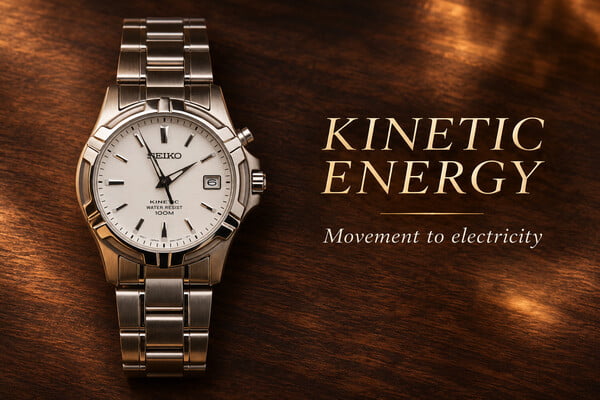
A Kinetic watch also uses an oscillating weight, but the weight drives a miniature generator through a gear train. The generated electrical energy is stored and used to power the quartz movement.
The resulting energy storage is therefore different: a mechanical watch stores energy in a spring, while a Kinetic watch stores electrical energy.
Some Kinetic watches have additional features. For example, certain Kinetic Direct Drive movements also allow energy generation by turning the crown. Follow the instructions for the specific caliber.
Can a Conventional Watch Winder Charge a Seiko Kinetic Watch?
Seiko states in its service guidance that an auto-winder intended for a mechanical watch is unsuitable for charging a Kinetic watch. The guidance recommends following the appropriate swinging and wearing instructions for the watch.
Read Seiko's Kinetic service guidance.
This recommendation does not mean that a watch inside a winder cannot move. It means a conventional mechanical watch winder should not be treated as a reliable Kinetic charging device.
A winder's advertised turns per day, or TPD, describes its operating program. It does not by itself tell you how much electrical energy a specific Kinetic movement will generate or store.
A device would need appropriate evidence for the relevant watch and operating conditions before its Kinetic charging performance could be claimed. We have not assumed such compatibility for the conventional watch winders discussed in this article.
Why Is Movement Alone Not Enough to Confirm Charging?
The watch winder rotates the complete watch. Inside it, the oscillating weight moves relative to the movement and drives a gear train connected to the generator.
The amount of useful energy obtained depends on the actual motion and the watch's internal energy-conversion system. The operating pattern, watch orientation, mechanical losses and storage-unit condition can all affect the result.
A research study examining a Seiko Kinetic 5M63 movement found that motion input and internal mechanical losses affected generator output. However, the study did not test every watch winder or establish a universal charging setting.
Read the research paper on Seiko Kinetic micro-generators.
For a retailer, the practical point is straightforward: “the watch rotates” is not the same claim as “the watch is being charged effectively.”
Does a Seiko Kinetic Watch Need a Watch Winder?
For ordinary use, a conventional watch winder is generally not necessary for a Seiko Kinetic watch.
A fully charged Kinetic watch may have months of power reserve, depending on the caliber. Some models also have a power-save feature that retains time information when the hands have stopped. These characteristics can reduce the need to keep the watch moving between wears.
That does not mean a Kinetic watch never needs attention. If the watch has low or depleted energy, follow the instructions for its caliber. The available reserve depends on how much energy has been stored and the condition of the watch.
For example, Seiko's 5M62 instructions describe swinging the watch at the recommended pace and then wearing it. The manual provides swing counts as charging guidelines, not as a way to calculate an equivalent watch-winder setting.
What Is a Conventional Watch Winder Designed to Do?
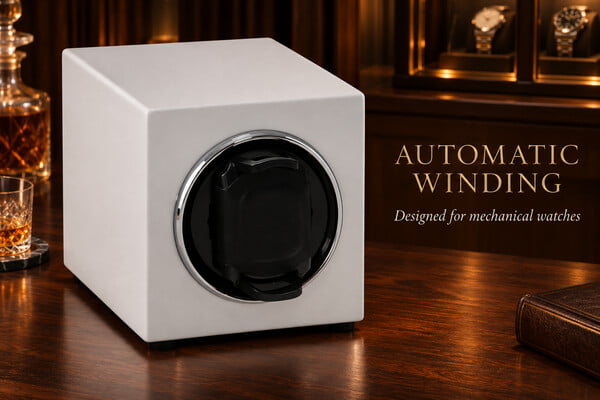
A conventional watch winder rotates a compatible automatic mechanical watch while it is not being worn. Its purpose is to help maintain the watch's power reserve through a programmed operating cycle. For example, this white single watch winder is designed for one automatic mechanical watch.
Depending on the model, a winder may provide different:
- Rotation directions.
- Preset turns per day.
- Rotation and rest intervals.
- Controls for individual rotators or groups.
These settings should be checked against the requirements of the watch and the specifications of the selected winder. Not every model offers the same controls.
For brands and retailers, describing the intended watch type clearly helps customers understand what the device is designed to do.
A Manufacturer's Perspective: Watch Fit and Charging Are Separate
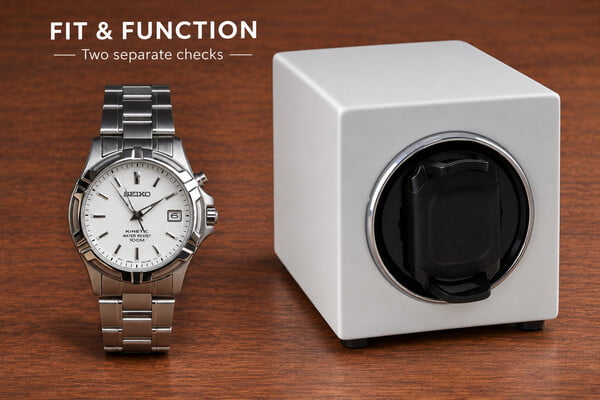
When selecting a watch winder, physical compatibility still matters. The watch should sit securely on the cushion and have enough clearance around the case, crown, clasp and surrounding components.
However, a secure fit answers only a physical question. It does not verify that the device provides a suitable charging program for a Kinetic watch.
For a customer who wants to store a Kinetic watch without using a winding function, a static watch case may be worth considering. Check the cushion dimensions and internal clearance before selecting a case.
What Should Buyers Check?

Identify the Watch Caliber
Look for the caliber information on the watch and use it to find the corresponding instructions. Seiko has produced Kinetic movements with different power reserves and features.
The official Seiko instruction page allows owners to find manuals by caliber.
Check the Power Reserve and Charging Instructions
Find out how the specific movement indicates low energy, how Seiko recommends replenishing it and whether the watch has a power-save or time-relay function.
If the watch does not hold charge as expected, its condition may need professional assessment. A shorter-than-expected reserve should not automatically be attributed to the way it is stored.
Confirm the Device's Intended Function
A conventional automatic watch winder, a static watch box and a device specifically intended for Kinetic charging may serve different purposes.
Ask the manufacturer what the device is designed to do. If Kinetic charging is claimed, request information about the compatible watch movements and the evidence supporting that claim.
Check Physical Fit Separately
For any storage product, check:
- Cushion size and the watch's closed bracelet or strap circumference.
- Case diameter and thickness.
- Clearance around the crown, pushers and clasp.
- Space between the watch, holder, surrounding components and lid.
- Whether the cushion sits securely in its intended holder.
These checks help establish physical fit; they do not establish charging performance.
How Retailers Can Explain This to Customers
A retailer can answer a Kinetic owner without making a claim that has not been verified:
“This watch winder is designed for compatible automatic mechanical watches. Seiko Kinetic watches store electrical energy differently and generally have a longer power reserve. Seiko states that a mechanical watch winder is unsuitable for charging a Kinetic watch, so we recommend following the instructions for your specific Seiko caliber.”
For product listings, identify the intended watch type and describe the actual functions of the model. Avoid broad wording such as “charges all watches powered by movement.”
If a customer asks about a particular product, confirm its specifications and intended use before giving a compatibility answer.
When Is an Automatic Watch Winder Useful?
An automatic watch winder can be useful for a compatible automatic mechanical watch that is not worn every day. It can help maintain the watch's power reserve and reduce how often the owner needs to reset the time or other functions.
When selecting winders for a retail range or an OEM/ODM project, buyers may also consider:
- The number of watches that can be wound.
- Rotator count and watches per rotator.
- Available programs and directions.
- Whether rotators or groups can be controlled separately.
- Confirmed cushion dimensions and watch clearance.
- Additional static storage positions or drawers.
These features vary by model and should be described accurately. Winding capacity, rotator count and storage capacity are separate specifications.
Explore the Ezicase watch winder collection for products intended for compatible automatic mechanical watches.
Frequently Asked Questions
Is a Seiko Kinetic watch an automatic mechanical watch?
No. A Kinetic watch uses movement to generate electrical energy, which is stored and used to power a quartz movement. An automatic mechanical watch uses movement to wind a mainspring.
Do all Seiko Kinetic watches have a four-year power reserve?
No. Power reserve and available functions vary by caliber. Some models can retain time information for approximately four years under specified power-save conditions, but the hands stop in that mode. Seiko specifies approximately six months of normal operation on a full charge for the 5M62 and 5M63.
Can I store a Kinetic watch in a watch winder?
It may be physically possible if the watch fits securely and has sufficient clearance. If the goal is storage, a static watch case is another option. Physical fit does not mean that the winder is suitable for charging the watch.
Does fitting on the cushion mean the device can charge the watch?
No. Cushion fit concerns how the watch is supported. Charging performance concerns whether a device provides suitable energy to the specific watch under the relevant conditions. These are separate checks.
How do I charge a Seiko Kinetic watch?
Follow the official instructions for the specific caliber. Charging procedures and additional functions can differ between models. If you are unsure of the caliber or the watch is not holding charge as expected, contact Seiko or a qualified watch service professional.
Choose the Device for the Watch's Actual Needs
Seiko Kinetic and automatic mechanical watches share a connection to movement, but they store energy differently. A Kinetic watch generally has a longer reserve and does not need a conventional watch winder for everyday use. Seiko also advises that a mechanical watch winder is unsuitable for Kinetic charging.
For brands, retailers and distributors, the most useful distinction is between physical fit, storage and verified operating function. Clear product descriptions help customers choose an appropriate solution without assuming that every movement-powered watch needs the same accessory.
Ezicase manufactures watch winders for compatible automatic mechanical watches and supports brands, retailers and distributors with product selection and customization. Functions, settings and watch-fit information should be confirmed for each model.