
An automatic watch may stop after it has been left unworn beyond its power reserve. For watches that require repeated time, date, or complication adjustments, a watch winder can offer added convenience.
A watch winder is a powered storage and presentation device that periodically rotates a compatible automatic watch while it is not being worn. With suitable settings, it can help the watch maintain its power reserve and remain ready to wear.

As a sales manager at Goochy, I talk to many buyers who want to understand watch winders better. Drawing on years of working with clients and coordinating with our factory teams, I will explain how these devices operate and which factors buyers should evaluate. You can also explore our watch winder collection to compare different capacities and configurations.
Why Do Automatic Watches Need Winding, and How Do Winders Help?
Automatic watches use movement to wind their mainspring. When left unworn beyond their available power reserve, they may stop and require resetting before use.
Automatic watches use a rotor to wind their mainspring through wrist motion. When the stored power is depleted, the movement stops. A suitably configured winder periodically rotates the watch to help maintain its power reserve.
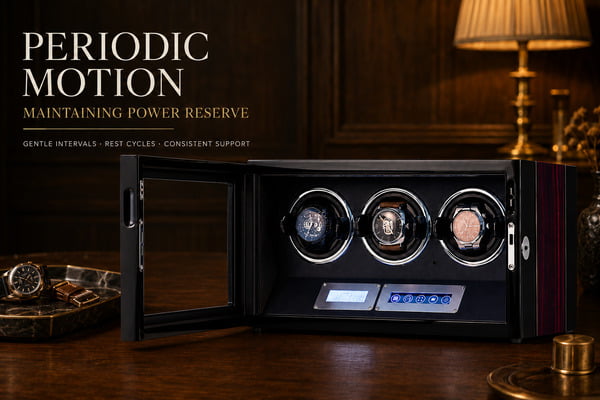
Understanding the movement is the starting point for understanding a watch winder. An automatic watch receives energy from a mainspring. During wear, wrist movement causes a weighted rotor inside the watch to turn, helping wind the mainspring and store energy. When the watch is removed, it continues running on that stored power until its available reserve is depleted. Power-reserve duration varies considerably by movement, so owners should refer to the watch manufacturer's specifications rather than assume a universal range. A watch winder recreates periodic rotational motion without the watch being worn. With compatible TPD and direction settings, this motion can help maintain the watch's power reserve and reduce the need to reset time, date, or other complications. It is a convenience device rather than a requirement for every automatic watch, and it does not replace normal watch servicing or care.
How Automatic Watches Power Up:
- Rotor: A half-moon shaped weight inside the watch.
- Motion: Wrist movement causes the rotor to spin.
- Mainspring: Rotor's movement winds the mainspring, storing energy.
- Power Reserve: Stored energy keeps the watch running for a movement-specific period.
Winder's Role:
- Provides periodic rotational motion.
- Helps a compatible movement maintain its power reserve.
- Can reduce repeated resetting when suitable settings are used.
What Makes a Good Watch Winder, and Are All Winders the Same?
You see many watch winders online. It is easy to think they are all alike. But this is not true. Quality varies greatly.
A well-made watch winder should provide stable rotation, suitable preset winding programs, appropriate watch support, and construction suited to its intended use. Motor noise, controls, materials, and protective features vary by model and manufacturer.

In my experience with product projects and buyer feedback, watch winders can differ significantly in component choice, programming, construction, and quality control. The motor is one important factor, but its brand or country of origin alone does not establish performance; buyers should also consider verified noise conditions, rotation consistency, service life testing, and installation quality. Preset Turns Per Day (TPD) programs and rotation directions should be compared with the requirements of the intended watch movements. Materials and workmanship also affect appearance, stability, durability, and market positioning. Depending on the design, a winder may use lacquered MDF, veneer, leather-wrapped panels, plastic, metal, or combinations of these materials. Electromagnetic performance should likewise be evaluated from the actual product structure and test information rather than assumed from general marketing language. For a more detailed procurement checklist, see our B2B guide to choosing a high-quality watch winder.
Key Differences in Watch Winders:
| Feature | High-Quality Winder | Low-Quality Winder |
|---|---|---|
| Motor | Verified rotation consistency and acceptable noise under stated test conditions | Unverified performance or inconsistent operation |
| Settings | Preset TPD and direction options suited to the intended movements | Programs that do not match the intended movement requirements |
| Materials | Materials and finishes appropriate for the design and target market | Poorly finished or unsuitable components and surfaces |
| Electromagnetic Performance | Product-specific design and test information available | No clear specification or supporting information |
| Quality Control | Defined checks for rotation, controls, fit, finish, and packaging | Limited or unclear inspection standards |
How Do I Choose the Right Watch Winder Settings, and Why Does TPD Matter?
After choosing a watch winder, the next step is matching its available programs to the watch movement. An unsuitable setting may fail to maintain sufficient power reserve, so movement-specific guidance is important.
Choosing suitable winder settings means matching the available Turns Per Day (TPD) and rotation direction to the requirements of the specific automatic watch movement.
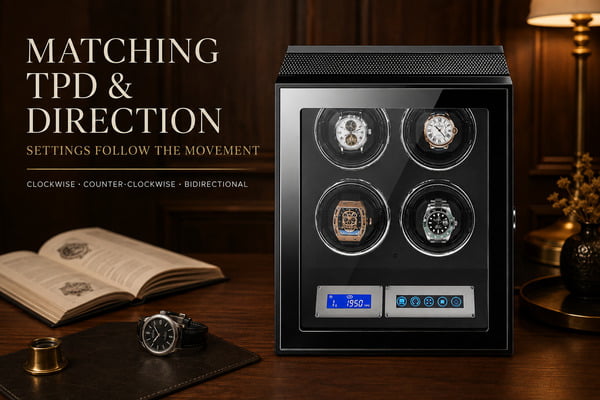
TPD is the approximate number of turns delivered during a programmed 24-hour cycle, while rotation direction may be clockwise, counter-clockwise, or bidirectional. Requirements vary by movement, and some movements wind in only one direction. If the selected TPD is too low, the winder may not maintain enough power reserve for the watch's consumption. A higher setting is not automatically better, even though many modern automatic movements use a mechanism designed to limit overwinding; excessive operation can consume more energy and add unnecessary running time to the winder. The safest approach is to check the watch manufacturer's manual or obtain movement-specific guidance. Avoid assuming that one TPD range or bidirectional program is suitable for every watch. Ezicase models use preset TPD and direction options that vary by product, so B2B buyers should match the verified program set to their target customers and markets. For a fuller explanation, read our watch winder TPD guide.
Understanding Winder Settings:
- Turns Per Day (TPD): The number of rotations a watch winder performs in a 24-hour cycle.
- Too Low TPD: Watch may stop, not enough power.
- Higher Than Needed: Not automatically more effective; it increases operating time and should be evaluated against movement guidance.
- Rotation Direction:
- Clockwise (CW): Rotates only right.
- Counter-Clockwise (CCW): Rotates only left.
- Bi-directional (Both): Rotates both right and left.
Finding Your Watch's Settings:
- Check your watch manufacturer's manual or website.
- Confirm the exact movement reference when the watch model uses more than one movement.
- Use a reputable movement database only as a secondary reference, then monitor whether the selected preset maintains sufficient power reserve.
What Are the Risks of a Bad Watch Winder, and How Can I Avoid Them?
Automatic watches can represent a significant investment. When evaluating a winder, buyers should consider both watch compatibility and the reliability of the device itself.
Poorly designed or inadequately tested winders may provide inconsistent winding, produce excessive noise, or fail prematurely. Electromagnetic performance should be assessed using model-specific design and test information where available.

Through client communication and coordination with factory teams, I have seen how inconsistent rotation, unexpected noise, weak component installation, or unclear specifications can create complaints and warranty pressure for B2B buyers. A winder that does not deliver its stated program consistently may fail to maintain the watch's power reserve. Noise performance also depends on the motor, cabinet construction, installation, operating mode, environment, and test distance, so terms such as “silent” should be supported by stated test conditions. Premature component or control failure can create additional after-sales costs, while unsuitable watch pillows or poorly aligned holders may affect fit and presentation. Because electromagnetic performance depends on the particular motor installation and cabinet structure, buyers should request product-specific information where it is material to the project. Useful procurement evidence includes the verified motor specification, preset program list, functional test process, sample inspection, materials, workmanship, and packaging method. You can also review whether a winder may overwind a watch in our watch winder safety guide.
Common Risks of Bad Watch Winders:
- Electromagnetic Concerns:
- Cause: Product-specific motor placement and cabinet design may affect electromagnetic performance.
- Effect: Potential effects should be assessed from relevant test information rather than assumed.
- Solution: Ask for model-specific specifications or test evidence when this is an important purchasing criterion.
- Inconsistent Winding:
- Cause: Unstable motors, controls, installation, or rotation mechanics.
- Effect: Watch does not get enough power, may still stop.
- Solution: Review functional testing and confirm that available presets suit the intended movements.
- Excessive Noise:
- Cause: Motor characteristics, loose components, installation, cabinet construction, or resonance.
- Effect: Annoying to the user, degrades experience.
- Solution: Compare noise information under stated test conditions and inspect a sample where possible.
- Premature Failure:
- Cause: Unsuitable components, weak assembly, or inadequate testing.
- Effect: Earlier-than-expected failure, customer dissatisfaction, or warranty issues.
- Solution: Review component specifications, workmanship, testing, and after-sales terms.
How Does Goochy Ensure Quality in Watch Winder Manufacturing, and Why Is It Important for B2B Buyers?
For B2B buyers, choosing a supplier is big. You need products that last and perform well. This means looking closely at how they are made.
Goochy manages watch winder quality through material inspection, production checks, assembly control, and model-specific functional testing. Materials, motors, features, compliance documents, and test requirements vary by product and project.
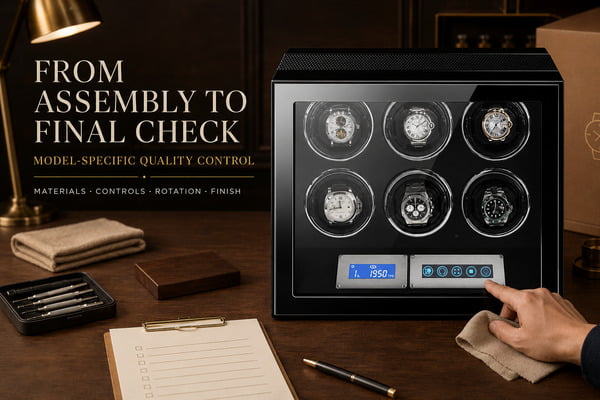
At Goochy, experience gained since 2013 in luxury storage manufacturing informs how we develop and produce watch winders. Projects begin by confirming the intended product structure, materials, finish, capacity, controls, functions, and target market. Depending on the model, construction may include lacquered or veneered MDF, leather-wrapped surfaces, plastic or metal components, and different interior materials. Motor specifications and preset winding programs are confirmed by model rather than applied as a single standard across the range. Quality checks can cover incoming materials, in-process assembly, cabinet fit and finish, controls, rotation cycles, noise under defined conditions, power operation, and final appearance. Packaging is also evaluated according to product size, weight, structure, and shipping requirements. Compliance documentation may be available for applicable products, power supplies, or components, but its scope should be confirmed for the specific order and destination market. This model-specific approach helps B2B buyers evaluate the actual product they plan to source instead of relying on broad claims. Learn more about our factory and company capabilities or review the available customization options for private-label projects.
Goochy's Quality Assurance Steps:
- Material Selection: Confirm materials and finishes against the approved sample and specification.
- Craftsmanship: Check woodworking, surface finishing, wrapping, lining, hardware, and assembly as applicable.
- Component Integration: Verify the motor, controls, power components, and installation for each model.
- Product-Specific Requirements: Confirm protective features and any related test requirements for the selected design.
- Rigorous Testing:
- Consistent rotation cycles.
- Noise checks under defined conditions.
- Overall functionality.
- Compliance: Confirm applicable documentation for the product, power supply, components, and destination market.
- Packaging: Select packaging according to the product structure and intended shipping method.
Conclusion
A watch winder is a powered storage and presentation device that can help a compatible automatic watch maintain its power reserve while it is not being worn. It is not essential for every owner, but it can be useful for people who rotate between automatic watches or prefer to reduce repeated setting. For B2B buyers, the right choice depends on movement compatibility, preset programs, capacity, construction, testing, documentation, and the needs of the target market.
For business buyers, product suitability is only one part of the sourcing decision. Order quantity, preparation time, branding requirements and market-testing goals also determine whether stock inventory or a made-to-order project is more appropriate. Our guide to ready stock vs custom watch winders explains how retailers, distributors and brands can compare these sourcing routes.
