
Navigating the world of watch storage can be a bit overwhelming, especially when you’re trying to decide between a traditional watch box and an automatic watch winder. Many watch enthusiasts, or those new to collecting, often grapple with this choice, wondering which option truly serves their timepieces best. Making the wrong decision can leave your watches unprotected or, in the case of automatics, unwound and needing frequent resetting.
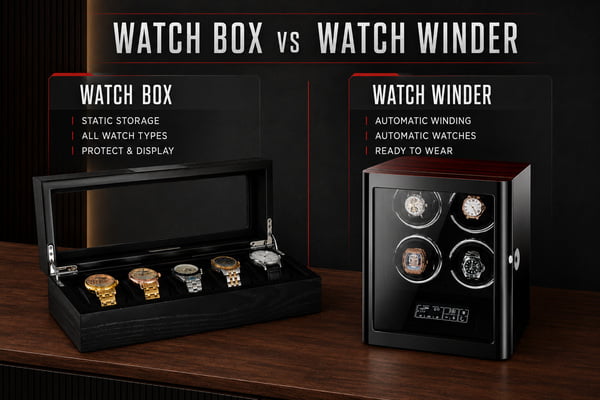
A watch box provides organized static storage for automatic, manual-wind, and quartz watches, helping reduce exposure to dust, scratches, and everyday knocks. In contrast, a watch winder is a powered device designed to help compatible automatic watches remain running when they are not being worn, reducing the need for frequent winding and resetting.
From our experience producing storage solutions for watch brands, retailers, and collectors, a well-chosen product can make a collection easier to organize, protect, and enjoy. But how do you know which one is right for you, or if perhaps you need both? Let’s look at the practical differences between watch cases and watch winders so you can make an informed decision for your collection.
What Exactly is a Watch Box, and When Should You Choose One?
Have you ever worried about where to keep your precious watches safe from dust, scratches, or even accidental drops? A watch box is the classic answer to this concern, offering a dedicated, protective space. Choosing a watch box means prioritizing secure, organized, and often aesthetically pleasing static storage for your entire collection.
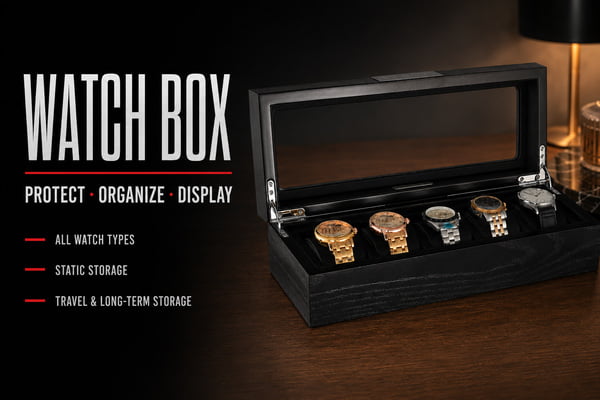
A watch box is a container designed to hold and protect watches when they are not being worn. It offers static, secure, and organized storage for all types of watches—automatic, manual-wind, and quartz—shielding them from environmental damage and physical harm, making it ideal for displaying, storing long-term, or transporting timepieces.
From a manufacturing perspective, a watch box is more than a container; it is an organizational and display solution for a collection. A well-made box can reduce exposure to dust, help prevent watches from rubbing against one another, and provide some protection from everyday knocks when they are not being worn. When we develop watch boxes at Ezicase, we consider the exterior structure, surface finish, lining, cushions, and compartment dimensions because each element affects protection, usability, and presentation. For a manual-wind watch, a quartz watch, or an automatic watch you do not wear often, a box is often a practical choice.
Beyond Simple Storage: The Craftsmanship of a Quality Watch Box
When you're considering a watch box, it's easy to think of it as just a container, but its materials, construction, and design affect both appearance and everyday use. At Ezicase, we manufacture premium storage products in structures and finishes selected for different design goals and budgets. Depending on the project, a box may use MDF, solid wood, wood veneer, lacquer, leather, or other decorative coverings. High-gloss lacquer can create a reflective finish, while leather wrapping offers a softer tactile appearance. These options can also be adapted through our customization service for OEM and ODM projects.
Inside, soft linings such as velvet, suede-like fabric, or microfiber can help reduce surface contact and scratching. Cushion size and firmness should be chosen carefully so that a bracelet or strap is supported without excessive compression. For collectors who want to see their watches while they are stored, glass or acrylic lids are common options; tempered glass may be specified on suitable designs. Concealed hinges, magnetic closures, locks, and other structural details are available depending on the model. Materials and finished products are checked during production according to the requirements of each project.
When a Watch Box is the Perfect Solution for Your Timepieces
A watch box is an incredibly versatile storage solution, suitable for almost any watch owner. It truly shines in several key scenarios:
- For All Watch Types: Whether you own automatic, manual-wind, or quartz watches, a watch box provides equally effective protection. Unlike winders, which are specific to automatics, a box is a universal solution.
- Long-Term Storage: If you have watches you do not wear every day, or vintage pieces that need organized storage, a watch box can reduce dust exposure and accidental contact. Unless a product is specifically designed and tested for environmental control, however, it should not be assumed to regulate humidity.
- Travel and Portability: Smaller travel watch cases or rolls can keep watches separated and organized while on the go. They provide useful everyday protection inside luggage, although they should not be treated as crush-proof or waterproof unless the product is specifically rated for those conditions.
- Display and Organization: Many watch boxes feature glass lids, allowing you to admire your collection even when stored. This transforms your watches from hidden treasures into a visible display, organized neatly in dedicated compartments. It also makes it easy to choose which watch to wear each day.
- Gifting and Presentation: A well-designed watch box can complement the presentation of a watch and also serve as a standalone gift. From our B2B perspective, we produce custom collection boxes for brands, wholesalers, retailers, and corporate projects.
| Watch Box: Pros | Watch Box: Cons |
|---|---|
| Universal for all watch types (automatic, manual, quartz). | Does not keep automatic watches wound. |
| Excellent protection from dust, scratches, and impact. | Watches may require manual setting if not worn regularly. |
| Organized and often elegant display solution. | Can take up significant space for large collections. |
| Often more budget-friendly than watch winders. | No active maintenance for watch movement. |
| Available in portable travel versions. | — |
What Makes a Watch Winder Different, and Why Do Automatic Watches Need It?
Have you ever picked up your favorite automatic watch, only to find it stopped and in need of resetting? This common inconvenience is what a watch winder is designed to address. But what exactly does it do, and when is it useful?
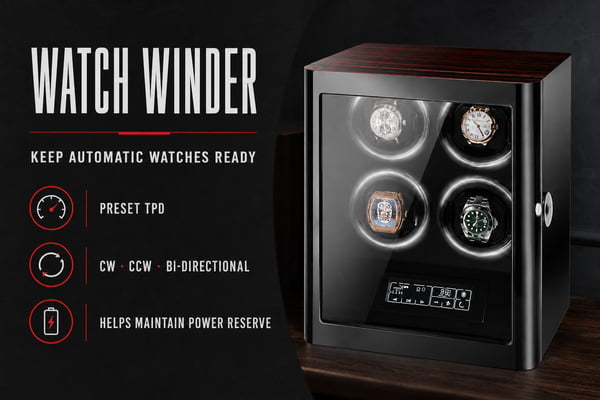
A watch winder is an automated device designed to rotate compatible automatic watches at intervals when they are not being worn. By moving the watch's rotor, it can help maintain the power reserve so the watch remains running and ready to wear without frequent resetting.
Automatic watches use wrist movement to wind the mainspring through a rotor. When a watch remains still beyond its power reserve, it normally stops and must be wound and reset before use. A watch winder provides programmed periods of rotation and rest to help maintain the power reserve of a compatible automatic movement. Its main benefits are convenience and reducing the need to reset watches with time, date, moon-phase, or calendar displays. A winder is not essential for every automatic watch, and allowing a properly maintained watch to stop is not inherently harmful. If you are new to the subject, see our guide to what a watch winder is and how it works.
The Mechanics Behind the Motion: Understanding Watch Winder Technology
The seemingly simple act of rotating a watch within a winder depends on the motor, gearbox, controller, and programmed cycle. At its core, a watch winder uses intermittent rotation to move the rotor inside an automatic watch. A key setting is "Turns Per Day" (TPD), which refers to the programmed number of rotations within a 24-hour cycle. Automatic movements can differ in their recommended TPD and winding direction—clockwise, counter-clockwise, or bidirectional. A suitable winder therefore offers a selection of preset TPD and direction settings so the user can choose the closest appropriate program for the watch movement. Too few turns may allow the watch to stop, while unnecessary rotation adds operating time without providing an additional practical benefit.
Modern watch winders may incorporate features beyond basic rotation, such as independently controlled rotors, LED lighting, remote control, door-stop sensors, fingerprint locks, and storage compartments. Selected Ezicase models may also use design measures intended to reduce magnetic interference; this is model-dependent and should be confirmed in the individual product specification. Motor, gearbox, cabinet construction, and programming all affect operating noise and reliability, which is especially relevant when a winder is used in a bedroom or office.
The Practical Benefits of a Watch Winder
The clearest benefit of a watch winder is keeping a compatible automatic watch running and ready to wear. Claims that a winder will extend a movement's lifespan or replace regular servicing are not well established, so it is more accurate to evaluate one as a convenience product.
- Keeping the Movement Running: A correctly configured winder can maintain the power reserve of a compatible automatic watch. It does not remove the need for servicing, and the watch manufacturer's storage and maintenance advice should take priority.
- Reducing Repeated Resetting: For watches with complications such as perpetual calendars, moon phases, or multiple time zones, resetting all indications after the watch stops can be time-consuming. Keeping the watch running reduces how often this is necessary, provided the winder is set correctly.
- Supporting a Consistent State of Wind: A winder can help keep the watch within an operating range instead of allowing its power reserve to run down completely. Actual timekeeping accuracy still depends on the movement, its regulation, condition, position, and other factors; a winder does not guarantee improved accuracy.
- Convenience and Readiness: This is the most obvious benefit, but it's incredibly valuable. Imagine being able to grab any automatic watch from your collection and know it's already set to the correct time and date, fully wound, and ready to go. This convenience is particularly appealing for busy individuals or those with a rotation of several automatic watches.
| Watch Winder: Pros | Watch Winder: Cons |
|---|---|
| Keeps automatic watches wound and ready to wear. | Only suitable for automatic watches. |
| Helps maintain the power reserve of a compatible automatic watch. | Typically more expensive than a basic watch box. |
| Reduces the need to repeatedly reset complex complications. | Requires a power source (electricity or batteries). |
| Keeps the watch running when the correct program is used. | Can be larger and heavier, less portable. |
| Ultimate convenience for multi-watch automatic collectors. | — |
Watch Box vs Watch Winder: Key Considerations for Your Collection?
Feeling torn between choosing a sleek watch box or an advanced watch winder? It's a common dilemma, but the "right" choice really depends on understanding your unique collection and habits. Don't worry, there's a straightforward path to making the best decision for your timepieces.
Choosing between a watch box and a watch winder (or both) ultimately depends on your watch movement types (automatic, manual, quartz), how frequently you wear them, the size of your collection, your available space, and your budget, with the primary goal being either static storage and display or keeping compatible automatic watches running and ready.
From my conversations with watch collectors and brand buyers over the years, I've learned that the decision isn't always about one being "better" than the other. It's about alignment—aligning the storage solution with the specific needs of your watches and your lifestyle as a collector. We often advise customers to consider a few critical questions before making their choice, because what works perfectly for one person's collection might be entirely unsuitable for another's. Let's explore these considerations that will guide you in the Watch Box vs Watch Winder debate.
Understanding Your Watch Movement Types
The most fundamental factor in deciding between a watch box and a watch winder is the type of watch movements in your collection:
- Automatic Watches: These watches are wound by the motion of your wrist. If you wear them regularly, normal wrist movement may be enough to maintain their power reserve. If you rotate through several automatics or go days without wearing one, a watch winder can be convenient because it helps keep compatible watches running. For automatics you rarely wear, a box is also perfectly suitable, but you may need to wind and reset them before use.
- Manual-Wind Watches: These watches must be wound by hand, typically by turning the crown. A watch winder serves no purpose for them, as they don't have an oscillating weight to convert motion into energy. For these, a watch box is the ideal and only practical storage solution, providing protection and a dedicated resting place.
- Quartz Watches: Powered by a battery, quartz watches do not require rotor movement to keep time. A watch winder offers no winding benefit for them. Like manual-wind watches, they can be kept in a watch box for organized, static storage.
Collection Size and Wear Frequency
Your collection's size and how often you wear each watch play a huge role:
- Small Collection, Worn Frequently: If you have just one or two automatic watches that you wear almost every day, a winder might be a luxury rather than a necessity, as your own wrist motion will keep them wound. A simple watch box for protection when off-wrist might suffice.
- Large Collection, Rotated Often: For collectors with several automatic watches, rotating through them can mean some sit idle beyond their power reserve. A multi-watch winder can be a practical solution when the selected programs are compatible with the individual movements.
- Large Collection, Some Worn Rarely: Many collectors have a mix of daily wearers and special occasion pieces. In this scenario, a combination approach is often best: a winder for your most frequently rotated automatics, and watch boxes for your manual-wind, quartz, or automatic watches that see very infrequent use.
Space and Aesthetics
Consider where you plan to keep your watches:
- Space Availability: Watch boxes tend to be more compact, especially single-layer models, and can be easily stacked or stored in drawers. Watch winders, especially those for multiple watches, can be bulkier and require an electrical outlet.
- Display Preference: Both watch boxes with glass tops and watch winders can serve as display pieces. Ezicase offers models and custom projects using materials and finishes such as wood veneer, lacquer, and leather. Think about whether you prefer a static display or watches displayed in motion.
Budget and Investment
The financial aspect is always a consideration:
- Watch Boxes: Generally, watch boxes are more accessible in terms of price, with quality options available at various price points. This makes them a great starting point for any collector.
- Watch Winders: Watch winders can represent a more significant investment, particularly for multi-watch units with independently controlled rotors, multiple preset TPD programs, lighting, locks, remote control, or other model-specific functions. Whether the additional cost is worthwhile depends mainly on the number of automatic watches you rotate and how much you value ready-to-wear convenience.
Combining Solutions: The Best of Both Worlds?
From my professional experience, many discerning collectors opt for a combination of both a watch box and a watch winder. This approach provides maximum flexibility and protection:
- Utilize a watch winder for frequently rotated automatic watches, using the appropriate preset TPD and direction to help keep them running and ready.
- Use a watch box for all your manual-wind and quartz watches, as well as any automatic watches that are rarely worn or are awaiting their next rotation onto the winder.
- A travel watch roll or box can also be an indispensable part of this combined strategy for protecting your watches while traveling.
| Decision Factor | Choose a Watch Box If... | Choose a Watch Winder If... | Consider Both If... |
|---|---|---|---|
| Watch Movement | You own manual-wind or quartz watches primarily. | You own automatic watches exclusively or predominantly. | You have a mixed collection of automatic, manual, and quartz. |
| Wear Frequency | You wear watches infrequently or don't mind resetting them. | You have multiple automatic watches you rotate frequently. | You have many automatics, some worn daily, others rarely. |
| Priority | Static protection, dust prevention, elegant display. | Convenience and keeping compatible automatic watches running. | You want suitable protection, display, and convenience across different watch types. |
| Budget | You're looking for a more economical storage solution. | You're willing to invest in specialized care for automatics. | You're a serious collector ready for a comprehensive solution. |
| Space | You need compact, stackable storage. | You have space for a dedicated powered unit. | You have ample space and a diverse collection requiring varied care. |
Frequently Asked Questions
Can I store my quartz watch in a winder?
A quartz watch does not need a winder because its movement is battery-powered and cannot be wound by rotation. Placing one in a winder provides no functional benefit and uses power unnecessarily. A watch box is the more appropriate storage option.
How many TPD (Turns Per Day) do I need for my watch winder?
The appropriate TPD and direction depend on the specific automatic movement, and there is no single setting that suits every watch. Consult the watch or movement manufacturer's instructions, or ask an authorized service provider when the specification is unclear. Ezicase winders offer model-dependent preset options such as 650, 750, 850, 1000, and 1950 TPD; always check the individual product specification rather than assuming every model includes every setting.
Are watch winders bad for my watch?
A suitable, properly functioning watch winder used with the correct TPD and direction is generally intended for regular use with compatible automatic watches. However, it is not automatically beneficial for every watch, and an incorrect program, poor-quality mechanism, or damaged cushion may create unnecessary operation or physical strain. Follow the watch manufacturer's guidance and stop using the winder if you notice abnormal noise, movement, or fit.
Do manual wind watches need a watch winder?
No. Manual-wind watches require winding through the crown and do not use an automatic rotor to convert motion into winding energy. A watch winder therefore provides no winding function for them. A watch box or watch roll is a more suitable storage solution.
What's the ideal material for a watch box?
The most suitable material depends on your aesthetic preference, budget, intended use, and construction requirements. Options may include lacquered MDF, solid wood, wood veneer, genuine or synthetic leather, and other decorative finishes. Internally, soft linings such as velvet, suede-like fabric, or microfiber can help reduce scratching. Construction quality and correct cushion sizing are at least as important as the exterior material.
Conclusion
Deciding between a watch box vs watch winder becomes easier once you consider your watch movements, wearing habits, available space, and budget. A watch box provides organized static storage and display for quartz, manual-wind, and automatic watches. A watch winder is a specialized convenience product for compatible automatic watches, helping them remain running and ready to wear when they are not on the wrist.
Ultimately, many collectors find that a combination of both solutions is practical for a mixed collection. Ezicase is a brand of Guangxi Goochy Craftworks Co., Ltd., producing watch winders, watch cases, and other premium collection-storage products for wholesale, OEM, and ODM projects. If you need a standard model or a tailored solution for your brand or retail program, contact Ezicase to discuss capacity, materials, functions, branding, MOQ, and project requirements.
